MEPs visit China amid EU's mixed trade signals; experts warn Brussels' 'dual track' approach undermines good-faith talks
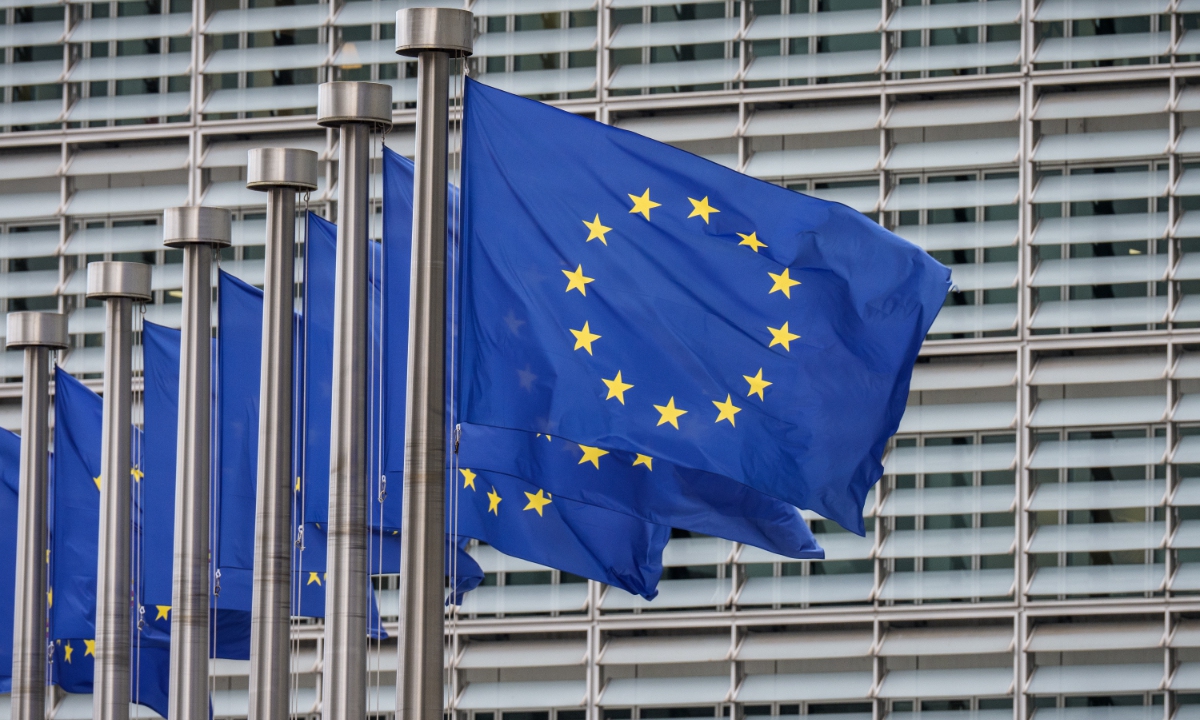
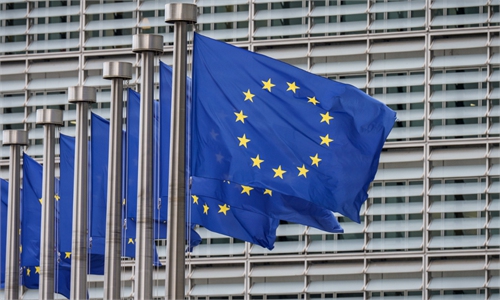
The European Union (EU) flags in front of EU headquarters in Brussels, Belgium. Photo: VCG
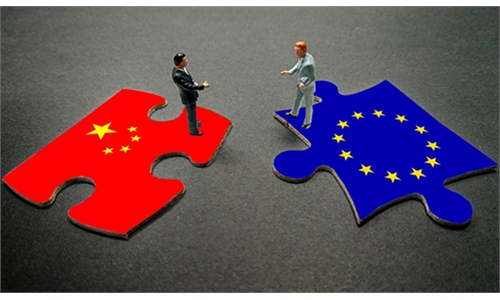
A 12-member delegation from the European Parliament's International Trade committee (INTA) is touring Beijing, Hangzhou and Shanghai from Tuesday to Thursday for talks with Chinese counterparts and government officials, as well as visits to Chinese tech innovators Unitree and BrainCo. It marks the committee's first China trip since 2018 and the European Parliament's fourth China delegation this year, the parliament said in a release.
Yet Chinese experts warn the EU is sending mixed signals by engaging in dialogue while planning new curbs on Chinese imports, arguing such double-dealing undermines good-faith talks.
Bloomberg reported that Brussels plans to use safeguard measures to cut imports of Chinese chemicals, furniture and machinery, possibly as early as the first quarter of 2027. Since July, low-value parcels entering the EU have faced a temporary customs duty of 3 euro ($3.34), and from November 1, a further handling fee of 2 euros will apply, AFP reported, noting that about 93 percent of such parcels previously came from China.
Mixed signals cloud trade talks
The core problem, Chinese experts said, is that the European side cannot show a gesture of seeking engagement and dialogue while simultaneously exerting trade restrictions.
"The EU cannot expect to gain benefits by imposing restrictions. Unilateral measures run counter to WTO rules, and the consequences will only cut the EU's nose to spite its face. China will not accept such measures," Li Yong, a senior research fellow at the China Association of International Trade, told the Global Times on Tuesday.
Li noted that the delegation's visit coincides with Brussels drafting restrictions targeting Chinese chemicals, furniture and machinery alongside new levies on small parcels - a posture that treats trade curbs as bargaining chips to create background pressure on Beijing.
As for the visit's prospects, Li said that "the outcome largely depends on whether Europe abandons pressure tactics and meets China halfway.
Irrationality of the EU's contradictory stance
Bao Jianyun, dean and professor of the Department of International Politics at the School of International Studies at the Renmin University of China, told the Global Times on Tuesday that the EU's contradictory China posture originates from its internal economic woes.
"Sharp internal contradictions in Europe - including growth headwinds, trade deficits, employment pressure, and rising politicization of economic issues - are pushing the bloc toward a harder line on China," Bao said. However, seeking to use trade curbs on China as a quick fix for domestic economic troubles stems from flawed logic, the expert stressed.
China's Foreign Ministry said earlier that "the root causes of the challenges facing the EU do not lie with China" and called for deeper cooperation.
Li pointed out that "Europe may try to secure limited small concessions from China, but this tactic will not work. China boasts robust trade capacity and holds its own leverage. Europe's past leverage is fading; it should drop illusions and engage with China from a realistic footing."
Analysts noted that the EU's reported new curbs on Chinese imports would involve a large amount of intermediate products, which could be essential materials that support EU factories.
"The EU, including manufacturing power Germany, faces deindustrialization and declining manufacturing competitiveness. Chinese intermediate goods exports can particularly help ease Europe's manufacturing bottlenecks," Li said.
According to analytical data, China's intermediate goods exports to the EU account for about half of its total exports to the bloc. This means that Chinese products help reduce the production costs of EU factories, thereby increasing the competitiveness of EU exports.
"Cooperation with China is not a 'loss' for Europe - it creates industrial opportunities. The key is whether Europe adopts a realistic, problem-solving approach that addresses mutual concerns," Li stressed.
Restrictions on Chinese intermediate goods will raise costs for European manufacturers and consumers, the very people the EU says it is protecting, experts noted.
Chinese Foreign Ministry spokesperson Guo Jiakun said on Tuesday that "as far as China is concerned, the relationship with the EU is essentially a partnership, and the economic and trade ties are mutually beneficial," commenting on reports that the EU is planning measures to cut imports of Chinese products from sectors including chemicals, furniture and machinery in the new year.
"It is hoped that the EU will abide by the principles of market economy and fair competition, avoid abusing trade remedies, and take concrete actions to promote the steady and sound development of China-EU relations," Guo said.
More room for cooperation
Despite the contradictory signals from the EU side, analysts welcomed the face-to-face exchanges.
"Dialogue itself is valuable, and the space for cooperation is larger than the space for friction. The INTA delegation's trip shows EU's recognition that China-EU trade matters," Bao said.
Broad areas for collaboration include new energy, AI, big data and mutual investment. "The delegation's visits to Unitree and BrainCo suggest that robotics, AI and embodied intelligence could similarly become areas of cooperation," Li said.
Li stressed that the two economies remain highly complementary. He cited the case of ZXMOTO, a Chinese motorcycle manufacturer, as a model of how bilateral partnership can deliver success.
In March 2026, French rider Valentin Debise rode a ZXMOTO bike to a double victory in the WorldSSP category at the Portuguese round of the World Superbike Championship, marking the first win by a Chinese brand. "That is what China-EU cooperation should look like," Li said, emphasizing the combination of Chinese technology and products with European distribution, racing expertise, and professionalism, competing for world titles rather than erecting barriers.
China and the EU are fully capable of properly addressing economic and trade differences through open and pragmatic dialogue and consultation. In October 2026, China and the EU reached an arrangement on hybrid vehicle trade.
"An upward adjustment from the 2025 baseline was agreed to guarantee Chinese exporters room for steady growth and accommodate industries' legitimate concerns. No measures shall single out Chinese products or discriminate against Chinese firms," a spokesperson for MOFCOM stated on October 12.
For electric vehicles, the two sides secured a "soft landing" for the EU's countervailing duty case in January this year, when the EU issued general guidance on price undertakings. MOFCOM also indicated that the consensus safeguards the interests of Chinese enterprises, avoids the escalation of trade friction between China and the EU, and provides a stable, predictable and sustainable trade and investment environment for China and the EU.
RELATED ARTICLES