China's 15th Five-Year Plan Illustration: Xia Qing/GT
Editor's Note:2026 marks the commencement of China's 15th Five-Year Plan (2026-30), a pivotal phase in the nation's medium- to long-term development. A successful venture starts with a good plan and clear goals set. At this critical juncture, where a profound restructuring of the global order converges with a tipping point in the technological revolution, China's Five-Year Plan is poised to inject momentum and certainty into global development, charting a steady course for the new journey ahead.
In its "New Blueprint, New Opportunities" series, the Global Times invites Nobel laureates in economics, former central bank governors, core decision-makers of international organizations and renowned economists from countries with diverse civilizations, different economic systems and stages of development to deeply analyze how the 15th Five-Year Plan will reshape the underlying logic of China's interaction with the rest of the world and to explore the "anchor of certainty" and "new paradigm of development" this plan offers to a turbulent world.
In the 14th installment of the series, Global Times (GT) reporter Su Yaxuan spoke to Ryan Perkins (Perkins), founder of the Global Economic Indicators platform, to explore how an economics expert who has lived in China for more than 20 years understands the significance of China's 15th Five-Year Plan.
GT: As an observer of China's economy at the start of the 15th Five-Year Plan period, how do you understand the plan? And what do you see as the main forces driving it?
Perkins: China's 15th Five-Year Plan is very interesting because it is positioned very much as a transitional five-year plan, laying the groundwork for the 16th Five-Year Plan, which will end in 2035. That is when the Chinese government aims to have basically achieved socialist modernization.
I think there are four main driving forces behind this plan.
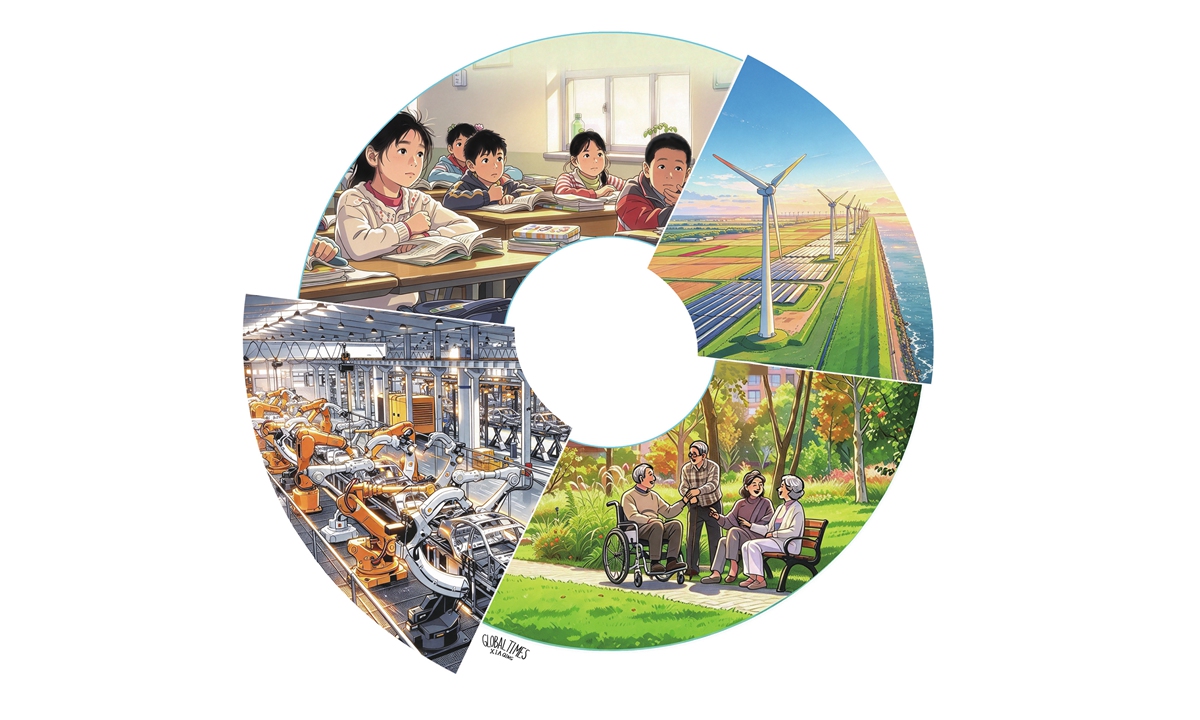
First, obviously, geopolitical tensions have increased. So, one of the key priorities is to develop greater self-reliance in China's own technological base, reducing dependence on imported high technologies in certain areas.
Second, the plan places considerable emphasis on improving living standards. I think there are 20 key indicators, and seven of them directly address people's livelihoods, focusing on improving people's lives in one way or another.
Third, another key driver is addressing demographic changes in China. There is great emphasis on improving childcare and care for the elderly. There are plans to increase the number of eldercare beds, expand nursery enrollment and reduce the cost of childcare.
And finally, China has green targets. These are driven both by China's international commitments to creating a more sustainable environment and by economic considerations. This is really important because green technologies are a key driver of China's economy moving forward. China is very much at the leading edge of development in green technologies, so there is a dual benefit.
GT: What advantages do you think China's 15th Five-Year Plan has compared with the economic policies in Western countries?
Perkins: I think China's Five-Year Plan system is very much one of its greatest strengths. I've heard it described this way: "You frame the forest, and you let the trees grow."
The plan gives the government the ability to direct and channel the different forces in society, whether that's science, technology, talent or government support, so that they can be coordinated toward improving society and meeting its actual development needs.
We often compare this with the West. Western countries like to talk about the free market, and they like to pretend that there is no real planning. But that's not really true. All economies are planned to some extent, in one way or another. If they weren't, nothing would ever get built, and nothing would ever happen. So, the question is: Who does the planning?
In Western economies, to a very great extent, planning is done mainly by the financial sector, including banks, hedge funds and large financial institutions. They tell you that it's simply the free market. But, in practice, the free market largely means that the financial sector gets to decide where resources go.
It plans the economy around maximizing profits for itself and its own institutions. Increasingly, what we see is that its interests are not aligned with the interests of society. In fact, in many ways, they are the opposite of what's good for society.
This is one of the reasons why we see so much unrest in Europe, including riots and protests. Increasingly, society is being organized around maximizing profits for the financial sector, at the expense of education, healthcare, housing and infrastructure. This is one of the reasons why we are seeing the decline of Western industry. China is very different in this respect.
GT: China's 15th Five-Year Plan emphasizes high-standard opening-up, two-way investment cooperation and mutually beneficial engagement with the rest of the world. Yet in recent years, some Western voices have increasingly portrayed Chinese companies' efforts to go global as a form of economic or strategic "expansion." Based on your interactions with European companies, how widespread are these views?
Perkins: I think these views come from a particular sector of society, and it's a very powerful sector. The political class in the West very much represents the financial interests. It doesn't really represent the companies that operate in the productive sector, because the financial sector is so much more powerful. I think that explains a lot of it.
When you look at Europe in particular, which I know very well, it's quite confusing because we have two different narratives coming out of Europe. On the one hand, we hear about wanting to do business with China and wanting to work with China. On the other hand, we hear a lot of talk about "decoupling," "de-risking" and the "danger" of China "taking over our markets."
To understand this, you have to recognize that these are two different messages coming from two different sections of the economy. You have companies involved in the productive economy. These are companies that provide goods and services and actually make things. This sector understands the need to do business with China and cooperate with China. They want Chinese products, Chinese services and Chinese investment, and they also want access to Chinese markets.
Above that, you have a financial sector, or a financial class, which is very tightly embedded within the US dollar system. So, you find that its perspective is very closely aligned with that of the US. It sees China as a competitor to its global financial dominance. That's where that narrative comes from.
GT: When discussing China's 15th Five-Year Plan, particularly the trade development, some Western voices link it to claims of "China overcapacity." What is your view on these accusations?
Perkins: It's been a very long time. I remember writing about the first European Union report on "China overcapacity," which I think was in 2005. So that was 21 years ago. But they're still saying China has "overcapacity." I actually spoke to somebody from the European Union when that report was released in 2005.
I asked them if they could define "overcapacity" in strict economic terms, but nobody was actually able to do so. It was almost like a feeling they had. It's a sort of vague claim that there must be "overcapacity" because China is exporting so much.
However, the reality is that the key driver behind the decline of European manufacturing over the past 25 years, and probably the past 35 years, has been a lack of investment.
RELATED ARTICLES