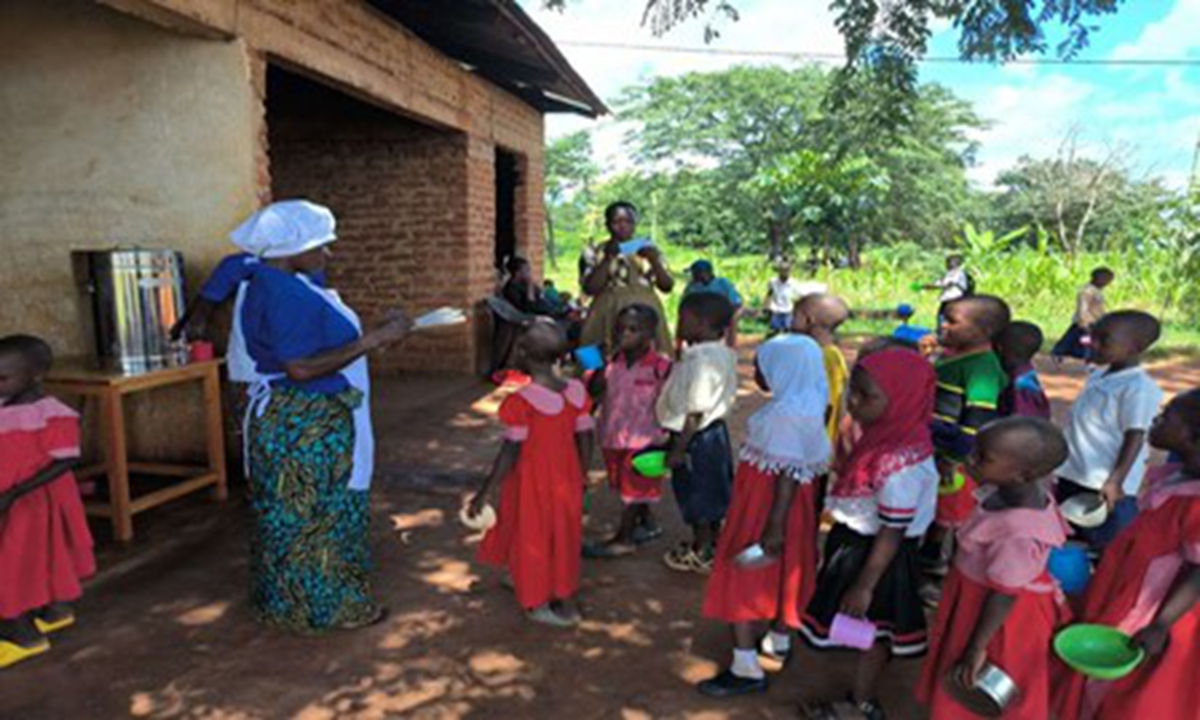
Juhudi Primary School students line up for their break time meal (soymilk and mandazi). Photo: Courtesy of Piyazis Togolai Tindikali
At Mtego wa Simba village in Tanzania's Morogoro region, a cup of soy milk and two pieces of mandazi may not look like a major development tool. But at Juhudi Primary School, this simple meal has become part of a much bigger story, one about nutrition, education, agriculture and the possibilities of China-Tanzania cooperation.Since 2021, approximately 365 pupils at the school have received soy milk and mandazi as part of the "Small Beans, Big Nutrition" project, an initiative developed within the broader framework of China-Tanzania agricultural cooperation. The soybeans are processed locally by trained community members using hand-powered tools and supplied to the school through local soy milk groups.
I first became connected to this story after having joined the China Agricultural University as a PhD student in 2024. Under the guidance of Professors Li Xiaoyun and Xu Jin, whose work focuses on international development and South-South cooperation, I learned more about agricultural cooperation between China and Tanzania.
Professor Li's approach particularly influenced my thinking: Development experiences cannot simply be copied from one country and transferred wholesale to another. They need to be interpreted and adapted to local circumstances.
That principle is visible in Mtego wa Simba as the project grew from an earlier agricultural initiative promoting maize-soybean intercropping to improve soil fertility and diversify production. It subsequently developed into a school nutrition initiative.
The project introduced hand-powered tools, allowing community members to process soybeans locally despite challenges associated with electricity and energy costs. At the same time, farmers gained a local market for their produce while children gained access to protein-rich food. It connects agriculture with nutrition, nutrition with education and education with community development.
Teachers at Juhudi Primary School reported improved attendance and growing interest from parents in enrolling their children. Teachers also described a learning environment in which children are more eager to attend and participate.
One parent explained that her child was so eager not to miss the school meal that even when the child was unwell, the first priority was to go to school for soy milk and mandazi before visiting the hospital.
These stories show that food can influence how children experience school. The project has also generated effects beyond the daily meal. According to the local extension officer, school facilities have been renovated, teachers have begun using school farms to grow soybeans and pupils can observe the journey of a crop from the field to the cup.
Development cooperation is most meaningful when it moves beyond the transfer of technologies, money or infrastructure and creates opportunities for knowledge exchange, local participation and mutual learning. Tanzania has its own knowledge, institutions, farmers and community networks. China has its own experiences, technologies and lessons from rural development. Cooperation becomes stronger when these different forms of knowledge meet.
Across the Global South, many communities face interconnected challenges involving food security, child nutrition, agricultural productivity and educational access. Projects that connect these challenges rather than treating them separately may offer useful directions for future development cooperation. The experience of Juhudi Primary School suggests that development does not always have to begin with something large. Sometimes it can begin with a farmer growing soybeans, a community group processing them, a teacher incorporating agriculture into learning, and a child receiving a nutritious meal before returning to class.
A cup of soy milk may appear small in the scale of international development. Yet, in the hands of a child who arrives at school hungry, it can mean the difference between struggling through a lesson and being ready to learn.
The significance of China-Tanzania cooperation should ultimately be measured not only by the projects completed or technologies transferred, but also by the everyday changes experienced by ordinary people. In Mtego wa Simba, global development becomes tangible when locally processed soybeans reach children, turning agricultural cooperation into everyday improvements in their lives.
The author is a PhD student at the China Agricultural University and is currently conducting field research in Morogoro, Tanzania. opinion@globaltimes.com.cn
RELATED ARTICLES