South Korea’s dream of AI autonomy lays bare contradiction within the alliance with the US
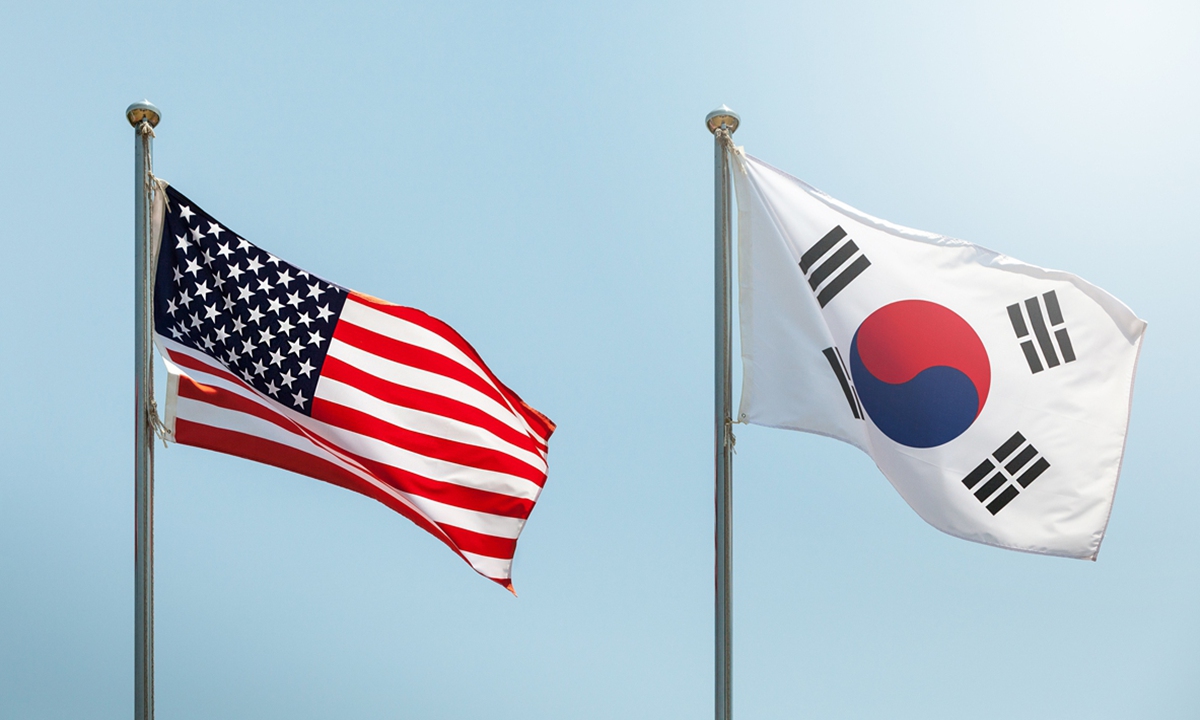
Photo: VCG
South Korea's ambitious $1 trillion chip bet is facing pressure from its most important ally, the US. According to media reports, President Lee Jae-myung plans to build a major semiconductor cluster in southwestern South Korea. Washington, however, wants more of Seoul's AI expansion to happen in the US. What appears to be a conventional industrial investment project has become a new window into the competing interests within the US-South Korea alliance.
The fundamental divide between the two countries is not whether to develop the semiconductor industry, but who will control advanced manufacturing capabilities and share the industrial dividends of the AI era.
First, the US wants not only semiconductors manufactured by South Korean companies, but also the capacity to manufacture semiconductors on American soil. In the past, the US and South Korea maintained a relatively stable division of labor in the semiconductor industry: The US held advantages in chip design, core technologies and markets, while Samsung and SK Hynix made South Korea a global hub for memory-chip manufacturing. Washington is now increasingly dissatisfied with simply purchasing Korean chips. It wants South Korean companies to transfer more capital, technology and production capacity to the US to support its manufacturing reshoring and supply-chain localization.
South Korea is not unwilling to cooperate. Samsung has already built an advanced foundry in Texas, while SK Hynix is investing in an advanced high-bandwidth memory packaging fab in Indiana. Yet Washington continues to press for greater investment. South Korea, meanwhile, needs to expand domestic production to preserve its semiconductor advantage. If new investment, jobs and advanced manufacturing capabilities increasingly flow to the US, South Korea risks gradually weakening its own industrial base.
More ironically, while the US urges South Korean companies to build factories there, it has failed to adequately resolve problems involving skilled technical personnel and cross-border labor. In September 2025, US law enforcement authorities detained more than 300 South Korean nationals at the site of a Korean-invested factory project in Georgia, shocking South Korean society and exposing tensions within Washington's manufacturing reshoring agenda.
Second, South Korea is unwilling to remain merely a chip supplier to the US' AI industry. Although Samsung and SK Hynix enjoy significant advantages in advanced memory chips, South Korea still has weaknesses in foundational AI models, computing platforms and software ecosystems. The Lee administration hopes to capitalize on the AI boom by building on its semiconductor manufacturing strengths to develop data centers, computing infrastructure and AI applications, transforming South Korea from a semiconductor powerhouse into an AI powerhouse. South Korea wants to retain more of the technological, financial and employment benefits of AI development at home, rather than relying solely on chip exports to the US. This ambition inevitably conflicts with Washington's push for greater Korean investment in the US.
South Korea's pursuit of industrial autonomy is increasingly colliding with its dependence on the US for security.
The Gwangju project is a case in point. South Korea plans to relocate an existing military airfield and build a major semiconductor cluster on the vacated land. However, the airfield is associated with joint US-South Korean military operations, so its relocation requires coordination with the US. South Korean media have reported that the US military is still carrying out construction projects at the Gwangju airfield. This means that even when South Korea has established a major industrial development plan, it cannot fully determine the timetable for its implementation independently. There is currently insufficient evidence to conclude that Washington is deliberately using the airfield relocation to obstruct South Korea's semiconductor development. Nevertheless, the case illustrates how US-South Korean military arrangements can become an important variable in South Korea's industrial policy.
These show that the US-South Korea alliance is not free of contradictions: Their security cooperation coexists with persistent conflicts of interest. Washington wants Seoul to assume greater security responsibilities, invest more in the US economically, and align its technology and supply chains with American priorities. South Korea, meanwhile, seeks American security guarantees while strengthening its own defense capabilities and preserving room for its domestic strategic industries. The two countries share some objectives, but their interests are not entirely aligned.
South Korea does retain some room for maneuver. The US' AI industry remains highly dependent on advanced memory chips from Samsung and SK Hynix, whose technologies and manufacturing capabilities cannot be fully replaced in the short term. Their semiconductor relationship, therefore, remains deeply complementary, and the two countries are more likely to keep adjusting the distribution of benefits through a combination of cooperation and competition than to enter outright confrontation.
South Korea's fundamental dilemma, however, remains unresolved. Greater investment in the US may ease some economic and trade pressures, but it does not necessarily secure greater strategic autonomy. Its semiconductor strengths may enable it to benefit from the AI boom, but South Korea may still be unable to determine independently where its most advanced production capacity is located. This is the deeper contradiction beneath the surface of the US-South Korea alliance.
The author is the director and professor of the Center for Korean Peninsula Studies at the Shanghai University of International Business and Economics. opinion@globaltimes.com.cn
RELATED ARTICLES