Philippine DFA warning exposes divisions regarding China policy: experts
Healthy ties hinge on whether Manila delivers tangible actions and reins in provocative elements: experts
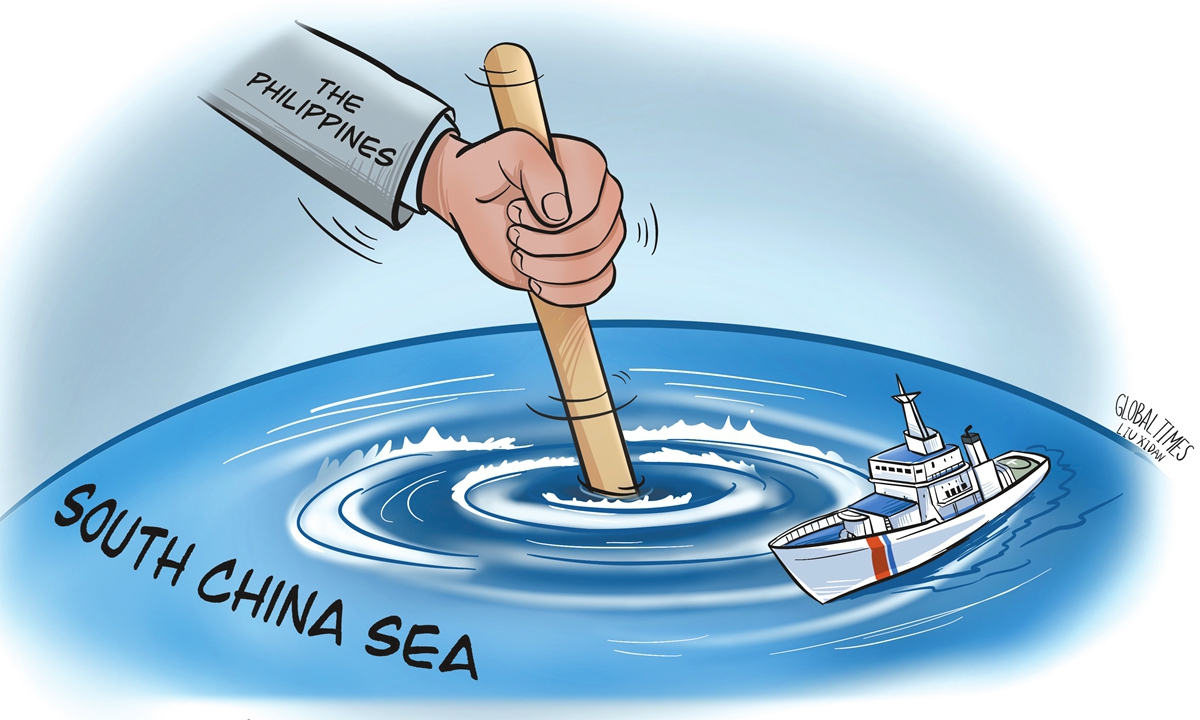
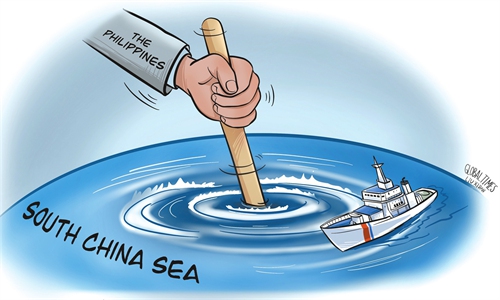
Illustration: Liu Xidan/GT
The Philippine Department of Foreign Affairs (DFA) has publicly warned individual officials, agencies or sectors against "pursuing preferred approaches toward China, or any other international partner, without regard for the consequences on the government's overall policy," stressing that all civilian and uniformed officials must follow the president's foreign policy direction. The statement, issued on Sunday, did not name any specific officials, but has drawn attention from Philippine media amid signs of policy discord within the government over how to manage relations with China, with local outlets singling out Philippine Coast Guard spokesperson Jay Tarriela and Defense Secretary Gilberto Teodoro Jr.
In its statement, the DFA described as "regrettable" recent public comments by certain government officials that conflated documentary evidence, public rhetoric and official diplomatic messaging. The DFA warned that portraying diplomatic dialogue as inadequate, counterproductive or secondary to public exposure creates a false choice between diplomacy and transparency, which could erode the Philippines' international credibility and weaken its negotiating position. It stressed that transparency should not displace, constrain or collide with diplomacy.
Chinese experts observed that the DFA's statement reflects an internal division within the Philippines regarding its China policy. Certain Philippine officials have prioritized self-serving interests above national interests, and their provocative public remarks disrupt official diplomatic arrangements. The DFA's statement represents an effort to reassert control over foreign policy. Experts caution that China-Philippine ties will see no meaningful improvement if Manila fails to deliver tangible actions, and reckless remarks from individual officials will only add obstacles to bilateral relations.
Internal divisions exposed
The Manila Standard interpreted the DFA's statement as an apparent reaction to a newspaper column published Saturday by Tarriela on the South China Sea issue, titled "Why Beijing wants us to go quiet." In the article, Tarriela claimed that releasing videos, photographs and information about maritime incidents had helped shape international opinion and sustain support for the Philippines. He said ending these disclosures would reduce global attention to the waters and weaken support for Philippine maritime interests.
Philippine news outlet Politiko in a Sunday report suggested that the DFA's statement appeared to be directed at Teodoro. Teodoro criticized Chinese Foreign Minister Wang Yi following his November 3 telephone conversation with Philippine Foreign Affairs Secretary Ma. Theresa Lazaro, according to The Philippine Star.
An opinion article on the Manila Times on Monday called Teodoro "a huge liability" for the Philippine government that is already imploding, urging President Ferdinand Marcos Jr. to fire him if only to lighten his burden.
Dai Fan, director of the Center for Philippine Studies at Jinan University, told the Global Times on Monday that politicians, including Tarriela and Teodoro, have frequently taken a tough stance on China-related issues, including matters beyond their own duties. Their approach reflects personal political ambitions and attempts to expand their influence rather than considerations for national interests.
Dai further noted that the DFA statement exposed a lack of coordination within the Philippines on China policy. "It may signal an effort by the DFA to reassert its role in shaping and coordinating foreign policy, following repeated attempts by the defense establishment to securitize and militarize China-related matters, in order to prevent South China Sea disputes from overriding the full spectrum of bilateral ties," the expert said.
The DFA stressed that civilian authorities direct the country's foreign relations, while security agencies provide operational assessments. All government officials must follow the president's policy direction, with professional advice handled through appropriate internal channels, the statement said.
Actions awaited
The DFA statement came shortly after top diplomats of China and the Philippines held a telephone conversation on November 3.
According to the Chinese Foreign Ministry, Chinese Foreign Minister Wang Yi noted that China-Philippines relations were facing malicious disruptions and urged the Philippine side to strengthen restraint over relevant individuals and send a rational and unified voice on its policy toward China.
The ministry said the two sides reached basic consensus on improving and developing China-Philippines relations, including agreeing to maintain diplomatic dialogue, making efforts to remove all kinds of interference at home and abroad, opposing any acts of malicious provocation and sabotage against the diplomatic efforts of both sides, responsibly managing differences and stabilizing the situation, and seeking to expand shared interests.
The DFA reaffirmed its account of the November 3 telephone conversation, describing it as part of efforts to maintain stable and predictable bilateral relations while managing differences responsibly, according to the Manila Standard.
Ding Duo, director of the Research Center for International and Regional Issues at the National Institute for South China Sea Studies, told the Global Times that in the Philippines, diplomatic officials seemingly favored dialogue to prevent maritime tensions from dominating bilateral relations, while some military and coast guard officials advocated for a tougher and more provocative approach toward China.
Dai noted it remains to be seen whether the DFA's statement could effectively coordinate internal division and rein in provocative elements. The Marcos administration may be pursuing a two-pronged tactic: letting defense agencies sustain a hardline posture while diplomats seek de-escalation. Such a dual-track strategy, however, would severely damage the government's policy credibility, the expert warned.
In its statement, the DFA also said the November 3 exchange was part of efforts to maintain stable bilateral relations and secure a conducive regional environment before, during and beyond the ASEAN and APEC meetings.
The Philippine diplomatic establishment hopes to prevent maritime disputes from disrupting high-level exchanges and regional agendas, reflecting its willingness to stabilize bilateral relations. However, whether this will translate into concrete actions remains to be seen, Ding said.
Grassroots calls heard
Business and civil society voices push for healthy China ties. Against the backdrop of official discord, Philippine business and civil society groups are calling for sustained diplomatic engagement with China.
Tourism data cited by BusinessMirror on October 28 showed strong momentum in people-to-people exchanges: 234,953 Filipinos traveled to China in the first nine months of 2026, a 51.04 percent year-on-year jump, far outpacing the 7.16 percent rise in the country's total outbound travel.
On November 7, 20 organizations representing labor, business, and civil society expressed support for the DFA's efforts to maintain dialogue and cooperation with China, citing the importance of bilateral relations for trade, exports, tourism and overseas Filipino workers.
Their appeal followed an earlier call from Philippine business and sectoral groups that warned against public recriminations and inflammatory rhetoric, and urging both sides to return to established diplomatic channels.
Dai said these appeals reflect a growing cohort within Philippine society advocating a more balanced China policy. Allowing security priorities and individual or institutional interests to dominate Manila's China strategy will ultimately hurt the Philippines' national and public interests. A stronger coordinating role for the DFA, paired with greater heed to civil society and business voices, could foster a more rational, balanced approach toward China.
Ding cautioned that inconsistent policy messaging from Manila leaves China and regional states guessing about the Philippines' true foreign policy direction. The crux lies in whether Manila can turn its commitments into tangible action: scaling back maritime friction and reining in certain politicians' confrontational rhetoric, and refraining from hyping South China Sea disputes at multilateral regional forums.
RELATED ARTICLES