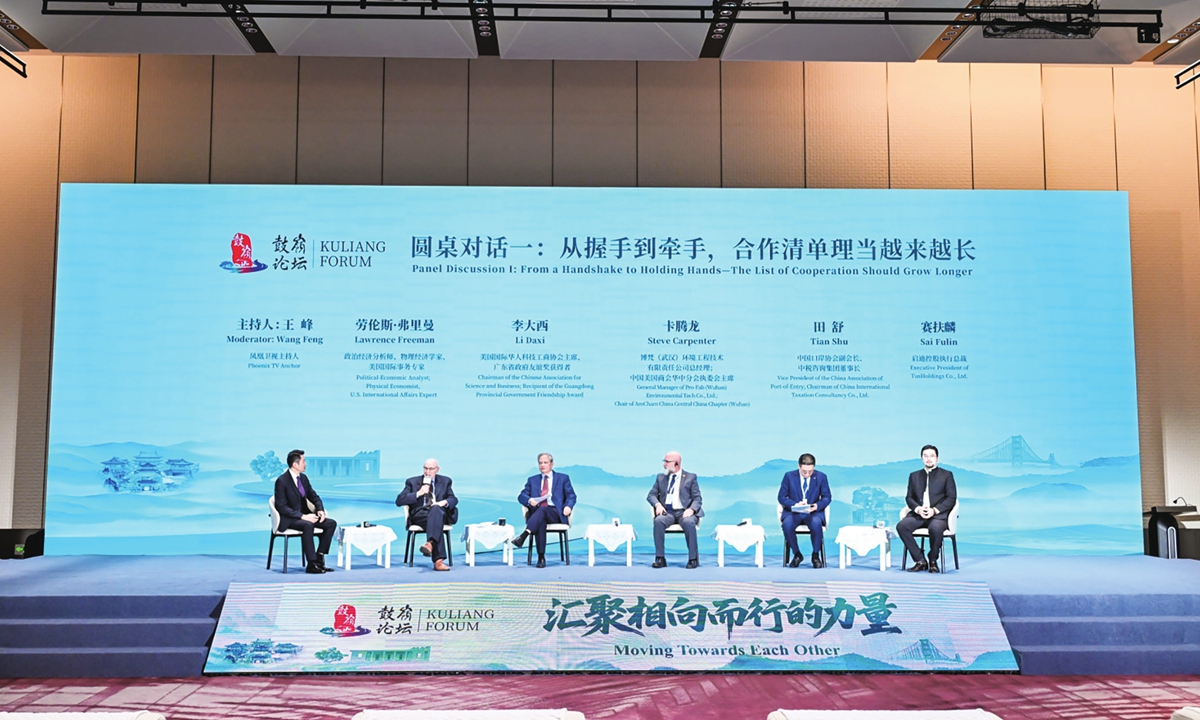
Panel I at the Kuliang Forum Photo: Courtesy of People's Daily Digital Communication Co., Ltd
Editor's Note:
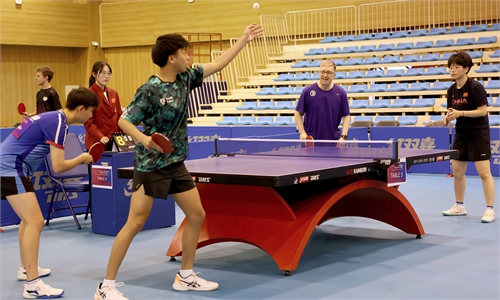
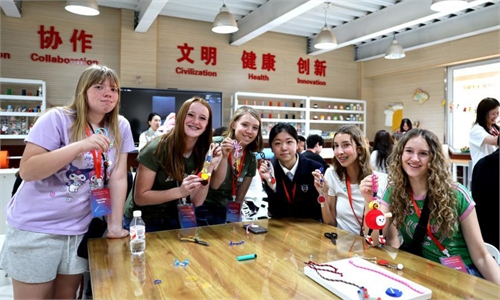
At the roundtable discussions of the 2026 Kuliang Forum, participants from diverse backgrounds shared their perspectives on the future of China-US relations, drawing on their experiences in politics, media, education, scientific research and social media. Despite approaching the relationship from different angles, their remarks converged on a common message: Relations between countries are ultimately built by people, and cooperation should not be hindered by differences. The Global Times has selected excerpts from five US participants, highlighting their views on why China and the US have more reasons to cooperate and how closer collaboration can benefit both countries and the wider world.
Lawrence Freeman, US political and economic analyst
We are living in an extremely dangerous time. Therefore, cooperation between China and the US is of the utmost importance and has the potential to prevent the world from going further down the pathway of nuclear war and economic destruction. It is not just the possibility of preventing the escalation of war, but we also have the potential to bring about peace. The emergence of the Global South and its institutions, typified by the expanding BRICS and the Shanghai Cooperation Organisation, portends a new paradigm for the world: one centered on the promotion of economic development and equality.
I should emphasize that there are no inherent objective reasons for any hostilities between the US and China. We should look beyond cooperation and work toward genuine collaboration on great projects that will transform the yet unseen future.
Such missions would serve as the political equivalent of outflanking the zero-sum mind-set. These great joint endeavors, to be led by China and the US, should include, but are not limited to, ending poverty in every nation, exploration of space, the realization of fusion power and the transparent development of new technologies such as artificial intelligence (AI).
Sandra Dorothy Carpenter, former vice principal of Wuhan Yangtze International School
As an education consultant, I will begin with the history (of China-US educational exchanges). The American educator John Dewey taught in China for two years. His Chinese student Tao Xingzhi also brought Dewey's ideas home and made them Chinese. When we learn from each other, our children benefit. Moving forward together has long been the will of the people.
China has a long tradition of finding talent early, with strong teaching in math and science. The US has tried flexible paths, such as project-based learning. Neither system is perfect; each has something the other needs.
In terms of working together, I suggest four steps. The first is joint research. How can we find talent early without limiting a child's future? How can we support the emotional health of gifted children? The second is teacher exchanges, especially in STEM and early childhood education. The third is a shared conversation about AI in schools. The fourth is young people working together across languages.
Adam John Privitera, professor at the University of Electronic Science and Technology of China
When I first saw the theme for panel III, "letting the tree of friendship strike deeper roots and grow taller," I thought immediately of the redwood sapling brought from California to Hangzhou more than 50 years ago. Trees teach us a quiet truth: The height we see above ground depends on the strength of what grows beneath the soil.
A tree's roots do not grow only when the weather is sunny. They must also endure darkness, uncertainty and difficult conditions. I believe the same is true for China-US cooperation. We cannot pretend our differences do not exist. We have different histories, different governance traditions and different lenses through which we interpret progress and security. Honest friendship does not require us to erase those differences. But it does require us to reject a dangerous simplification: the idea that one side's success must be the other side's loss.
As someone working in academia, I have seen how easily opportunities for exchange can narrow when uncertainty grows. Roots need nutrients, and for our tree, the primary nutrient is mutual respect. Respect means listening before debating. It also means recognizing that many of our greatest challenges extend beyond national borders.
Zachary Gordon Lundquist, US editor of China Today magazine
One lesson I have learned is that relations between countries are ultimately about people. Telling China's story requires more than recounting historical events. We must help people from different cultural backgrounds see the real human stories behind them. Exchange is not about making others accept our views, but recognizing that those across the table are people just like us.
Today, I would like to reflect on the history of China-US cultural exchanges through two historical figures.
The first is Yung Wing, the first Chinese student to graduate from Yale University. His efforts helped send 120 Chinese boys to study in the US through the Chinese Educational Mission. Many returned to contribute to China's modernization, including Zhan Tianyou, a pioneer of China's railway engineering.
The second is John Leighton Stuart, born in Hangzhou in 1876. As president of Yenching University from 1919, he helped build an institution that genuinely integrated Chinese and Western cultures, bringing together Chinese scholars, foreign educators and academic resources in an open learning environment.
More than a century ago, education and cultural exchange built bridges between our peoples. Bilateral relations may experience ups and downs, but people-to-people understanding should never be interrupted. It is essential to reducing misunderstandings, building trust and creating a better future for both nations and the world.
Dante Muñoz, US vlogger
I've been thinking about the lack of trust that everyday Americans have with China. Sadly, it's a widespread problem. The US and China are closer than ever in some ways while still feeling as distant as possible... geographically, culturally, philosophically. How can friendship help us bring the world closer together?
Americans only know China from what their media tells them, and it's almost always negative. But the good news is that once someone actually gets to know China and the Chinese people, all of those negative exaggerations and lies about China start to sound ridiculous. I have seen it over and over again: Once Americans can actually come to China, start interacting with Chinese people on social media, or learn the story and culture of China, then the two countries stop feeling like strangers.
Right now, it is a very exciting time, and the world faces a great challenge. In my opinion, this moment might be the very climax of China's reform and opening-up, and the effects on the whole world are tremendous. The world wants Chinese ideas and creativity, not just efficient manufacturing.
When we all build bridges of trust and understanding with each other, the world will become a place of peace and prosperity.
RELATED ARTICLES