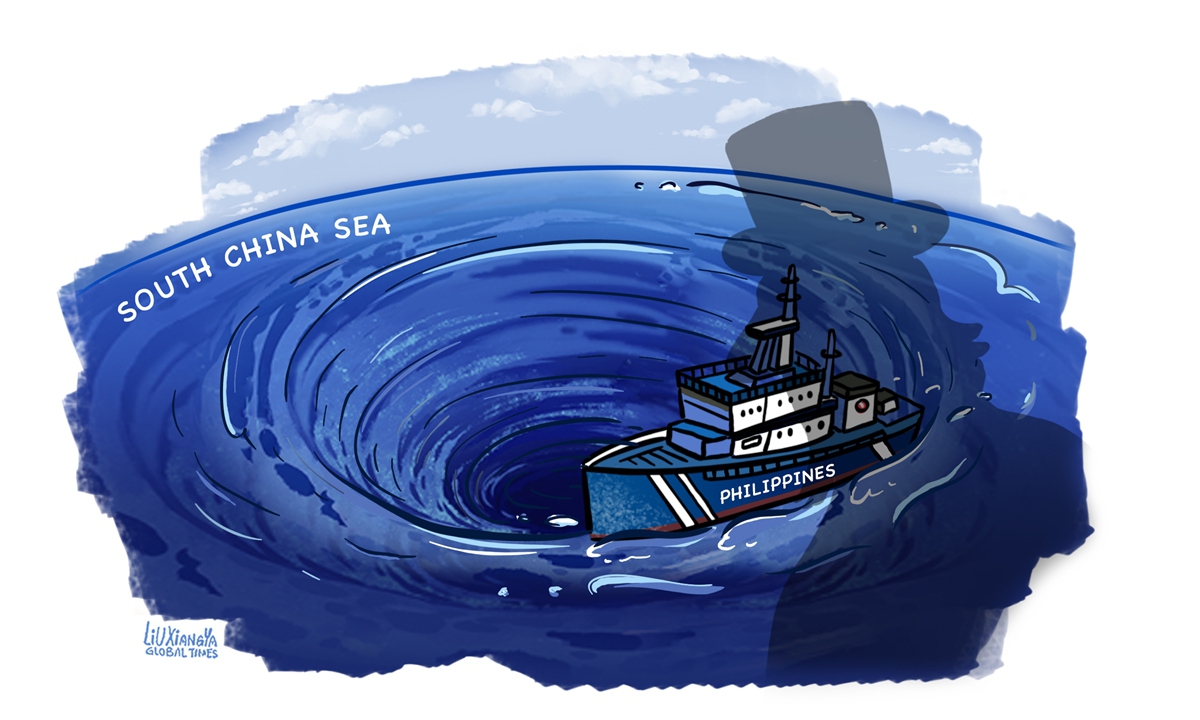
South China Sea, the Philippines Illustration: Liu Xiangya/GT
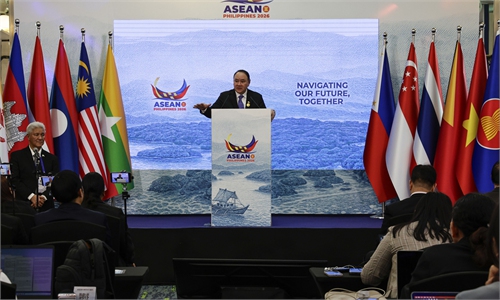
The Philippine Department of Foreign Affairs recently issued a statement titled "Statecraft, Transparency and the National Interest," warning that "recent public commentary made by certain government officials have incorrectly merged three distinct elements: documentary evidence, public rhetoric and official diplomatic messaging." Significantly, many media outlets interpreted the statement as a clear message to Defense Secretary Gilberto Teodoro and other officials over their China remarks. Given the recent state of China-Philippines relations, such a pointed intervention would not have been issued without authorization from the higher political leadership.Elements in the Philippine military, the Philippine Coast Guard and the security establishment have advocated a confrontational approach toward China. Beyond maritime incidents, some have expanded their focus to trade, investment, people-to-people exchanges, Chinese-language education and other domains of bilateral interaction. This hardline tendency is not new. What has intensified is the attempt of certain figures to treat China-related friction as a vehicle for domestic visibility.
Philippine Defense Secretary Teodoro's public posture, including his openness to a 2028 presidential run, illustrates the point. Intense family and factional competition ahead of the next election creates incentives to generate political traffic. For some, the South China Sea has become an arena not primarily for national strategy but for personal exposure and alignment with external partners.
Decades of close personnel exchanges, training and operational ties between the Philippine military and the US have embedded certain mindsets within the security apparatus. Domestic political dynamics amplify this: When a president is a strong political operator capable of disciplining internal noise, maritime issues can be compartmentalized; when the executive is more permeable to military and anti-China constituencies, the risk of relations being subordinated to those constituencies rises. The incumbent Philippine administration has shown periods of both tendencies.
This is not simply a current aberration. The Philippines' China policy has long exhibited oscillation and a degree of opportunism. Since the establishment of diplomatic relations, the mainstream of bilateral ties has been cooperative, but sharp deterioration has sometimes occurred due to specific Philippine moves.
The public and business sector in the Philippines have favored practical cooperation. The current internal debate over China relations is therefore not a permanent rupture but a phase shaped by domestic politics and external influence. When such phases persist, they erode the cumulative efforts of officials, scholars and business communities on both sides. They also impose costs on the Philippines itself. Other ASEAN members have leveraged frameworks in technology governance, marine cooperation and blue partnerships to share China's growth; the Philippines has lagged relatively in infrastructure, investment absorption and the management of livelihood pressures partly because policy volatility has complicated deeper engagement.
Rational voices inside the Philippines have never been absent. Business groups have increasingly signaled that stable economic ties serve national interests in employment, inflation management and supply chains. These voices have been amplified by sustained engagement from Chinese diplomatic missions, foreign ministry channels, and think-tank and people-to-people networks that counter exaggerated narratives while highlighting mutual benefits. Such domestic constituencies exercise a restraining influence on policy. They indicate at least some recognition, within the diplomatic apparatus, that peace, stability and the management of differences constitute the mainstream. Manila has also expressed a willingness to address maritime and other issues appropriately through dialogue and consultation.
Stabilizing the relationship requires clear boundaries. The Philippines cannot continue to rely on malicious attacks and smear campaigns as a default tool, nor can it allow narrow domestic interests to hold ASEAN or regional agendas hostage. Introducing external forces, especially through large-scale military exercises and coordinated "exposure" strategies, undermines the peace and stability of the South China Sea rather than advancing it.
The real test lies ahead: Can the Philippines manage differences with China through diplomatic dialogue and keep tensions within bounds, or will hardline rhetoric continue to hold its foreign policy hostage?
The author is director of the Research Center for International and Regional Studies at the National Institute for South China Sea Studies. opinion@globaltimes.com.cn
RELATED ARTICLES