Xizang Illustration: Xia Qing/GT
Editor's Note:
National support for Xizang's development has yielded remarkable achievements. Over the decades, numerous volunteers from across China have come to Xizang, making indispensable contributions to the region's growth. Their efforts focus on various fields such as education, healthcare and infrastructure. Despite harsh conditions, these volunteers persevere in their roles, writing chapters of endeavor on the snowy plateau. Each diary they pen serves as a vivid testament to the building of the Chinese national community. Against this backdrop, the Global Times launches the "My Xizang Diary" series, presenting firsthand reflections from these dedicated volunteers. This is the ninth piece of the series.
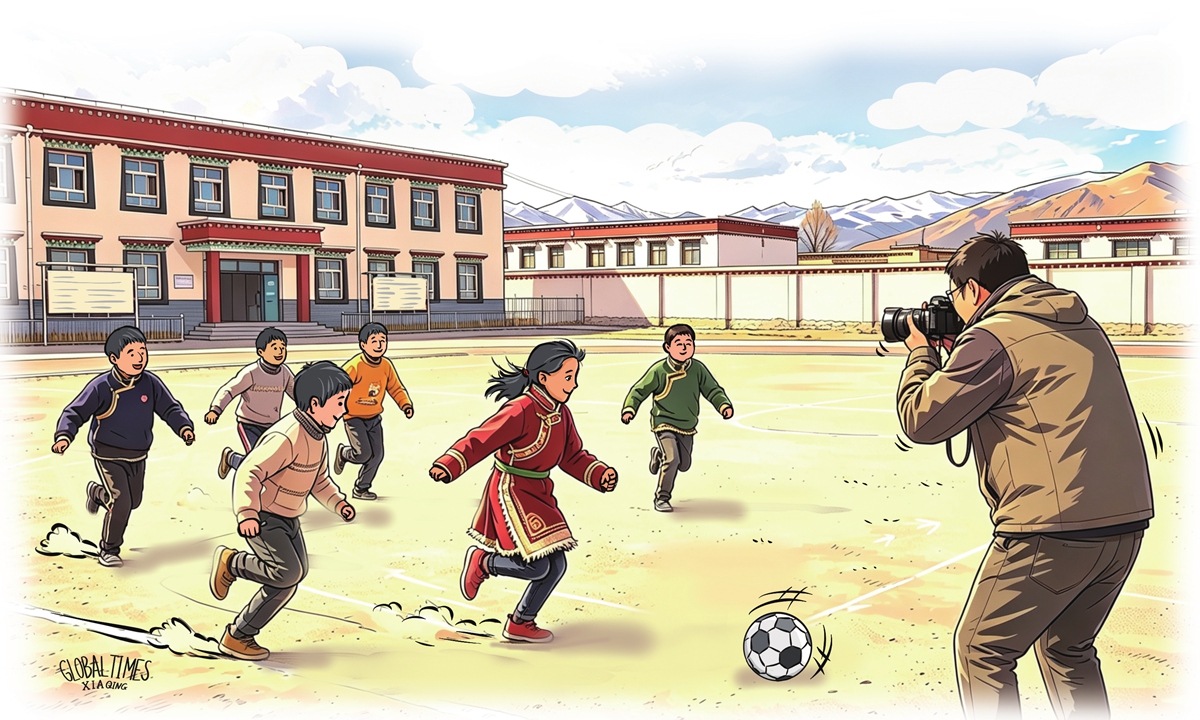
In February 2021, I left Qingdao, East China's Shandong Province, for the Xizang Autonomous Region in Southwest China, where I served as a correspondent reporting on aid programs and supporting media development in Xizang. On the plateau, I witnessed and reported on many stories and projects related to assistance in the region.
After arriving in Sangzhuzi District, Xigaze, I focused on reporting about various kindergarten projects. Since 2021, 28 standardized rural kindergartens built with assistance from Qingdao in Sangzhuzi District have been put into operation. When children on the plateau entered bright classrooms for the very first time, I understood: The meaning of paired assistance lies in lighting up childhoods on the highlands.
Among the stories I have covered, what has touched me most is not only the smiling faces of children in kindergartens but also the stories of farmers and herders who, after enduring years of illness and pain, have found hope for a better life again.
Osteoarthritis is relatively common in the high-altitude areas of Xizang. Due to limited medical resources and long travel distances, some patients have long relied on painkillers to relieve their discomfort.
In 2023, a medical team from Qingdao working in Xizang launched a special screening program and organized patients eligible for surgery to travel to Qingdao for treatment.
At first, many patients knew little about the surgery, and few were willing to undergo the procedure. However, as the positive results of the first patients' surgeries gradually became evident, more and more people began actively seeking treatment. Initially, doctors from Qingdao on the aid mission to Xizang had trouble finding patients who were ready for surgery. Later, however, they faced the opposite challenge, becoming concerned as the number of patients continued to grow and they struggled to keep up with the demand for operations.
These experiences helped me realize that the value of assistance to Xizang lies not only in the completion of individual projects but also in strengthening the region's capacity for self-sustained development. The key is to start from local realities and address concrete needs. This philosophy has also been reflected in the work that I have participated in and witnessed in Xizang.
My job was to help make the voices of the plateau heard by a wider audience. The changes brought about by media assistance in Xizang go beyond simply establishing a platform for news dissemination. More importantly, we have helped local media develop a stronger capacity to document their own development and tell their own stories.
The Sangzhuzi District Media Center, where I worked in Xizang, started out with just a single office and no studio at all. With Qingdao's support, we built a fairly complete county-level media center and sent more than 50 local workers to train in Qingdao, advancing the district's news operations.
From improving facilities to training professionals, media assistance aims to equip local journalists with practical skills in news planning, reporting, editing, video production and new media communication, enabling the converged media center to operate effectively. As grassroots reporting and content production have continued, local news dissemination has gradually developed a more complete workflow. Local journalists are increasingly becoming active storytellers who document their hometown and share its stories with the wider world.
Now, the media center has been consistently publishing content through its local social media accounts and building its own presence.
My four and a half years working in Xizang have further convinced me that media assistance must go beyond building studios and purchasing equipment. It must focus on training professionals, developing teams and establishing sustainable mechanisms, which are essential for local media to independently and continuously document their own development and tell their own stories.
Only then can the changes taking place on the plateau be seen by more people, and local voices reach a wider audience.
Before I set off for Xizang, a veteran journalist from Qingdao's first group of volunteers sent to support the region provided me with scanned copies of a set of old photos of Xigaze in Southwest China's Xizang taken 30 years ago.
Later, I traced the scenes in these photos to their original locations and created before-and-after image comparisons. Gravel tracks have turned into asphalt avenues, and low dwellings have given way to a modern urban district. These images vividly and tangibly illustrate the tremendous development brought by three decades of assistance to Xizang and lend deeper meaning to successive generations of volunteers who have come to support the region.
The author is a reporter for Guanhai News at Qingdao Daily. Global Times reporter Su Yaxuan contributed to this story. opinion@globaltimes.com.cn
RELATED ARTICLES