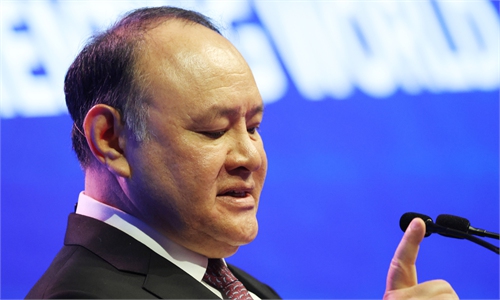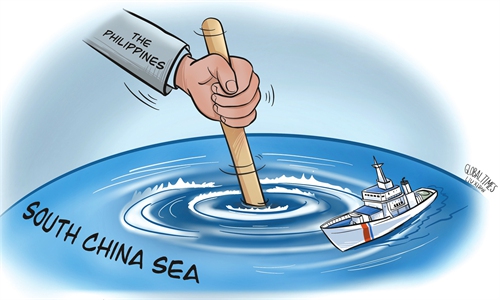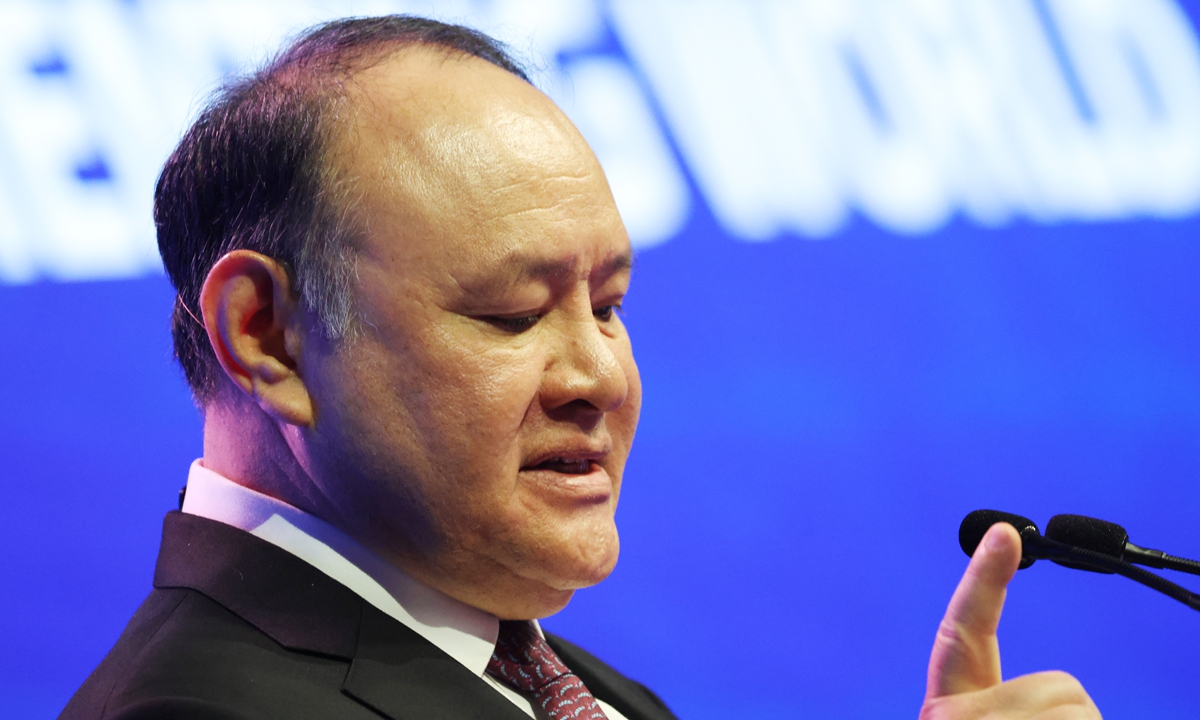
Philippines Secretary of National Defense Gilberto Teodoro Jr. delivers his speech during a plenary session of the International Institute for Strategic Studies (IISS) Shangri-la Dialogue Defense Summit in Singapore, 31 May 2026. Photo: VCG
Following a public statement by the Philippine Department of Foreign Affairs (DFA) criticizing the inappropriate China-related remarks of "certain government officials" for damaging the country's international credibility, Philippine President Ferdinand Marcos Jr. has also weighed in. On November 10, Marcos, through his spokesperson, called on officials to exercise "caution" when making public remarks concerning China and to consider the potential diplomatic repercussions of their statements. This marks the highest-level response so far from the Philippine government to anti-China politicians at home. Although no names were mentioned, everyone knows who the message was directed at.The target was none other than Philippine Defense Secretary Gilberto Teodoro. Marcos' statement elevated the DFA's criticism into an explicit restraint imposed at the presidential level. The clarity of this signal exceeded many people's expectations. After being criticized by the DFA, Teodoro had defiantly declared that he "will listen only to the President of the Republic of the Philippines." Now, however, that protective shield has been unceremoniously stripped away. If Teodoro continues his anti-China theatrics, he will effectively be challenging Marcos himself, forcing the president either to admit that he cannot control his defense secretary or to take more decisive personnel or policy measures.
Since Chinese Foreign Minister Wang Yi spoke by phone with Philippine Foreign Affairs Secretary Ma. Theresa Lazaro and criticized a handful of Philippine politicians as "irrational and intolerable," calls within the Philippines to hold Teodoro accountable have grown increasingly vocal. On November 9, The Manila Times published an article titled "Teodoro should go," arguing that the defense secretary is a huge liability for the government and is "worsening Marcos' image as a president who can't even control his officials." Philippine public opinion had previously speculated that Teodoro dared to behave so arrogantly because he enjoyed the president's indulgence or even tacit approval. However, Marcos' emphasis on the "diplomatic repercussions" of officials' remarks demonstrates that the country's top leadership has come to recognize that allowing Teodoro and others to carry on unchecked has raised questions both at home and abroad about who actually speaks for Manila.
The Philippines' two-track approach to China policy should indeed come to an end. What Manila needs is not a competition over who can appear tougher on China, but a pragmatic framework capable of managing differences while advancing cooperation, thereby avoiding the recurring pattern of putting out fires only to see them deliberately reignited. Continued indulgence will merely allow personalized anti-China narratives, such as those promoted by Teodoro, to further erode the country's credibility. Ultimately, those who suffer are ordinary Filipinos, whose livelihoods depend on a stable external environment and predictable market conditions.
As for Teodoro, he has only himself to blame for becoming an isolated figure. It is also worth noting that his hard-line approach has been encouraged by external forces. This means that for Manila to put its China policy in order, it must do more than rein in a single cabinet minister. It must also recalibrate the relationship between its security and diplomatic priorities, clearly distinguishing between its own core national interests and the agendas of others.
RELATED ARTICLES