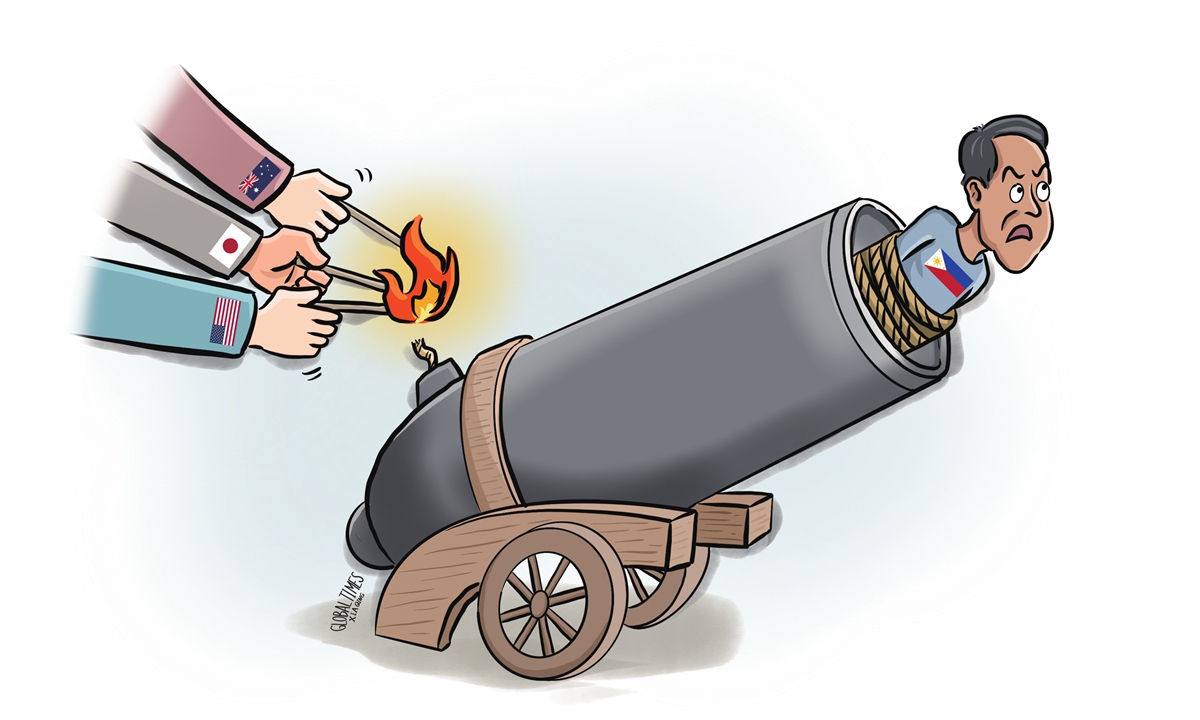
The Philippines, Squad Illustration: Xia Qing/GT
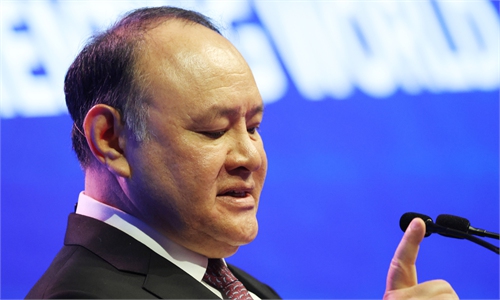
Recently, on the sidelines of the ASEAN Defense Ministers' Meeting-Plus hosted by the Philippines, the defense ministers of the US, Japan, Australia and the Philippines met and agreed to establish a so-called Combined Coordination Center (CCC) in the Philippines, emphasizing the need to "synchronize defense investments to support the Philippines in defending its archipelago." This is the latest escalation in the long-running attempt by the US, Japan, Australia and other countries to use the South China Sea issue to create troubles for China.
The Philippines has said that this military coordination mechanism is already operating. What deserves attention is that the establishment of this center will turn the Philippines into a geographic hub for external forces seeking to jointly intervene in Southeast Asian affairs, further placing the country at the center of geopolitical tensions. The US, Japan and Australia each have their own strategic calculations in becoming involved in the South China Sea. The US seeks to weaken China from China's surrounding areas. Japan hopes to use the South China Sea issue to contain China and ease the pressure it faces in the East China Sea. Australia, meanwhile, seeks to obstruct the development of China's relations with South Pacific countries.
None of these calculations has anything to do with the Philippines' interests. Yet, all are packaged under the banner of "defending the Philippines," turning the country into a geopolitical pawn for these nations. The Philippines, meanwhile, is expected to be grateful for their "goodwill." However, neither the US, Japan nor Australia wants a direct confrontation with China. That is precisely why they are pushing the Philippines to the front line. If tensions in the South China Sea escalate into conflict, all they may do is supply weapons and cheer from the sidelines, while the Philippines will be the one taking the blows.
The Philippines' greatest tragedy is that it seems unable to recognize its own national interests. Territorial disputes between China and the Philippines are far from unique. Within ASEAN, similar sovereignty disputes exist between Singapore and Malaysia, the Philippines and Malaysia, and Thailand and Cambodia. In the Philippines, however, the sovereignty issue has completely hijacked its relations with China, leading the country to make a fundamentally wrong judgment about who its friends and adversaries are.
The Philippines' fundamental challenges are overcoming internal divisions and improving governance to build an effective and clean government; securing reliable energy supplies to support people's livelihoods and economic development; and attracting foreign investment and technology to improve infrastructure and strengthen industrial capacity. Yet today's Philippines is like an ostrich burying its head in the sand, unwilling to confront its real challenges.
The reasons behind this situation are not complicated. Political factors have taken the country hostage.
First, there are domestic political considerations. The Marcos administration is seeking to position itself for the 2028 presidential election. Against a backdrop of poor governance and record-low approval ratings, taking a hard line on sovereignty issues has become one of the few so-called political achievements the Marcos administration can put forward. Therefore, the Philippines seeks to strengthen cooperation with external powers such as the US, Japan and Australia to exert pressure on China and create the appearance of broad international support.
Second, there are external political factors, primarily the long-standing cultural influence, economic manipulation and political pressure exerted by the US and other Western countries on Philippine elites and their families. As a result, many among them have become unable to think clearly about what truly serves their country's national interests. Family-based politics is one of the most prominent features of the Philippines' political system. During their successive colonial rule over the Philippines, Spain and the US cultivated and relied on local political families to consolidate their control. This eventually led to a system in which a small number of families take turns governing or even monopolize power for extended periods at both the national and local levels. Under such a system, politicians tend to prioritize family interests over national interests. As long as the US can influence the interests of certain families, it can exert influence over the Philippines through them.
There is only one step from being a pawn to becoming cannon fodder. It is hoped that the occupant of Malacanang Palace will recognize how to escape this fate, rather than focus on setting up a so-called CCC. That is what the Philippine government should truly be thinking about.
The author is vice president of Shanghai Institute for International Studies. opinion@globaltimes.com.cn
RELATED ARTICLES