US Mexico Illustration: Xia Qing/GT
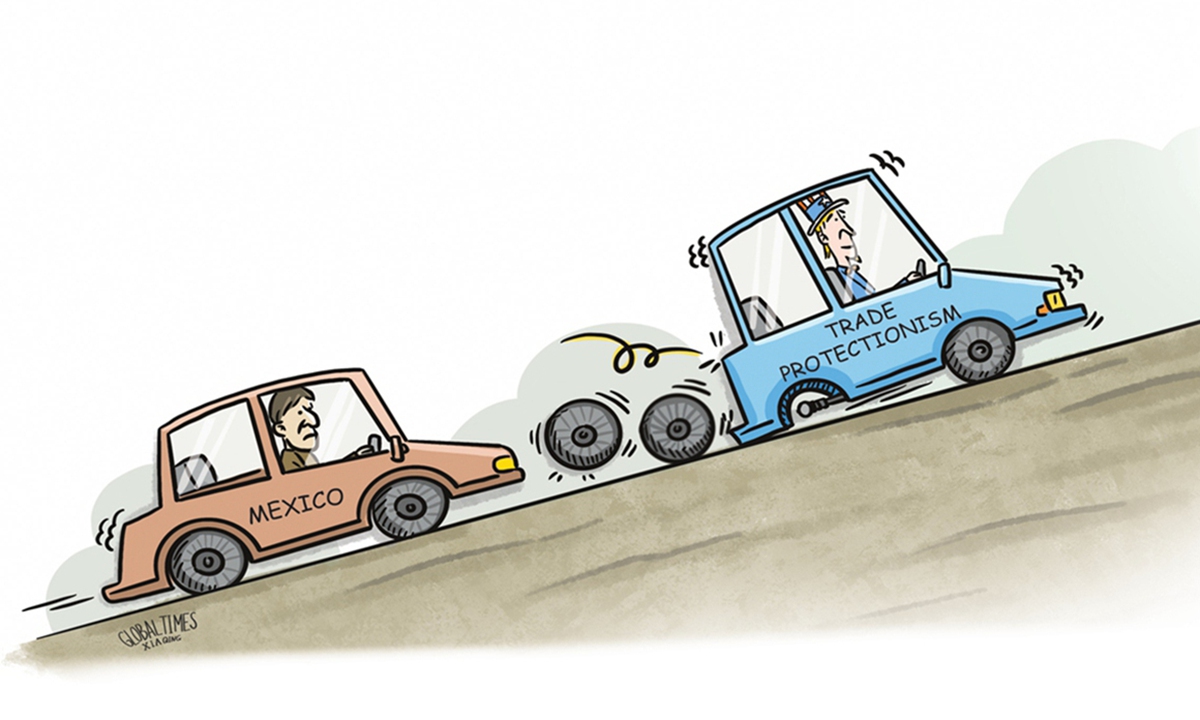
Washington has erected a wall of protectionism around the globe, and Mexico is eager to pass it more bricks, helping plug the "loopholes." But the higher this wall rises, the more likely it is to hem in Mexico itself, constraining not only its development prospects but also its independence in shaping trade policy.
According to Reuters, Luis Rosendo Gutierrez, Mexico's deputy economy minister for foreign trade, said on Wednesday that the Mexican government had tightened traceability measures with industry to ensure that no steel from China or other countries is rerouted through its territory into the US by exploiting Mexico's trade preferences. Meanwhile, Mexico is urging Washington to ease tariffs on Mexican steel, aluminum and automobiles.
Jiang Shixue, a distinguished professor at Hangzhou Normal University, told the Global Times that Mexico's move is rooted in its economic predicament created by strong dependence on the US. Facing US tariff pressure and uncertainty surrounding the US-Mexico-Canada Agreement review, Mexico hopes that aligning itself with Washington's restrictions on trade with China will win concessions from the US.
Since 2025, Mexico has repeatedly followed the US to announce measures to impose tariffs on imports from China and other countries without free-trade agreements. It seems that Mexico is actively standing guard at the door on Washington's behalf. While other countries may justify trade barriers as necessary to protect their own industries, Mexico's restrictions appear to be protecting the interests of a "third party." In effect, Mexico risks turning itself into a gatekeeper for Washington's protectionism.
This could end up as a potential "Faustian bargain." Mexico hopes to sacrifice part of its economic and trade cooperation with China in exchange for US concessions on tariffs and trade. But it may discover that what it surrenders far outweighs what it could gain. On the one hand, Washington is unlikely to abandon its trade pressure on Mexico. On the other, Mexico risks sacrificing long-term industrial cooperation, supply chain diversification and, ultimately, its economic sovereignty.
According to Gutierrez, the country has already reduced steel and aluminum imports from countries including China, South Korea and India, by about 30 percent. Zhou Mi, a researcher at the Chinese Academy of International Trade and Economic Cooperation, pointed out that manufacturing is a pillar of Mexico's economy, and steel and aluminum are essential inputs for industries such as auto manufacturing and machinery. Cutting imports of these materials could further aggravate supply pressures on Mexican manufacturers, disrupting production and undermining supply chain stability.
More importantly, if Mexico can readily change its trade policies under external pressure, other countries may begin to question the stability and predictability of its investment and trade environment, he added. Once policy predictability is undermined, the price Mexico pays could go far beyond the immediate costs of tariffs.
Just one day before the report, Mexican President Claudia Sheinbaum stressed that respect for sovereignty and cooperation free from subordination "are non-negotiable" tenets of Mexico's relations with the US. True sovereignty should not be confined to political rhetoric. It should be reflected in a country's ability to independently choose its trading partners, allocate resources according to its development needs and formulate its own economic and trade policies.
In an increasingly interconnected global economy, broader international partnerships give countries greater room to maneuver amid external uncertainties. Canada, also deeply integrated into the North American economic system, has not abandoned efforts to diversify its trading partners and is actively seeking to expand cooperation with China and other economies to get rid of its dependence on the US.
America's trade wall is America's choice. Mexico has no reason to turn it into its own barrier to development. What Mexico truly needs is not to become another brick in Washington's protectionist wall, but to safeguard its economic sovereignty, preserve its ability to connect with global markets and participate in international industrial chains. Otherwise, in trying to please Washington, Mexico risks cutting off its nose to spite its face.
RELATED ARTICLES