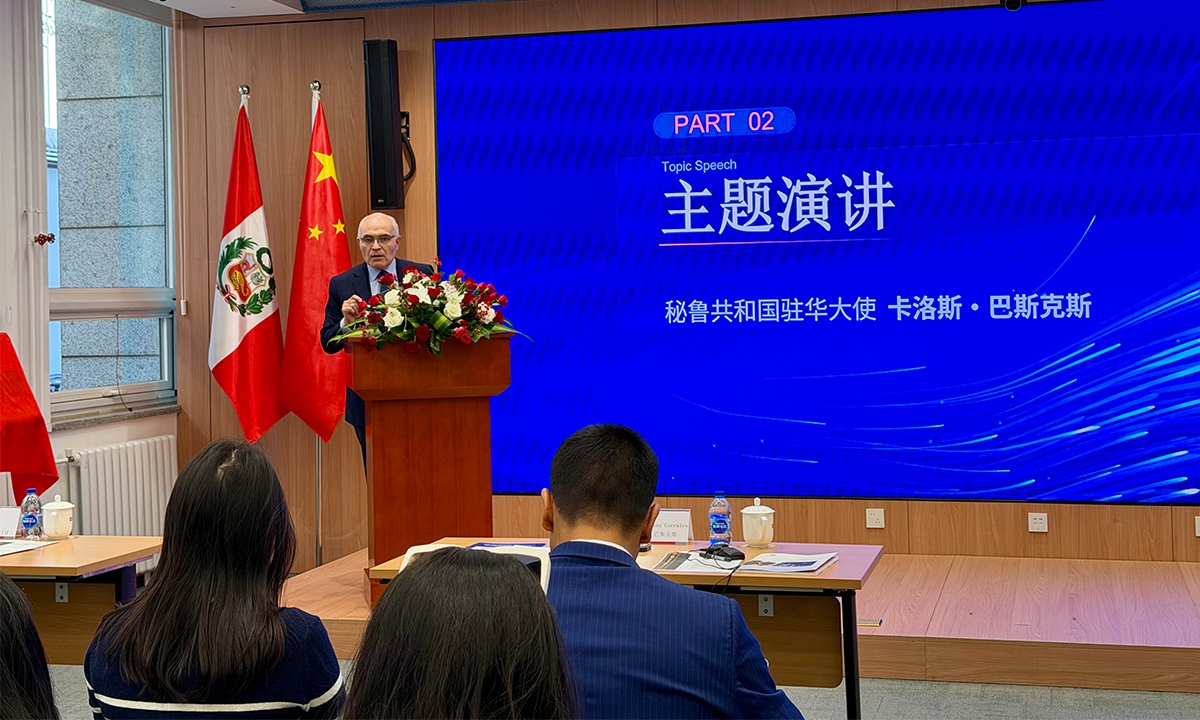
Carlos Vásquez Corrales, Peruvian ambassador to China, gives a keynote speech in Beijing on November 13, 2026. Photo: Dong Feng/Global Times
Peru is looking to move beyond its traditional focus on mining, energy and infrastructure cooperation with China and attract more investment in manufacturing and other value-added industries, the country's ambassador to China said on Friday, as the Peruvian Embassy in Beijing launched an investment guide for Chinese businesses.The report, titled Peru's Investment Climate Assessment Report - a guide for Chinese investors, is designed to provide Chinese companies with information to support investment decisions and deepen economic cooperation between the two countries.
Carlos Vásquez Corrales, Peruvian ambassador to China, described the report as a practical tool for supporting the next stage of bilateral economic relations. He said China is Peru's largest trading partner and one of its most important sources of foreign investment.
The two countries should ensure that international trade and foreign investment contribute not only to economic growth, but also to productivity, employment, innovation and greater participation in global value chains, Vásquez said.
A key priority for Peru is to transform its role in the economic relationship with China, moving from primarily serving as a logistics link between South America and Asia to becoming a platform for production, manufacturing and value-added exports.
The Port of Chancay, a major infrastructure project developed with Chinese participation, has significantly improved maritime connectivity between South America and Asia, Vásquez said. However, he noted that connectivity should be followed by greater productive capacity.
The launch comes as China prepares to host the 33rd Asia-Pacific Economic Cooperation (APEC) Economic Leaders' Meeting in Shenzhen from November 18 to 19.
Speaking to the Global Times, the ambassador also highlighted the role of APEC as a platform for bilateral exchanges between leaders. He pointed to the upgraded protocol to the China-Peru Free Trade Agreement (FTA), signed in 2024 in the presence of the two countries' leaders and which took effect on November 1, 2026.
The upgraded agreement includes new provisions on e-commerce and global supply chains, among other areas. Vásquez said these provisions could help Peruvian micro, small and medium-sized enterprises gain access to Chinese and wider Asia-Pacific markets, while integrating into industrial chains for electric vehicles and electronic components.
He said the Chancay Port project and the upgraded FTA together provide a model of connectivity linking Latin America with the Asia-Pacific region. Cooperation under the APEC framework, he added, can further strengthen South-South cooperation and bring tangible benefits to people across Latin America.
China and Peru are both members of the Global South and share common positions on multilateral platforms such as APEC, Shi Zhiqin, a professor at Tsinghua University's Institute of the Belt and Road Initiative, said at the event, adding that their cooperation in supporting multilateralism and South-South cooperation could serve as an example for other countries.
RELATED ARTICLES