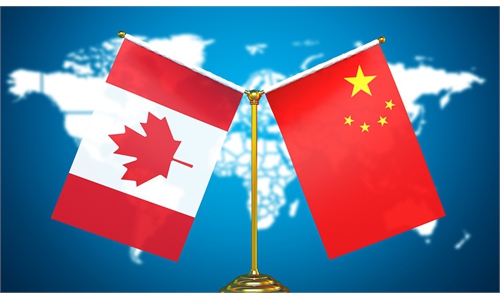
Diversification Illustration: Liu Xidan/GT
Even as external speculation continues over whether Canada is "playing the China card," the tangible benefits of China-Canada cooperation are already becoming evident.
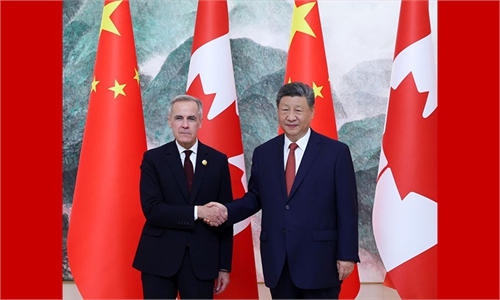
Canadian Prime Minister Mark Carney is currently in Shenzhen, China to attend the 33rd APEC Economic Leaders' Meeting on Wednesday and Thursday. Ahead of the event, his remarks on the future of Canada's auto industry attracted considerable media attention.
He said Canada could turn to Chinese automakers if trade negotiations with US fail to preserve an integrated North American auto industry. Asked whether he was using potential Chinese investment as a leverage in negotiations with Washington, Carney replied: "It's not leverage. But action, reaction."
Some foreign media outlets were quick to portray the move as Canada "playing the China card" in an attempt to pressure the US in the negotiations. Such interpretations take an unnecessarily narrow view of normal economic and trade cooperation and the expansion of diversified partnerships.
Liu Dan, a research fellow at the Center for Regional and Country Studies at Guangdong University of Foreign Studies, told the Global Times on Tuesday that Carney's remarks reflect Canada's reassessment of the policy space for auto cooperation with China amid changing prospects for North American economic integration. Cooperation that was once considered a sensitive issue is increasingly becoming a practical policy option.
This is both a pragmatic consideration as Canada diversifies its partnerships and a natural extension of the steady improvement in China-Canada economic relations since the beginning of this year, she added.
Diversified partnerships are not bargaining chips to be brought out at the last minute, nor are they gestures designed to put pressure on any particular country. They are a practical response to an increasingly uncertain world. Canada is reassessing its economic partnerships and translating that shift into concrete diplomatic action.
Carney's diplomatic itinerary this year shows Canada is working to build a broader network of partnerships. From seeking to become the first "associate member" of the European Union to pushing for trade negotiations with ASEAN and actively restoring and deepening economic and trade ties with China, Carney has effectively made the diversification of economic partnerships a central feature of his global agenda.
With its vast market and comprehensive industrial system, China is an indispensable node in this network. China's enormous economic scale offers extensive opportunities for its trading partners. Every substantive dialogue can open up new markets, while every cooperation agreement has the potential to translate into orders, investment and tangible industrial development.
During Carney's visit to China in January, the two sides reached specific agreements to address trade issues related to electric vehicles and agricultural products, and the resulting adjustments have already begun to pay dividends. According to Canadian media, Canadian exports to China surged by roughly 40 per cent in the first nine months of this year - an increase that far outpaces growth in exports to anywhere else. On the first day in Shenzhen, he also announced a series of new partnerships with China, covering trade and cultural measures including an expansion of current tariff agreements, more flights and agreements on education and the arts.
Liu said China-Canada economic and trade cooperation remains centered on goods such as agricultural products, energy and consumer goods, but has considerable potential to expand beyond bilateral trade into industrial cooperation. China has well-established supply chains for batteries and auto components, while Canada has critical mineral resources and a strategic geographic position for exports. The two sides therefore have room to explore cooperation in joint auto manufacturing ventures, local supply chains and technology licensing.
Since March, 16,211 Chinese electric vehicles have been imported into Canada. BYD has begun selling vehicles in Canada, while Geely announced in October that it expects to start selling electric vehicles in the Canadian market next year.
These developments show that the growth of China-Canada economic and trade ties is neither a political show of diplomatic rhetoric nor a geopolitical arrangement directed against any third party. Improving bilateral relations have created market opportunities, policy adjustments have unlocked trade potential, and high-level dialogue has provided businesses with more expectations for cooperation. The potential expansion of trade benefits into industrial cooperation is therefore a natural next step in deepening bilateral economic ties.
The world has changed, and countries cannot keep relying on old maps to find their way in a new economic landscape. China-Canada cooperation shows that geographical distance and differences in political systems should never make certain economic cooperation a "taboo." Diversification is not about proving to anyone that a country has an alternative way out; it is about giving itself more paths forward.
RELATED ARTICLES