APEC events set stage for continued bilateral engagements
Fruitful outcomes consolidated through concrete action: expert
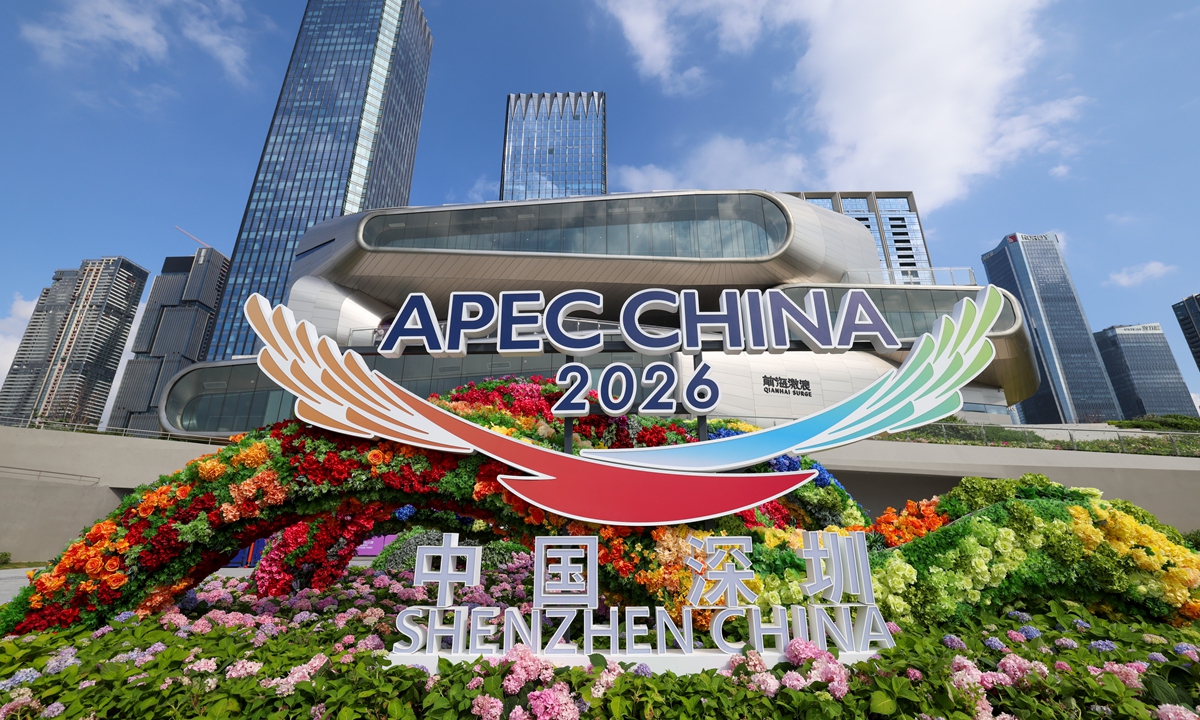
The APEC "China Year" logo decoration is seen at Qianhai Stone Park in Shenzhen. China will hold the 33rd APEC Economic Leaders' Meeting in Shenzhen from November 18 to 19, 2026. Photo: Xinhua
Building on the fruitful outcomes of the APEC meetings, China continued bilateral exchanges with its regional partners through a series of talks on Friday, with cooperation in areas of shared interest remaining high on their agenda.
Spanning AI, digital industries and green development, such tailored bilateral cooperative efforts complement the APEC multilateral framework, translating shared goals into concrete action and advancing inclusive regional development, Chinese analysts said.
Chinese President Xi Jinping on Friday met with Indonesian President Prabowo Subianto, Australian Prime Minister Anthony Albanese, Singaporean Prime Minister Lawrence Wong, Thai Prime Minister Anutin Charnvirakul, and Malaysian Prime Minister Anwar Ibrahim in Shenzhen separately, according to the Xinhua News Agency.
Within the broader APEC framework, bilateral talks shared a focus on open economic cooperation, with priorities tailored to each economy's development stage and interests, analysts said.
Tailored cooperation
On Friday, the Chinese leader and Indonesian President Prabowo announced the launch of negotiations for a bilateral comprehensive economic partnership. Xi called on both countries to expand mutually beneficial cooperation, advance major projects such as the Jakarta-Bandung High-Speed Railway, and deepen cooperation in energy and mineral resources, artificial intelligence, the digital economy, and clean energy, according to Xinhua.
Yang Xiyu, a senior research fellow at the China Institute of International Studies, told the Global Times that China-Indonesia cooperation, for example, spans areas from mineral resources to industrial intelligent transformation, reflecting their shared interests as partners in the Global South. He added that while ASEAN is a priority in China's neighborhood diplomacy and China has long been its largest trading partner, individual members such as Singapore, Malaysia and Thailand have distinct development needs.
During the meeting with Thai Prime Minister Anutin Charnvirakul, the Chinese President called on the two sides to make good use of cooperation mechanisms in economy and trade, science and technology, and the digital economy, expand and strengthen traditional cooperation in agriculture and connectivity, and cultivate and strengthen new growth areas of cooperation such as artificial intelligence, new energy vehicles, aviation and aerospace, disaster prevention, mitigation and relief, and water resources management.
In meeting with Singaporean Prime Minister Lawrence Wong, the Chinese leader also pointed out that China and Singapore should launch negotiations for an upgraded Version 4.0 of their free trade agreement, and deliver signature cooperation outcomes in areas such as the digital economy, green development, and artificial intelligence, per Xinhua.
On the same day, China signed a memorandum of understanding with Singapore to launch negotiations on upgrading their free trade agreement to expand bilateral economic and trade cooperation and deepen ties, the Ministry of Commerce said.
The Chinese leader also said during meeting with Malaysian Prime Minister Anwar Ibrahim that the two sides should also ensure high-quality development and operation of key projects, expand and improve agricultural product trade, and broaden cooperation in tourism, education and other areas.
China, as a global leader in both traditional and AI-related infrastructure development, creates strong complementarities and broad cooperation potential with ASEAN, particularly Thailand and Malaysia, Yang noted. As a result, infrastructure cooperation featured in talks, though the specific projects and areas of focus varied.
As next year marks the 55th anniversary of diplomatic relations between China and Australia, Xi called on the two sides to achieve greater progress in bilateral relations from a new starting point, when meeting with Australian Prime Minister Albanese.
He called for deepening mutually beneficial cooperation in pursuit of the two countries' respective development goals, advancing traditional cooperation in agriculture, energy and minerals, and expanding cooperation in emerging areas such as the green economy, new energy, the digital industry, AI and climate change response.
Australia, on the other hand, has significant stakes in green development, Yang said. With China at the forefront of global green development, the issue has generally become a key area of shared interest for both sides. Both sides share similar aspirations in this area and have complementary strengths, making their cooperation pragmatic and grounded in mutual interests.
"The APEC member economies differ widely in their stages of economic development and positions in the international landscape, representing both the Western countries and the Global South. But they come together around a shared pursuit of sustainable and inclusive development," Yang said.
Stronger bilateral engagement helps translate multilateral cooperation into concrete outcomes, while deeper multilateral cooperation creates greater scope for bilateral ties. At the Shenzhen meetings, the two tracks thus complemented and reinforced each other, the expert added.
Broad recognition, warm interactions
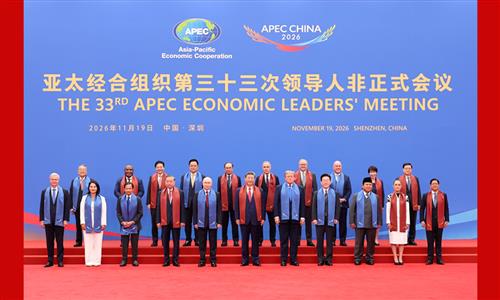
Shenzhen, a coastal city at the forefront of China's opening-up and innovation drive, welcomed leaders from around the world for the APEC CEO Summit and APEC Economic Leaders' Meeting, offering them a firsthand look at its dynamism and innovative spirit.
The city's vibrancy was matched by China's warm hospitality during the events, which left a strong impression on visiting leaders.
US President Donald Trump congratulated China on hosting a successful APEC Economic Leaders' Meeting, adding that both countries need to work together to lead and promote world peace and stability, according to Xinhua.
South Korean President Lee Jae-myung said in a post on X following the conclusion of the APEC events, "Once again, we thank China, this year's host, for its warm hospitality."
Beyond the conference halls, the APEC meetings in Shenzhen also offered a series of heartwarming moments as leaders stepped out to explore the city and mingle with locals. The streets of Shenzhen became unexpected spots for chance encounters: Thai Prime Minister Anutin, whose family roots trace back to Guangdong, showed off his Cantonese skills on several occasions, and Australian Prime Minister Albanese crossed paths with local residents while shopping at a supermarket.
Mexican President Claudia Sheinbaum Pardo also shared her journey home on X, saying she had arrived in Mexico City aboard a China Southern Airlines flight from Shenzhen and thanking the entire flight crew for their support.
Shenzhen is now an Asian innovation hub, a key node in East Asia's production networks and a leading international metropolis in China. Its remarkable rise demonstrates how openness, innovation and cooperation can shape economic development and create a miracle in urban development, Zhang Jianping, deputy director of the academic committee of the Chinese Academy of International Trade and Economic Cooperation of the Ministry of Commerce, told the Global Times.
The city's exemplary role vividly demonstrates how openness, innovation and cooperation can pave the way for the Asia-Pacific's future and advance the UN's 17 Sustainable Development Goals, carbon goals, climate action, global sustainable development and governance, Zhang said.
"Other developing countries in the Asia-Pacific and across the Global South can draw lessons from Shenzhen's reform, opening-up and innovation-led development, adapting them to their own conditions and national circumstances," the expert added.
"It's like a new thing we're trying to learn about these experiences [from Shenzhen], about all the technologies and bring that to our country," Sebastian Avila, a reporter from Chile, told the Global Times.
A series of measures have also been announced in the past two days to boost Asia-Pacific cooperation, including setting up an Asia-Pacific community studies center, a proposal to establish a World Association for Bay Areas Economic Cooperation, and financial support for practical cooperation.
Chinese Foreign Minister Wang Yi said the 33rd APEC Economic Leaders' Meeting produced the ambitious, practical and comprehensive APEC Leaders' Shenzhen Outlook, which is the most significant outcome of the APEC "China Year" and a new milestone in APEC cooperation.
Calling it a milestone in APEC history, Yang told the Global Times that it produced more substantive outcome documents than any previous meeting. "How could so much be achieved in just two days? The key is that these outcomes were not negotiated in those two days alone."
Over the past year, China has fully shouldered its responsibilities as APEC host, successfully holding 321 meetings and events, and this laid a solid foundation for leaders to reach consensus and deliver concrete outcomes, Yang said.
With a solid pipeline of outcomes and the shared direction, APEC economies will pursue more specific and tangible measures to advance multilateral cooperation and translate shared goals into concrete outcomes, he noted.
RELATED ARTICLES