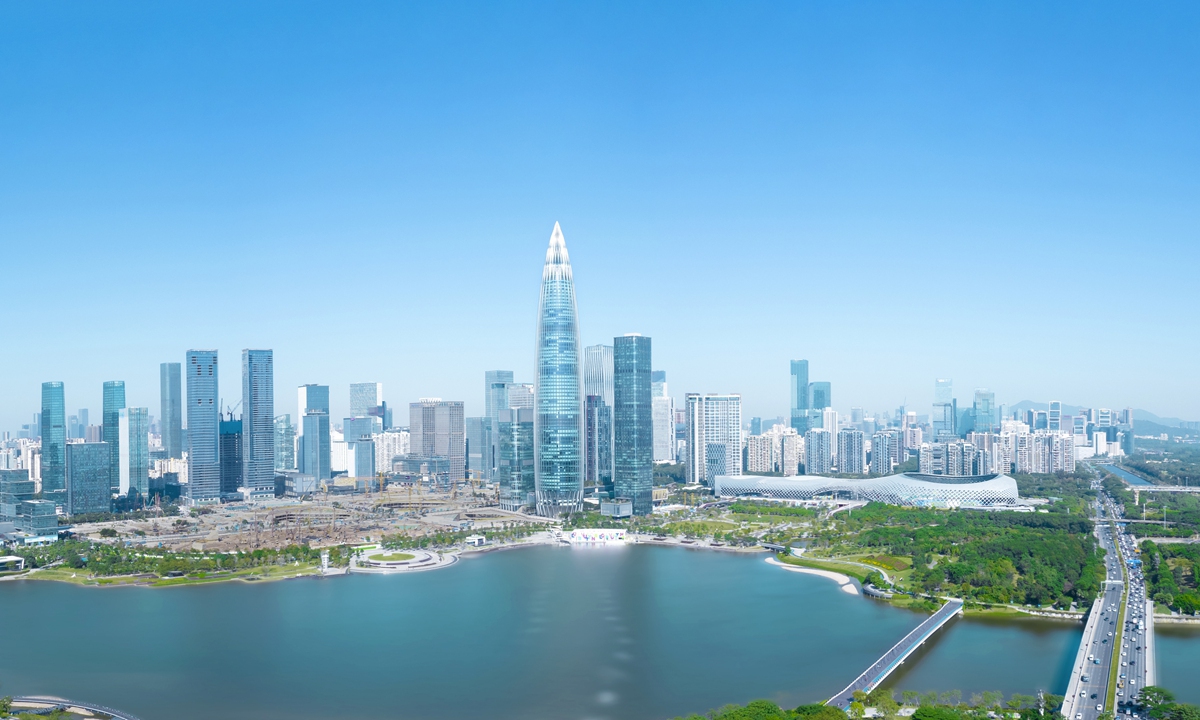
Skyline of Qianhai area in Shenzhen, South China's Guangdong Province Photo: VCG
Drones zip around delivering meals, and robots serve coffee with steady precision on the streets of Shenzhen. Then, the BBC pivots to factory relocations amid industrial restructuring and some food delivery riders voicing their grievances, deliberately shifting the focus from the city's technological achievements to the challenges faced by a few, by extension, those facing China as a whole. A recent BBC feature on Shenzhen uses this contrast to advance a predetermined narrative: In Shenzhen, the promise that hard work delivers a better life "feels less secure."
This "filtered" narrative is nothing new: It involves capturing isolated fragments of transformation, magnifying the growing pains, and then using preconceived biases to judge the entire city, and even Chinese modernization. Filters may alter the color tone of an image, yet they cannot stop the city's people from moving forward.
The recently concluded APEC meetings in Shenzhen offered another authentic view of the city. From November 14 to 19, Shenzhen hosted the Senior Officials' Meeting, the CEO Summit and the Economic Leaders' Informal Meeting in succession. As the eyes of world economies turned to Shenzhen, what the city presented to the world was not a selectively edited snapshot, but a complete model of openness, vitality and adaptability.
That APEC convenes in Shenzhen is itself testimony to the city's commitment to openness. Located in the Guangdong-Hong Kong-Macao Greater Bay Area, Shenzhen has grown from a remote town into an international metropolis over the past four decades - a transformation that has never relied on working in isolation. Openness has always been Shenzhen's lived reality, rather than a performative posture.
The series of APEC events has elevated this reality to new heights. China has pledged $20 million to support APEC practical cooperation, announced plans to set up the Asia-Pacific Community Research Center in Shenzhen and launch cooperative platforms covering digital technology, cross-border data flows, clean energy and the development of small- and medium-sized businesses. It also supports the establishment of a world association for bay areas economic cooperation. This signifies Shenzhen's evolution from a key node in the global industrial chain into a source of concepts and mechanisms for Asia-Pacific cooperation. Its openness is moving beyond "embracing the world" toward "connecting the world and defining cooperation."
This year's APEC cooperation focuses on three priority areas: openness, innovation and collaboration, which align perfectly with Shenzhen's DNA. Shenzhen's industrial evolution is, in itself, a history of proactive adaptation: From televisions to iPhones, electric vehicles and drones, and now humanoid robots, each leap forward stems not from passive waiting, but from learning alongside markets and technology; when setbacks strike, the city adjusts course and keeps learning. Today, "robot dogs assisting farm work in rural areas," autonomous driving, and drone food delivery have all evolved from concepts into reality in this city. China's massive innovation testbed allows cutting-edge technologies to iterate through practical application and transform into engines of growth.
Technology has changed the form of hard work, yet never diminished its value. Shenzhen engineers "spend every day thinking about how to make robots smarter" - this is what hard work looks like in the new era. The focus has shifted from manual labor and long hours to the speed of mastering new tools, the ability to identify new demands and the courage to reposition oneself amid change. Some foreign media narratives rush to portray this shift as "hard work becoming obsolete," yet the reality is quite the opposite: Technology brings fresh tests, while the essence of hard work remains unchanged.
The growing pains of transformation are real, but some foreign media overlook this city's proactive responses. Through vocational skills training, the protection of workers' rights in new forms of employment and the continued expansion of public services, workers undergoing this transition are provided with new career paths to pursue and opportunities to advance. The safety net provided by the system ensures that every adaptation has a viable path forward.
It is worth noting that foreign media lenses like the BBC's also captured some honest details. The gap between what is seen on the ground and the filtered narratives underscores a simple truth: Reality demands to be seen in full.
Shenzhen is a microcosm of reform and opening-up and a shining example of Asia-Pacific cooperation: Through its own openness, it bears witness to the value of openness; through constant adaptation, it responds to the imperative of change; through ordinary people's hard won striving, it embodies the human dimension of development.
Filters will fade, but growth will never stop. As "hard work" is redefined by technology, Shenzhen's answer reveals that hard work has never lost its value; it has merely taken on a more meaningful form. This aligns with APEC's choices and resonates with the future of the Asia-Pacific - "meet challenges facing development through opening-up, generate momentum for growth through innovation and pursue prosperity for all through cooperation." A boundless journey begins with every down-to-earth takeoff.
The author is a professor at the Shenzhen Party School. opinion@globaltimes.com.cn
RELATED ARTICLES