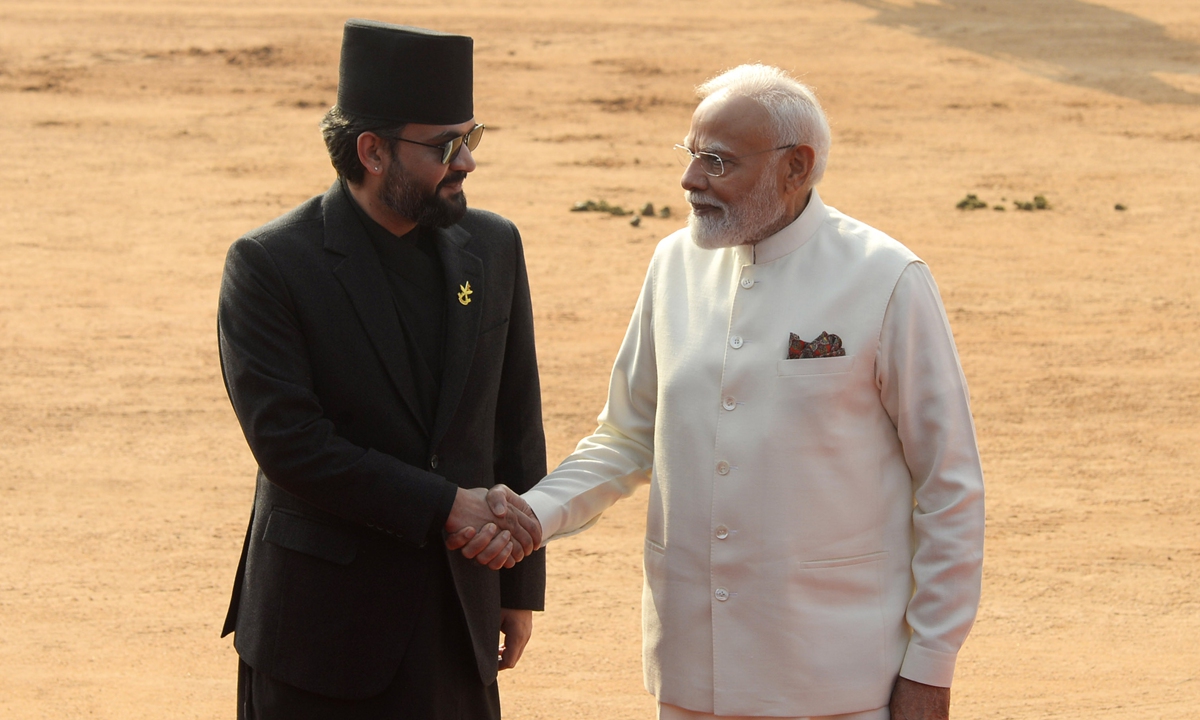
Indian Prime Minister Narendra Modi (R) and Nepalese Prime Minister Balendra Photo: VCG
From Sunday to Monday, Nepalese Prime Minister Balendra Shah paid an official visit to India. It was his first bilateral foreign visit since taking office nearly eight months ago and marked an important high-level engagement between Nepal and India in recent years.
The visit followed the long-standing practice of newly appointed Nepalese prime ministers choosing India for their first bilateral foreign visit. More noteworthy, however, were its distinctive features: a shortened duration, a substantially reduced itinerary and an agenda focused primarily on economic and functional cooperation. These arrangements were more than a matter of itinerary planning. They reflected the Shah administration's efforts to de-politicize diplomacy and transform Nepal from a traditional "buffer state" into a "bridge state."
Many small-sized countries seek to pursue a strategy of diplomatic balancing among major powers, hoping to translate it into economic gains. But this approach also carries considerable risks, as balancing on a global stage can easily spill over into domestic politics, fueling internal divisions and instability and ultimately undermining a country's long-term stability and development. The Shah administration appears determined to break away from this diplomatic predicament.
Nepal has long been described as "a yam between two rocks" - China and India - with its foreign policy centered on preserving room for maneuver between the two neighbors. The Shah administration, however, has explicitly proposed turning this geographical predicament into an advantage for development and making Nepal a "vibrant bridge." Achieving this transformation requires reducing the constraints that domestic politics impose on foreign policy. On the one hand, Nepal seeks to move its external relations away from partisan maneuvering and symbolic balancing, placing greater emphasis on professional expertise and practical interests. On the other, it aims to tone down the political and strategic dimensions of its diplomacy with neighboring countries and give greater priority to pragmatic cooperation.
The Shah administration's ambassadorial appointments to India and China are a clear expression of this approach. The new ambassadors, Dr Nishchal Nath Pandey and Dr Kalyan Raj Sharma, are both experts on their respective host countries, with extensive knowledge and professional networks there. Their appointments reflect an effort to insulate diplomacy from domestic political struggles and put bilateral relations on a more professional footing.
Shah's visit to India extended this de-politicizing approach to high-level interactions. Lasting just over 20 hours, the visit was tightly focused on New Delhi, with ceremonial activities kept to a minimum. The agenda centered on practical cooperation in energy, connectivity, investment, education, health and agriculture, while highly politicized issues such as border disputes were played down or left off the formal agenda. This reflected Shah's "domestic priorities first" approach and his preference for substance over ceremony.
By de-politicizing Nepal-India relations, Shah hopes to reduce the interference of domestic partisan divisions and ideological debates in foreign policy decisions, allowing external policy to better serve the needs of economic recovery and governance. At the same time, he seeks to secure greater room for maneuver between China and India through practical, measurable cooperation.
Recently, Nepal's ruling party also sent a large delegation of lawmakers to China. While this move carried an element of diplomatic balancing, its central focus remained functional cooperation rather than political alignment or choosing sides. The Himalayan Climate Resilience Mechanism that Shah previously proposed at the United Nations General Assembly, led by Nepal, India and China, reflects the same thinking. Rather than seeking to fundamentally reshape relations with its major neighbors, the initiative focuses on specific functional areas such as data sharing, glacier monitoring and disaster early warning.
Of course, Nepal's transition from a geopolitical buffer state to a bridge for functional cooperation remains, for now, largely a matter of policy direction. Its substantive results will take time to assess. The constraints imposed by geography and asymmetric dependence have not disappeared, as Shah's choice of India for his first bilateral visit also demonstrates.
Nevertheless, through the professionalization of ambassadorial appointments, a short and focused visit, and an agenda centered on practical cooperation, the Shah administration has made clear that de-politicizing diplomacy is a central strategy. Its goal is not to alter the China-India dynamic, but to minimize the extent to which geopolitical factors encroach on Nepal's room for independent action. It seeks to build its role as a functional bridge on workable cooperation rather than on the fragile performance of strategic balancing. Whether this approach can be sustained will depend on Nepal's domestic political stability and the accumulation of tangible diplomatic results.
The author is director of the Center for South Asian Studies at Fudan University. opinion@globaltimes.com.cn
RELATED ARTICLES