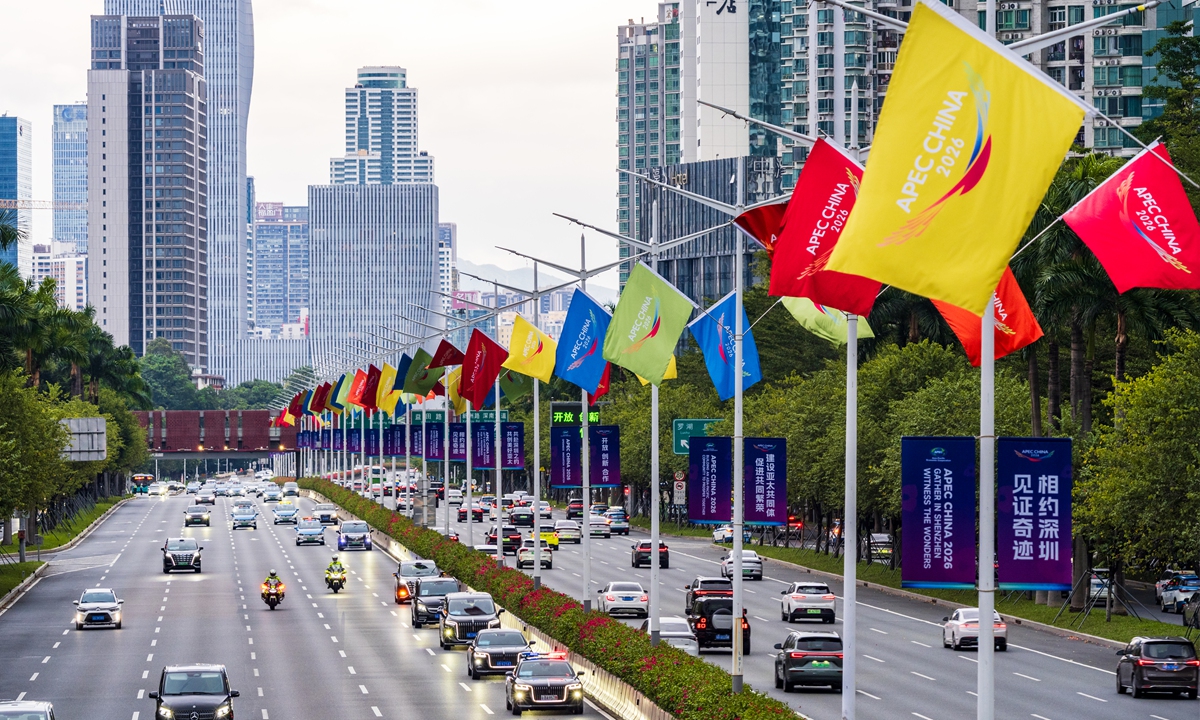
A street view in Shenzhen Photo: VCG
During the 2026 Shenzhen APEC meeting, two remarks went viral online, seemingly by coincidence. One came from Spanish influencer Santiago Armesilla, who, after experiencing Shenzhen's urban modernization firsthand, sincerely remarked, "I wish my country had its own Shenzhen." The other came from Tian, a sanitation worker on Shennan Boulevard in Shenzhen, who won widespread attention with her words: "This road isn't beautiful just because APEC is being held here. It's always been this beautiful."
If the former, from the perspective of civilization, posed the question of "Why has Shenzhen succeeded?", Tian offered an answer from her more than 30 years of working experience, in a conversation that crossed borders and reached the influencer: "Whenever I see something that doesn't look right, I have to clean it up. Only then can I feel at ease."
The foreign influencer and the sanitation worker - one reaching for the stars, the other rooted firmly on the ground. Behind this resonance across distance lies the shared aspiration of countless ordinary people in China and beyond: the longing for a better life. Much of the significance of Shenzhen's beauty lies in the fact that it has shown the world the value of people.
Today, in many countries, infrastructure is aging, public projects are caught in prolonged disputes, and people have grown accustomed to political infighting, slow development or even stagnation. Against this backdrop, when they see a city transformed beyond recognition over several decades, and witness so many workers diligently doing their jobs, year after year, in pursuit of a shared future, they cannot help but feel a deep sense of connection. As Chilean President Jose Antonio Kast remarked during his visit to Shenzhen, "progress is not a miracle but a resolution."
Tian is just one representative of the countless people working in different positions across the city. From the early pioneers who carved roads through saline-alkali land, to today's engineers tackling technological challenges in laboratories, and sanitation workers arriving on Shennan Avenue at 5 in the morning, every transformation that makes Shenzhen more beautiful is the result of countless hands cleaning, refining and persevering, time and again.
The reason this perseverance can bring people together lies in its response to the most basic aspirations of ordinary people: Life should get better with each passing day, and cities cleaner, more convenient and more hopeful. The foreign influencer's heartfelt remark on the streets of Shenzhen resonates, at its core, with what Tian described as being able to "feel at ease" - both reflect an appreciation for visible progress and the dignity that comes from seeing one's efforts make a tangible difference.
When a city makes sanitation workers feel that their work is respected, and allows visitors from afar to see that its order and efficiency are part of everyday life rather than a temporary makeover, it is quietly answering a fundamental question: Who is development ultimately for?
Perhaps Shenzhen's significance as a model lies not in offering a template for others to copy, but in proving something important: As long as "people" are placed at the center of development, and ordinary people's work is accorded dignity, fair rewards and a future, the wish that "my country had its own Shenzhen" need not remain merely an expression of admiration. It could become the starting point for people in other countries to take action and make changes. In fact, Tian's words have already made that starting point clear: First, clean up the road right in front of you. Only then can you feel at ease - and only then can the road ahead grow wider.