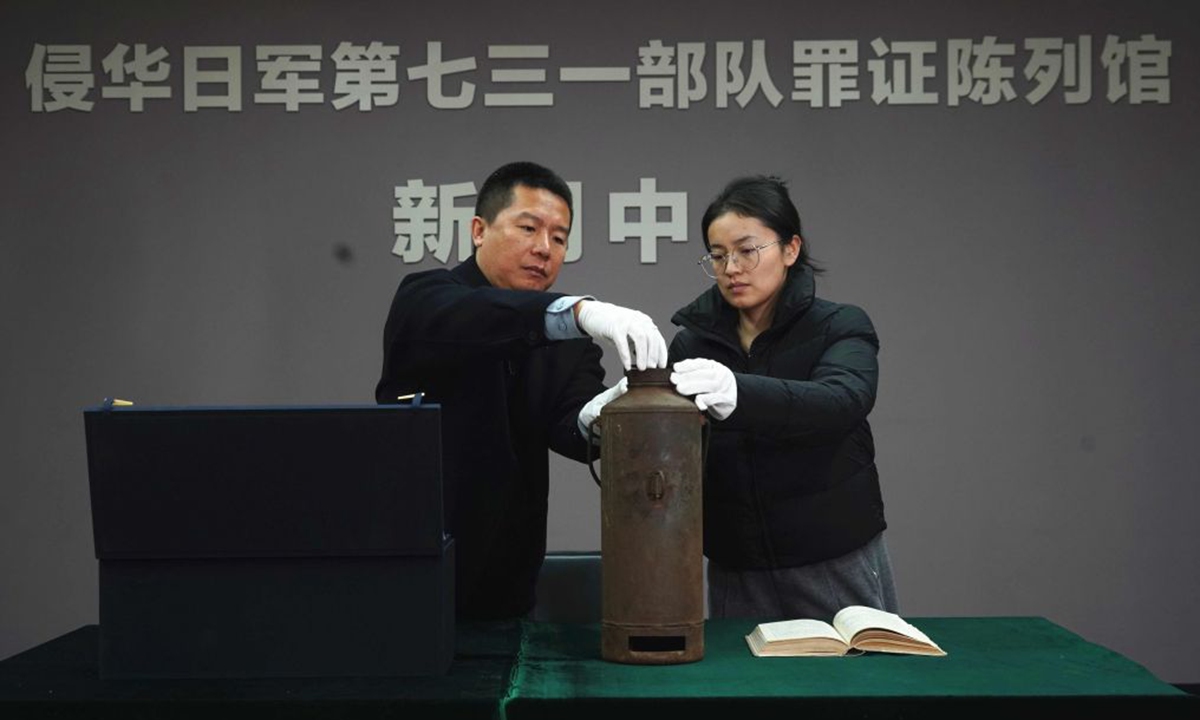
Staff members of Exhibition Hall of Evidences of Crime Committed by Unit 731 of the Japanese Imperial Army display a "Type 95" refill canister for a portable chemical agent dispersal device used by Japanese invading forces, on November 19, 2026. Photo: Xinhua
Three new pieces of evidence of chemical warfare crimes committed by Japanese invading forces in China were unveiled on Friday in Harbin, Northeast China's Heilongjiang Province, further exposing the systematic, state-organized nature of Japan's wartime chemical warfare program.
The evidence, collected from Japan by the Exhibition Hall of Evidences of Crime Committed by Unit 731 of the Japanese Imperial Army, includes a refill canister for a standard-issue chemical agent dispersal device, training materials for chemical warfare personnel and records of military engineering exercises in cold-weather conditions. Together, they provide corroborating evidence of the Japanese military's weapons manufacturing, personnel training and field testing.
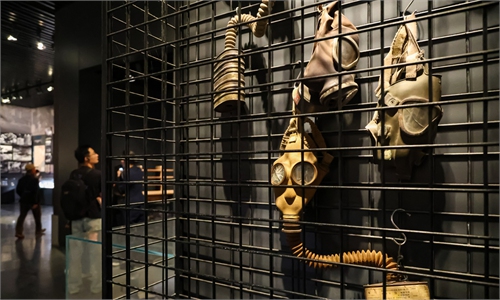
Among the newly unveiled artifacts is a well-preserved "Type 95" refill canister for a portable chemical agent dispersal device. Resembling a civilian fire extinguisher in appearance, the canister bears a nameplate recording its manufacturing date of July 1938, serial number and a Japanese manufacturer.
Jin Shicheng, a researcher at the exhibition hall, said the Japanese military employed various means of using chemical weapons on the battlefield during its invasion of China. The portable device was designed to disperse chemical agents, including blister agents such as mustard gas. The newly unveiled artifact provides direct physical evidence of the development and production of chemical warfare equipment by the Japanese military.
The historical documents include a 39-page compilation of teaching materials for chemical warfare trainees, compiled in 1942. The materials analyze and compare the properties of different categories of chemical agents and contain records of animal experiments and injuries caused to humans by chemical agents such as mustard gas and lewisite.
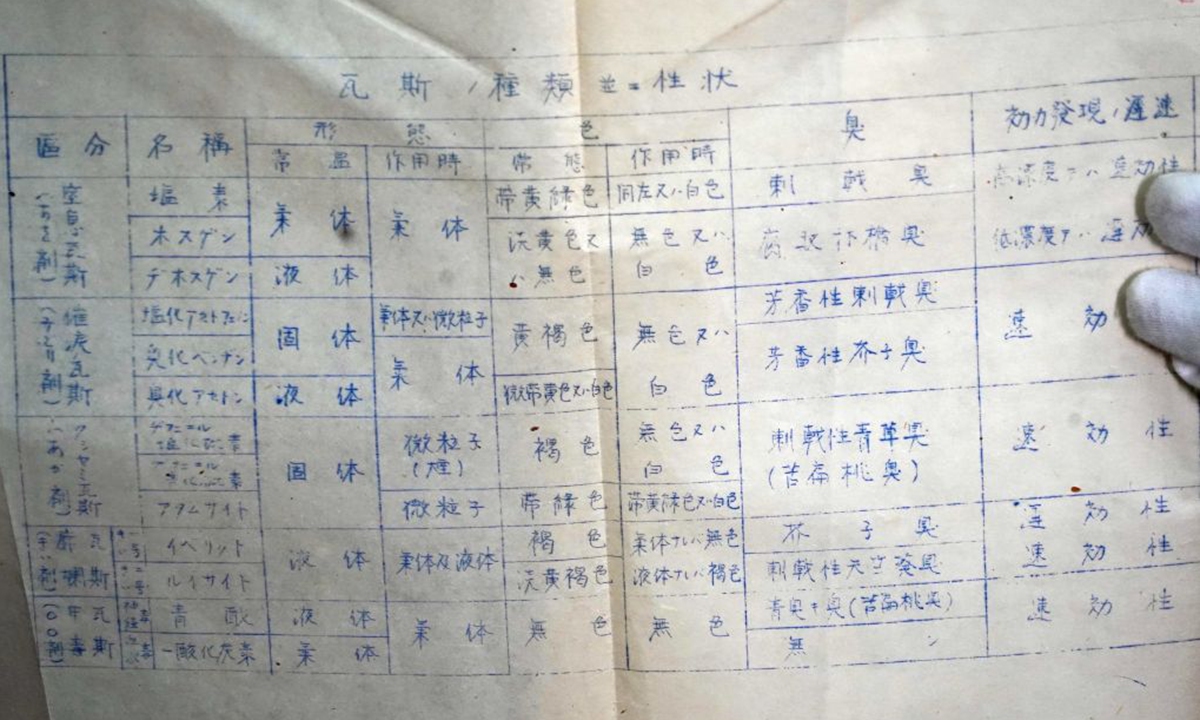
A page introducing chemical agents in a compilation of teaching materials for chemical warfare trainees of the Japanese invading military. Photo: Xinhua
Drawing on postwar testimonies documented in a book on biological and chemical warfare, Jin said that what the Japanese military presented as training in protection against toxic agents was in fact intended to prepare its personnel to wage chemical warfare.
Another document, compiled in December 1938 and roughly translated as "Military Engineering Operations in Cold Regions (Chemical Warfare Duties)," consists of 20 pages of records compiled following field exercises conducted in Northeast China by a unit of the Japanese Army's engineering school, Xinhua reported.
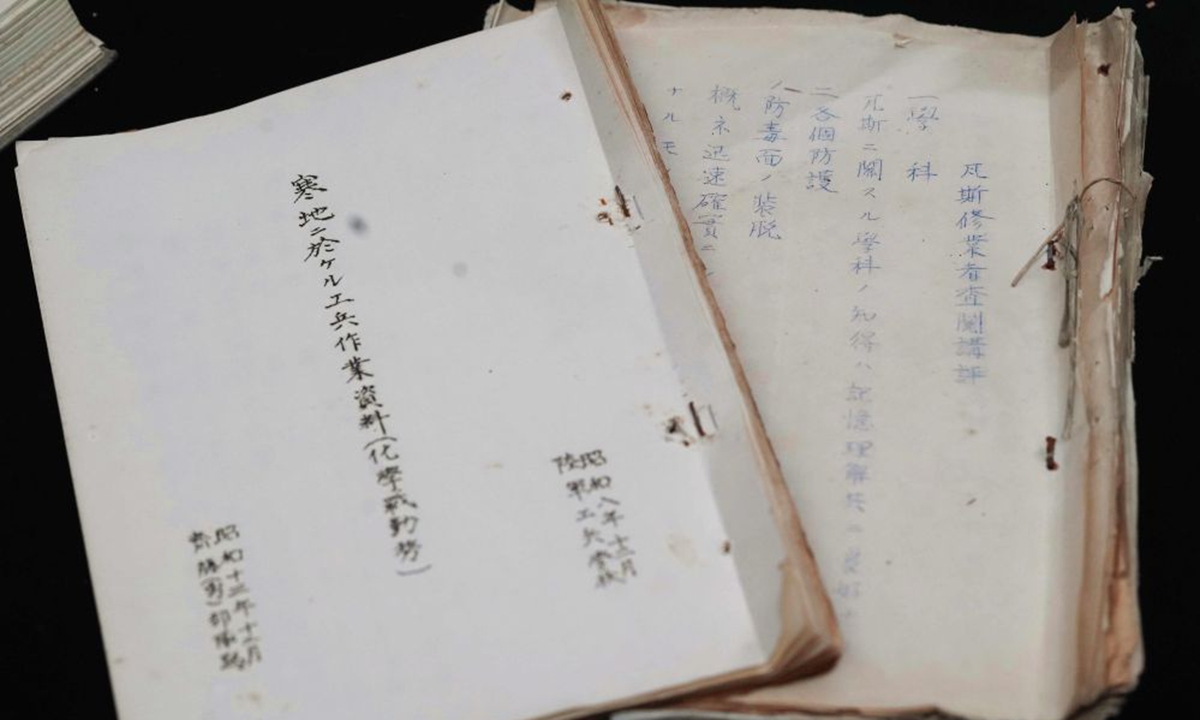
Two historical documents on chemical warfare conducted by Japanese invading forces, including records of military engineering exercises in cold regions and a compilation of teaching materials for chemical warfare trainees. Photo: Xinhua
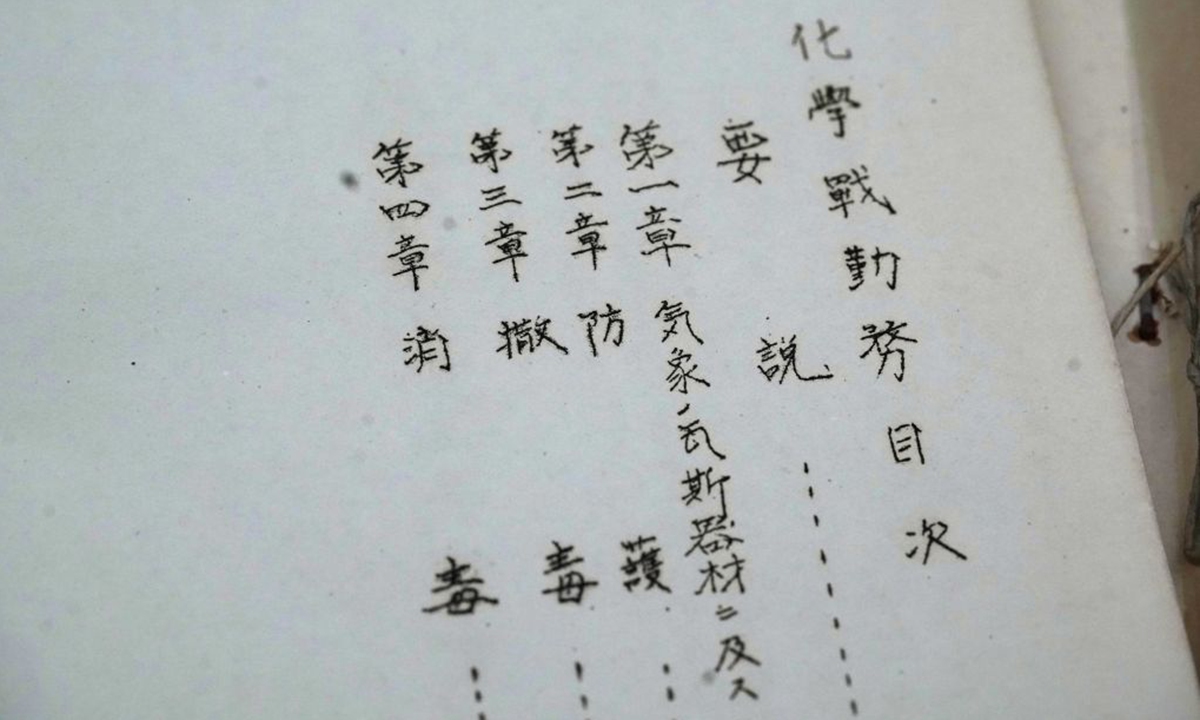
The table of contents of a historical document on military engineering operations in cold regions, focusing on chemical warfare duties. Photo: Xinhua
Jin said the document records the impact of extremely cold weather on chemical warfare operations, demonstrating that the Japanese military conducted chemical warfare experiments and tactical research tailored to the harsh winter conditions of Northeast China and the Soviet Union.
Japanese invading forces committed crimes against humanity through biological and chemical warfare during World War II. The chemical weapons abandoned across China by the Japanese military after its defeat continue to threaten people's lives and property, as well as ecological and environmental safety.
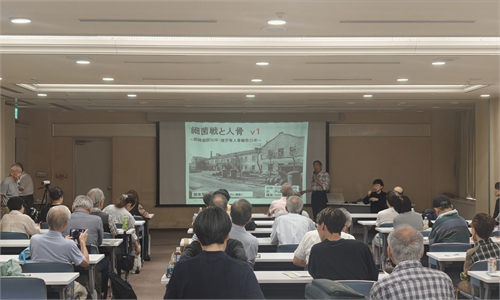
Friday's revelations followed the release of other research findings earlier this month on Japan's wartime atrocities. At a symposium in Heilongjiang, Jin presented findings from archival records concerning Unit 516, a Japanese chemical warfare unit, revealing that a team of about 70 personnel had been tasked with transporting, burying and abandoning chemical weapons before Japan's main force withdrew following Japan's surrender, Xinhua reported on November 12.
Chemical weapons left behind by invading Japanese forces have been found at more than 200 sites across 18 provinces in China, and a large number of toxic bombs are believed to remain undiscovered.
According to figures released on Tuesday by Sabrina Dallafior, Director-General of the Organisation for the Prohibition of Chemical Weapons (OPCW), 191,124 abandoned chemical weapons items had been recovered in China as of August 31.
Japan has missed its deadlines for destroying the abandoned chemical weapons four times. The latest plan, adopted in 2022, is due to expire in 2027, putting Japan at risk of missing the deadline for a fifth time. Japan's budget for addressing the abandoned chemical weapons in China was cut by 22 percent this year compared with 2025, even as its defense budget continued to rise, Xinhua reported on Thursday.
At a press conference on Thursday, Chinese Foreign Ministry spokesperson Guo Jiakun said China urges Japan to earnestly assume its historical, political and legal responsibilities, faithfully fulfill the obligations under the Chemical Weapons Convention (CWC) and the MOU between the two countries' governments, and speed up end-to-end disposal process, so that the day will come sooner when the hazardous Japanese abandoned chemical weapons (ACWs) are destroyed completely and thoroughly, when the Chinese people no longer have to live on soil tainted by ACWs, when justice prevails in the international community, and when humanity lives in a world free of chemical weapons.
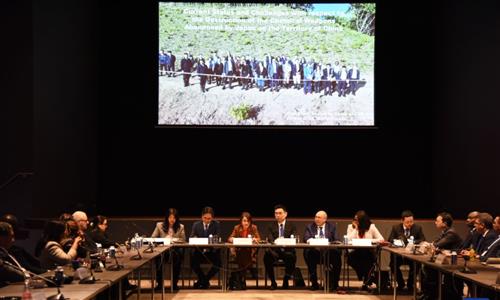
According to the ministry, on November 25, China organized a side event on Japan's ACWs in China on the sidelines of the 31st Session of the Conference of the State Parties to the CWC in the Hague, and briefed the delegates attending the meeting on the fact that Japan's ACWs in China are large in quantity, severe in harm and slow in disposal.
China stressed that early and complete destruction of these weapons is Japan's due obligation under international law in accordance with the CWC. The destruction process is now seriously lagging behind schedule. The root cause is that Japan insists on its distorted view of history, fails to genuinely reflect on its war crimes, stays indifferent to the harm of chemical weapons, flouts international obligations, and invests insufficiently in this matter, Guo said.
OPCW's Director-General Sabrina Dallafior, chairperson of the Executive Council permanent representative of Morocco Ambassador Mohamed Basri, and delegates from many countries pointed out that Japan's ACWs in China pose the greatest practical impediment to the goal of a world free of chemical weapons, the spokesperson noted.
Global Times