A shared dinner table in orbit offers heartwarming example of cultural respect as Pakistan looks forward to historic astronaut return
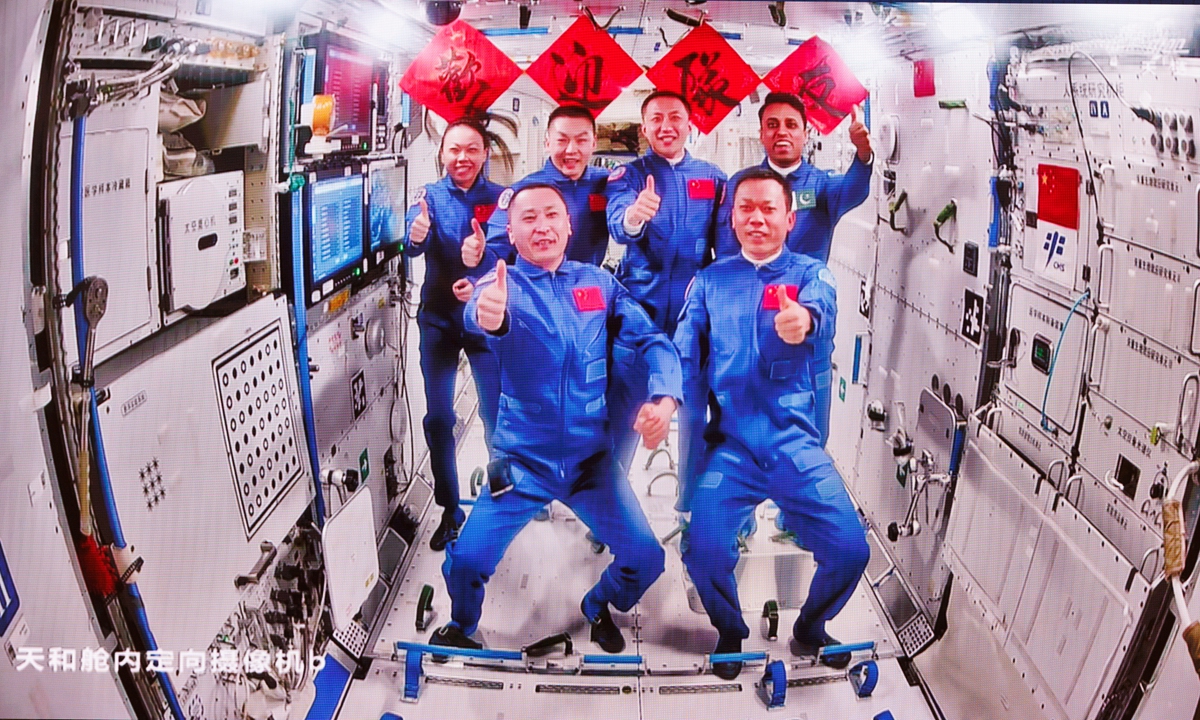
This image captured at Beijing Aerospace Control Center on November 25, 2026 shows a group picture of the crew of Shenzhou-23 and Shenzhou-24 spaceships. Photo: Xinhua
As Pakistan looks forward to the return of its first-ever astronaut to enter Earth's orbit, Muhammad Zeeshan Ali, aboard China's Shenzhou-23 spacecraft, the historic mission has generated expressions of national pride and aspirations for further scientific development in Pakistan. With Ali having completed his assigned experiment involving photosynthetic cyanobacteria, a specially customized menu featuring Pakistani dishes aboard China's Tiangong space station has also highlighted the cultural sensitivity and human-centered approach underpinning China's international cooperation in human spaceflight.
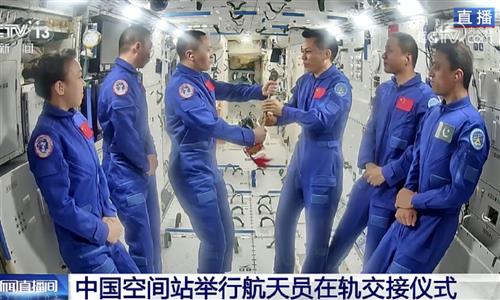
The Shenzhou-23 and Shenzhou-24 crews completed their in-orbit handover on Saturday, according to the China Manned Space Agency (CMSA).
Ali, together with Chinese astronauts Zhang Zhiyuan and Li Jiaying, is expected to return aboard the Shenzhou-23 spacecraft to the Dongfeng landing site in North China in the coming days. The returning astronauts have completed their scheduled tasks, with final preparations underway at the landing site and across the relevant systems.
The approaching return comes amid sustained attention in Pakistan, where the country's political leaders, scientific institutions and media outlets have highlighted the significance of the mission for Pakistan's aspirations in space exploration.
Pakistani Prime Minister Shehbaz Sharif held a space-ground call with Ali on Saturday from the headquarters of Pakistan's Space and Upper Atmosphere Research Commission (SUPARCO) in Islamabad, during which he congratulated Ali on his historic achievement and extended greetings to his Chinese crewmates, the Xinhua News Agency reported on Sunday.
Sharif highlighted the significance of the mission as China and Pakistan mark the 75th anniversary of diplomatic relations this year, expressing appreciation for China's support for Pakistan's participation in space exploration, according to Xinhua.
According to a statement issued by Pakistan's government Press Information Department on Saturday, the Pakistani prime minister expressed immense pride in the achievement and he also expressed confidence that the achievement would inspire the country and younger generation to pursue excellence in science and innovation.
Xinhua reported on Sunday that Ali had completed his assigned experiment involving photosynthetic cyanobacteria on Saturday, his fourth day aboard the space station.
Four joint scientific experiments are being conducted under the Shenzhou-24 mission, with Pakistani researchers taking the lead in developing experimental plans and identifying scientific objectives, and their Chinese counterparts providing engineering support.
The research involves cyanobacteria, quinoa, graphene hybrid composite materials and carbon fiber composite materials. Ali will bring back the first batch of cyanobacteria samples for further analysis by researchers on Earth.
Beyond scientific collaboration, details of Ali's daily life aboard the Chinese space station have offered another perspective on the historic mission.
When Ali entered Tiangong on Wednesday, he was welcomed with freshly baked cupcakes prepared in orbit by Chinese astronaut Li Jiaying. The Pakistani astronaut responded in Mandarin, or Putonghua, expressing his appreciation for the warm welcome.
Behind the welcome was months of preparation by Chinese space food researchers to accommodate the dietary traditions, nutritional needs and personal preferences of Pakistani astronauts.
A dedicated food reserve containing more than 100 items was developed by the Astronaut Center of China, including seven newly developed dishes featuring Pakistani flavors, such as nihari beef, lamb korma, curry chickpeas and butter chicken, according to Xinhua.
Chen Junli, a researcher at the center, disclosed the menu was designed to meet nutritional requirements while accommodating the astronauts' individual preferences and their need for easily digestible food during the initial period of adaptation to microgravity.
"The entire production line is a fully halal one," Chen said.
The food preparation also incorporated elements of cultural exchange that emerged during the Pakistani astronauts' training in China.
Having originally considered including traditional Pakistani spiced milk tea, the Chinese researchers adjusted their menu after the Pakistani astronauts developed a liking for Chinese black tea and rice and requested more of both during the mission, according to Xinhua.
Chinese researchers also designed a shared meal for the six astronauts during the crew handover period, selecting dishes that both crews enjoyed while respecting Pakistani dietary customs, according to media reports.
From jointly designed scientific experiments to a shared dinner table in orbit, the mission offers a tangible example of how international space cooperation can extend beyond technological collaboration to include respect for different cultural traditions and the everyday needs of astronauts living and working together in space.
Global Times
RELATED ARTICLES