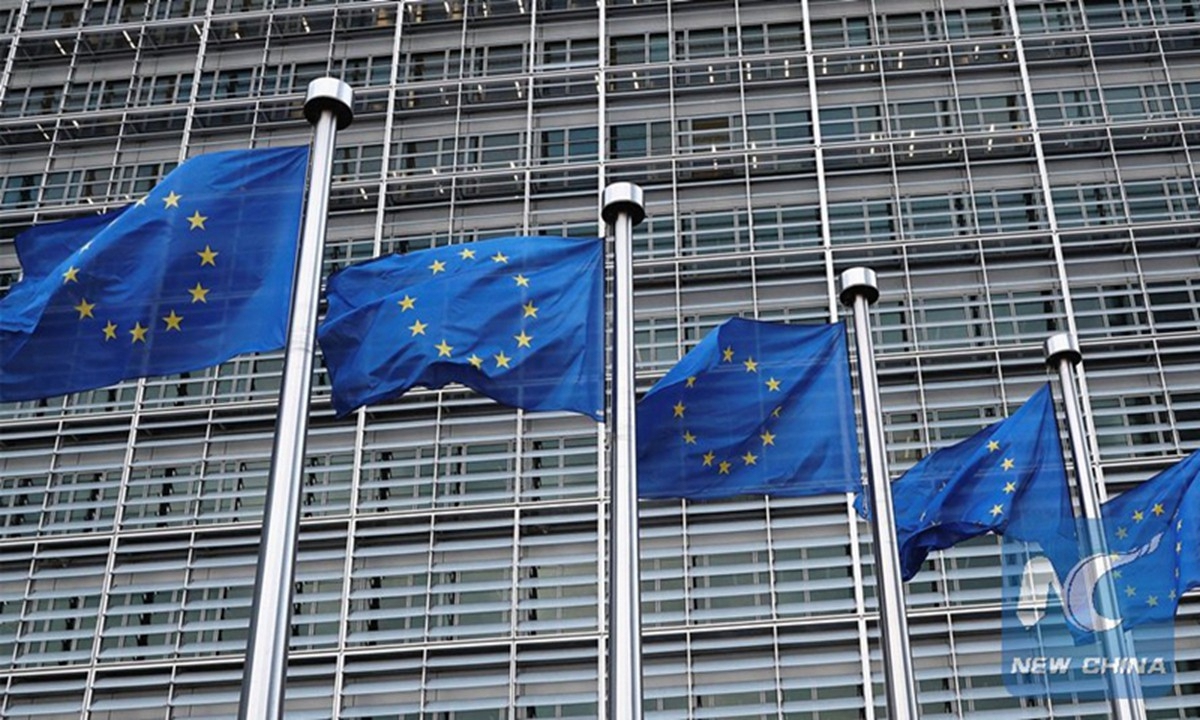
The European Union flags in front of EU headquarters in Brussels, Belgium. Photo: Xinhua
François Villeroy de Galhau, 67, former governor of the Bank of France, warned in a recent interview that if Europe fails to overcome its divisions and unite to catch up with the US and China, its status as a world power could "disappear."He likened Europe to a bickering village encircled by major powers, arguing that while Europe has enough funds, it lacks collective will to advance AI, clean energy and defense.
However, Villeroy's own framing appears divided. If he recognizes Europe's decline is largely made at home, but still feels the need to invoke an external threat to shock Europeans into action, this suggests that Europe's political psychology has become pathological.
This is why the more Europe dramatizes outside threats, the less it is able to unite.
The root cause of Europe's decline is not the absence of reform ambition, but rather the loss of the self-revolutionary spirit that makes reform real. The people of this village are asleep on yesterday's glories.
Consider Europe's manufacturing and technology base.
In AI, the field that will define future competitiveness, private AI investment in 2025 was about $285.9 billion in the US and $12.4 billion in China, while France and Germany together accounted for less than $10 billion. Among the world's best-known foundation models, the US has produced dozens, China more than 10, and Europe only a handful.
Even in manufacturing, once Europe's strength, the hollowing-out is accelerating. With persistently high energy costs, chemical producers and auto-parts companies are moving capacity to the US and Asia. Germany's proud auto industry is falling behind China and the US in the new-energy transition; in France, even Peugeot, once a national champion, is in retreat.
Villeroy seems to be calling Europe back to a Cold War-style collective mobilization. In the age of globalization, that is a serious misreading.
Today, competition and cooperation are intertwined: Supply chains are embedded in global networks, technical standards cross borders, and energy markets are interconnected. Speaking only of confrontation and not of cooperation - of how to shut the door more tightly and never of how to move forward together - will not make Europe stronger. It will only make Europe pay a higher price.
Europe's deepest crisis is that it has largely forgotten how to bake the cake, while spending its days indoors arguing over how to divide an ever-shrinking one. Every country is busy with its own abacus. Within the EU, there are endless disputes over the budget framework, farm subsidies, and aid to poorer regions. No one wants to pay more to build new industries.
Baking a bigger cake has a price. It means reforming welfare systems, opening markets, and trimming entrenched privileges to invest in the future. In electoral politics, those moves cost votes. As a result, politicians often prefer to preserve the status quo, divide the existing pie nicely, and avoid the hard choices. By shifting the blame for the crisis outward, they can suppress internal contradictions for a while and continue pursuing their own small calculations.
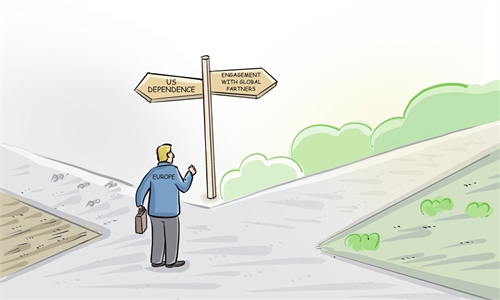
If Europe's political elites continue to substitute "external threat" for honest negotiations over internal distribution, and keep spending their energy slicing the cake instead of restarting growth and reviving manufacturing, then Villeroy's "disappearance" will cease to be mere rhetoric. If they keep dividing that ever-smaller cake, one day the villagers will no longer be able to make a living.
RELATED ARTICLES