Seoul's NSA reportedly says S.Korea unable to pay $350b upfront in investment in US for tariff deal; weaponizing alliance exposes nature of US economic coercion: expert
By Published: Sep 28, 2025 02:31 PM

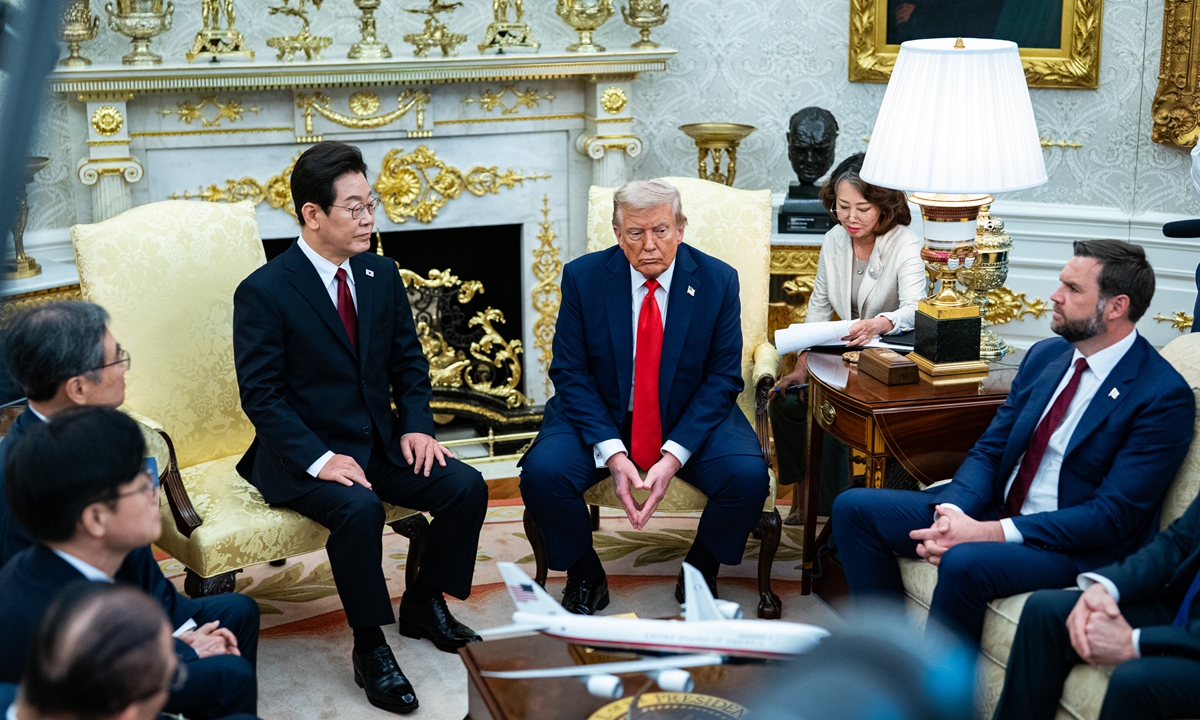
US President Donald Trump meets with visiting South Korean President Lee Jae-myung at the White House on August 25, 2025. Photo: VCG
Negotiations between South Korea and the US regarding the country's $350 billion investment in the US have reached a deadlock, according to Reuters.
Reuters, citing Seoul's presidential adviser, reported on Saturday that South Korea is unable to pay $350 billion upfront in investment in the US as Washington suggested under a deal to cut tariffs.
According to the report, US President Donald Trump in remarks on September 25 said South Korea would provide the investment "upfront", despite Seoul's contention that kind of outlay could plunge Asia's fourth largest economy into a financial crisis.
"The position we're talking about is not a negotiating tactic, but rather, it is objectively and realistically not a level we are able to handle," South Korea's National Security Adviser Wi Sung-lac said on Channel A News television. "We are not able to pay $350 billion in cash," he said, according to Reuters.
"We're discussing alternatives," he said, adding Seoul is targeting a meeting of the Asia-Pacific Economic Cooperation (APEC) grouping hosted by South Korea next month to finalize the trade deal with Washington, Reuters reported.
Since a handshake deal by the two countries' leaders in July to lower US tariffs to 15 percent from 25 percent, South Korea has said the $350 billion in investment would be in the form of loans and loan guarantees as well as equity, according to the report.
Wi, the top security adviser to South Korean President Lee Jae-myung, said nobody would question South Korea's position on the feasibility of the amount if it were required as a cash payment upfront.
According to the Chosun Daily on September 22, the $350 billion that the US is demanding as short-term investment in the Korea-US tariff negotiations exceeds South Korea's total global foreign direct investment (FDI) over the past five years. The report noted that questions and concerns are growing over whether it is feasible to invest such a massive amount in cash within a short period without mobilizing guarantees, loans or other financial instruments.
"This weaponization of alliance relations exposes the nature of US economic coercion. South Korea's candid response reflects a necessary pushback against unrealistic and imposed requirements," Lü Chao, an expert at the Liaoning Academy of Social Sciences, told the Global Times on Sunday.
The current deadlock has triggered concerns in South Korea about a potential repeat of the 1997 financial crisis. In an interview with Reuters on September 22, South Korean President Lee Jae-myung said the country's economy "could fall into crisis rivalling its 1997 meltdown" if his government accepts current US demands in stalled trade talks without safeguards.
The current US economic coercion against South Korea may be generating negative impacts on the bilateral alliance, Lü stated.
"Washington's intensified pressure risks triggering some backlash across South Korean business circles and the wider public, ultimately could undermine the foundation of bilateral cooperation," the expert said.
This month the US government rocked South Korea with the arrest of more than 300 South Korean workers at a Hyundai Motor battery plant in Georgia, with federal officials accusing them of immigration violations.
Bloomberg reported Thursday that South Korean Prime Minister Kim Min-seok said that South Korea's investment projects in the US will remain in limbo until visa issues are resolved.
Lü commented that considering the Lee administration has shown pragmatic approaches, the US' economic coercion may not achieve comprehensive control, as when national development interests fundamentally conflict with alliance obligations, Seoul is more likely to choose the pragmatic path that serves its own developmental needs.
RELATED ARTICLES