Populations of 19 nationally protected bird species, including crested ibis, remain stable or continue to grow
Winged care

A young teacher guides students in creating woodblock prints of the crested ibis in Hanzhong, Northwest China's Shaanxi Province, on March 17, 2023. Photos: VCG
China has consistently attached great importance to bird conservation over the years, noted the National Forestry and Grassland Administration (NFGA) at a news conference on the achievements of bird conservation in 2026.In particular, in September 2025, 17 government departments jointly launched a three-year bird conservation campaign and a special campaign to crack down on the illegal hunting and trade of birds.
Focusing on three core tasks - bird conservation activities, special enforcement actions, and publicity and education - the departments worked closely together and coordinated their efforts to combat the illegal hunting, trading and transportation of wild birds and other related violations throughout the entire chain, while striving to establish a long-term mechanism for regular supervision and governance.
The efforts have achieved phased results, with the populations of 19 nationally protected bird species, including the crested ibis, remaining stable or continuing to grow.
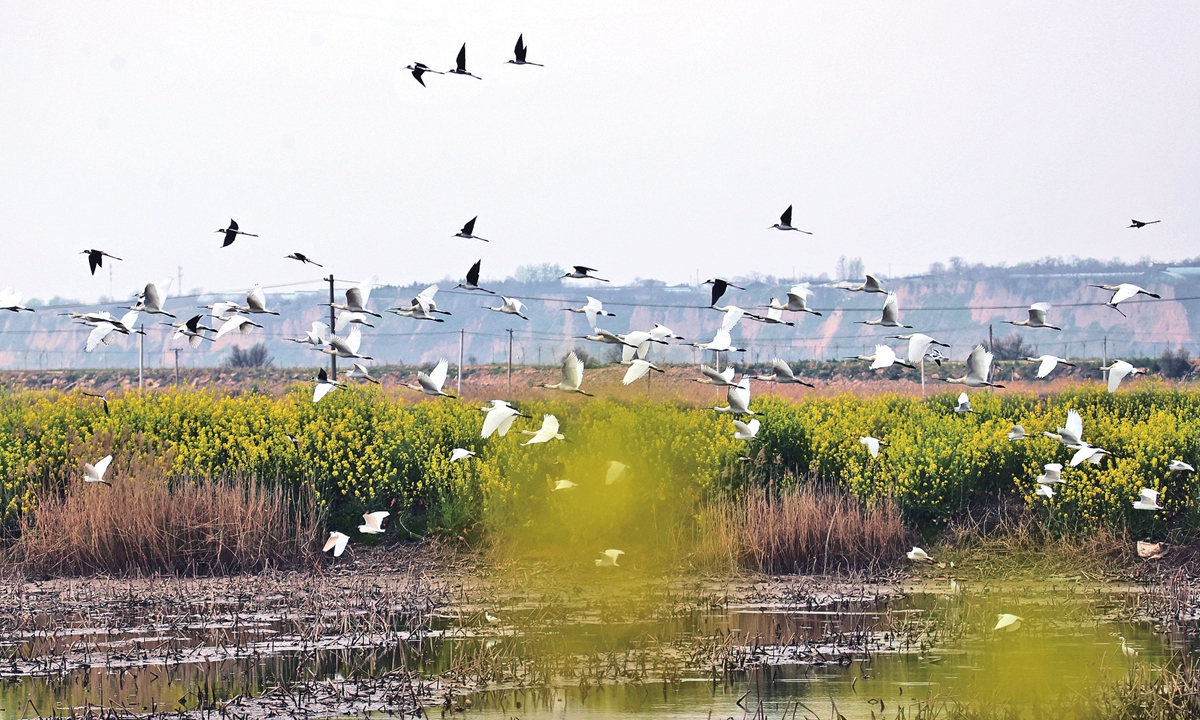
Flocks of birds soar across a Yellow River wetland in Fanjia township, Dali county, Northwest China's Shaanxi Province, on March 30, 2026.
Home to rich bird resourcesWang Zhen, director of the publicity center of the NFGA, pointed out at the news conference that birds are an important component of natural ecosystems.
Protecting bird resources is an important part of promoting ecological conservation, as well as an important measure to preserve biodiversity and safeguard the community of life on Earth.
China is one of the countries with the richest bird resources in the world, with 1,505 bird species, accounting for about one-sixth of the world's total bird species.
More than 800 species are migratory birds. China is also an important corridor for the cross-border migration of migratory birds. Of the world's nine major migratory bird flyways, four pass through China, covering almost the country's entire land territory and territorial waters.
Building a conservation framework
Wang Weisheng, director-general of the department of wildlife conservation of the NFGA, introduced that a three-year nationwide bird conservation campaign and a special campaign were launched in September 2025.
The campaign has severely cracked down on illegal hunting and trading, promoted the improvement of regular and long-term conservation mechanisms, carried out extensive publicity and science education on bird conservation, built a joint conservation framework featuring multi-department coordination, rapid response and full-chain supervision, and effectively safeguarded the safety of bird populations, including migratory birds, and their habitats.
The country has also strengthened the legal foundation for bird conservation. China revised and adopted the Wildlife Protection Law of the People's Republic of China in 2022.
In 2021 and 2023, respectively, it adjusted and released the List of National Key Protected Wild Animals and the List of Terrestrial Wild Animals of Important Ecological, Scientific and Social Value.
The number of nationally protected bird species has been expanded to 394, while the number of birds among China's "three haves" list, of animals considered to have ecological, scientific or social value, has increased to 1,028.
A total of 98.4 percent of bird species are now covered by legal protection, laying a solid legal foundation for bird conservation.
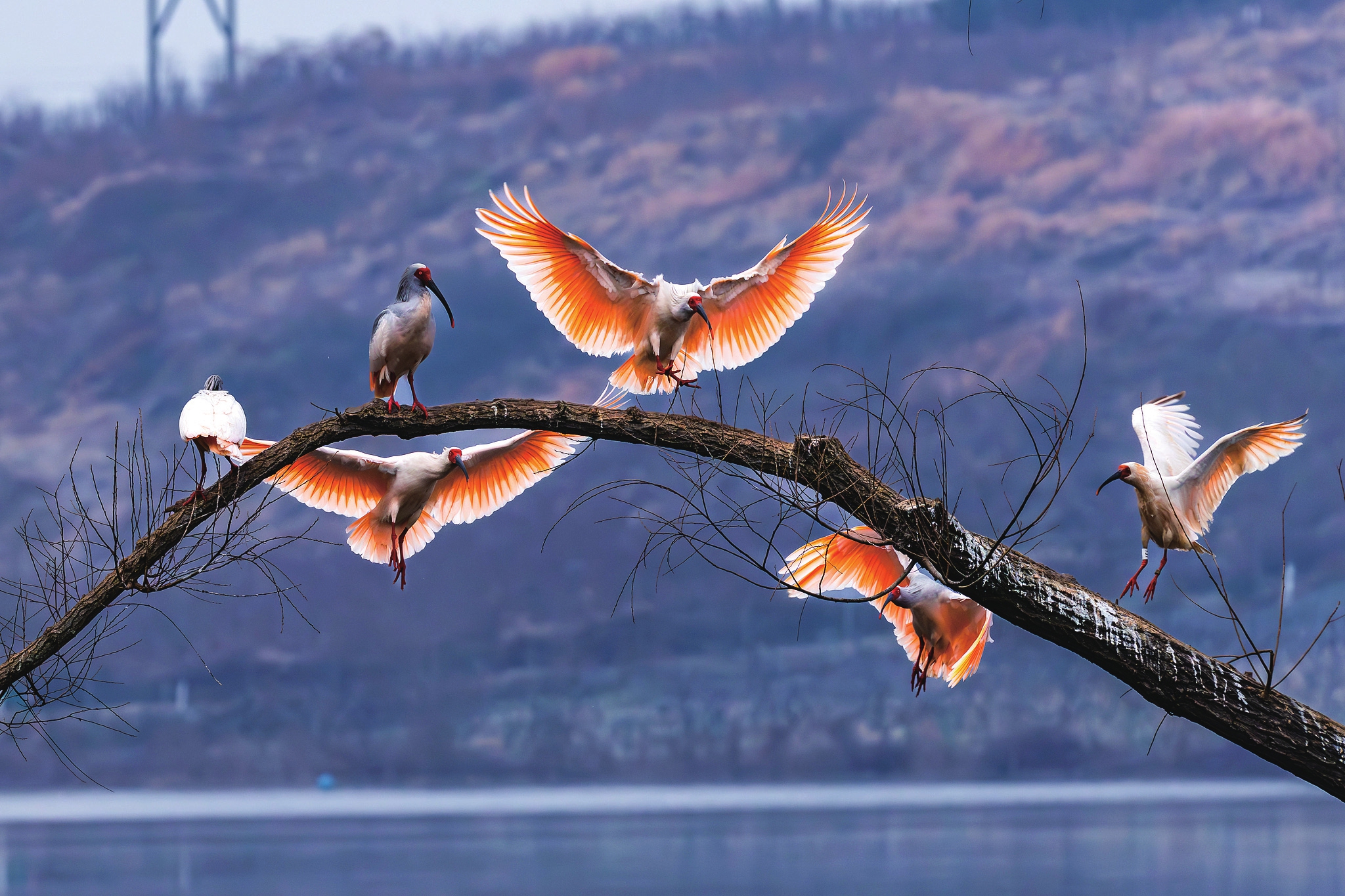
Crested ibises, a first-class protected species in China and revered as an "Oriental gem," fly around Yangxian county, Northwest China's Shaanxi Province, on January 26, 2026.
Conservation monitoring networkChina has identified 1,140 important habitats along migratory bird flyways and further selected 821 key habitats, comprehensively strengthening protection and restoration, improving the conservation monitoring network, and providing a favorable ecological environment for migration, breeding and wintering.
Fourteen bird species, including the crested ibis, green peafowl and red-crowned crane, have been included in the scope of emergency conservation species during the 14th Five-Year Plan period (2021-25).
Efforts are also underway to include another 21 bird species, including Baer's pochard and the Oriental stork, in the scope of emergency conservation species under the 15th Five-Year Plan (2026-30), while comprehensively strengthening surveys and monitoring, patrols and guarding, rescue and rehabilitation, captive breeding and release, and habitat restoration.
Cracking down on illegal and criminal activities that damage bird resources, China has carried out special campaigns for six consecutive years, strengthening joint law enforcement by multiple departments and severely cracking down on illegal and criminal activities that damage bird resources.
In particular, the three-year nationwide bird conservation campaign and special campaign to crack down on the illegal hunting and trade of birds have promoted coordinated efforts both online and offline and established a full-chain supervision system covering field patrols, market regulation and judicial accountability.
Deepening international cooperation, publicity and education, China has joined multilateral agreements such as the East Asian-Australasian Flyway Partnership and signed bilateral agreements with Japan, South Korea, Singapore, Russia and New Zealand on the protection of the crested ibis and other migratory birds and their habitats.
Together with the international community, China has promoted cooperation in bird banding, population monitoring, information sharing, scientific research and joint conservation.
Every year, China organizes themed publicity campaigns such as World Wildlife Day, Bird-loving Week and Wildlife Protection Publicity Month, and carries out a wide range of science popularization and public awareness activities both online and offline.
Since the spring of 2026, it has organized Bird-loving Week activities nationwide under the theme "protecting feathered spirits, painting an ecological landscape together," further fostering a stronger public atmosphere for loving and protecting birds. The populations of 19 nationally protected bird species have remained stable or increased.
This was compiled and translated by the Global Times based on an article originally published on Page 5 of the People's Daily Overseas Edition on July 8, 2026.
RELATED ARTICLES