President Xi's APEC vision offers pathways to counter economic fragmentation, sustain regional prosperity: experts
By Published: Nov 19, 2026 02:04 PM

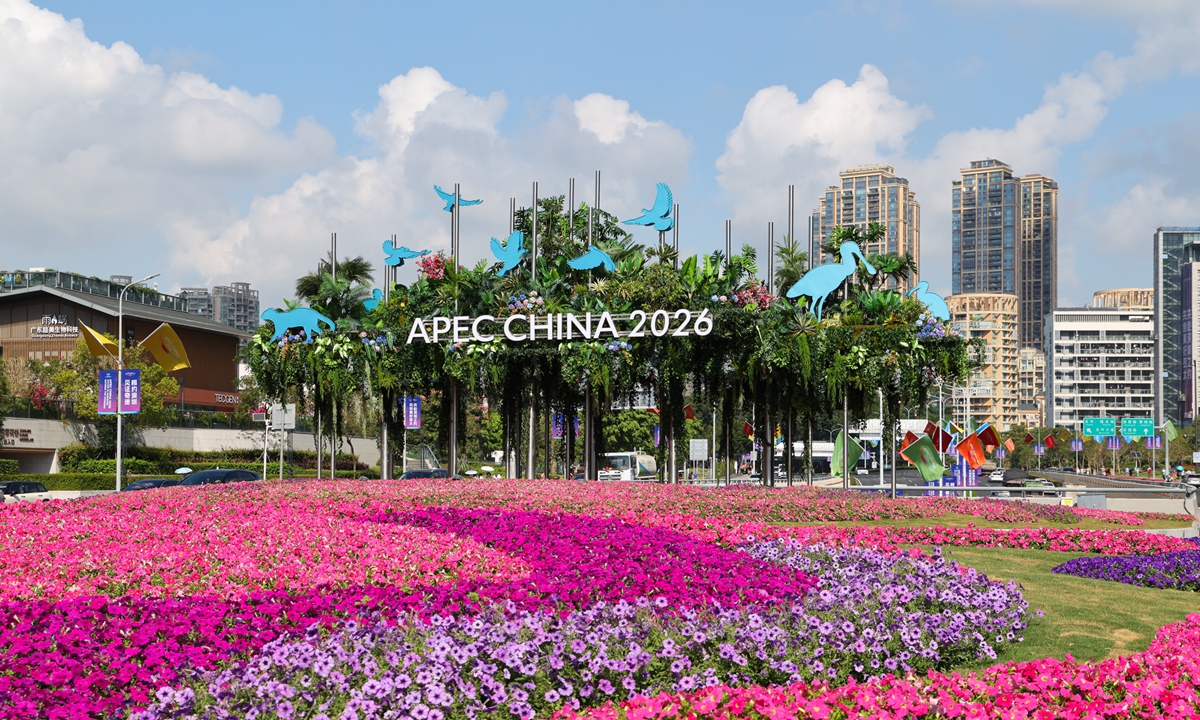
An APEC-themed installation is seen in Shenzhen, South China's Guangdong Province. The 33rd APEC Economic Leaders' Meeting will be held in Shenzhen from November 18 to 19. Photo: Xinhua
As rising protectionism, geopolitical tensions and intensifying technological competition threaten to fragment the global economy, President Xi Jinping's keynote speech at the APEC CEO Summit in Shenzhen on Wednesday outlined an interconnected vision for sustaining Asia-Pacific prosperity. The vision has resonated with Chinese experts, who highlighted how regional stability, institutional opening-up, innovation-driven growth and new cooperation mechanisms could help address the region's mounting challenges.
Beyond reaffirming support for free trade, the speech offered concrete avenues for deeper regional integration, from advancing a Free Trade Area of the Asia-Pacific (FTAAP) to supporting the establishment of a World Association for Bay Areas Economic Cooperation, while presenting China's super-sized open market and industrial ecosystem as opportunities for global businesses.
International media have paid particular attention to the speech's implications amid growing economic and geopolitical uncertainties. Reuters highlighted Xi's call for free and open trade against the backdrop of renewed US restrictions on advanced AI chips, while Singapore's CNA focused on his emphasis on regional stability as an engine for economic prosperity.
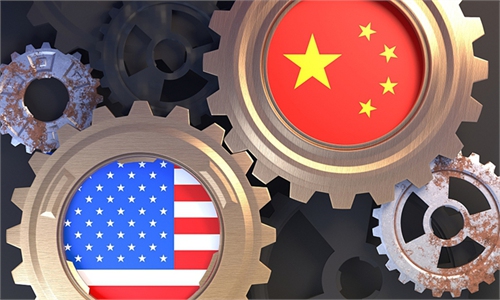
The Associated Press placed the speech in the broader context of contrasting Chinese and US approaches to trade, noting China's pledges to lower tariffs, expand market access and reform regulations against the backdrop of Washington's trade and technology restrictions. Meanwhile, the South China Morning Post highlighted the proposal for a global association of bay areas, reporting that closer links between major coastal innovation hubs could create new opportunities for economic exchanges, including between China and the US.
Xi identified four priorities for shared prosperity: upholding peace and stability, building bridges of opening-up and cooperation, boosting innovation to drive growth, and expanding ways for mutual benefits and win-win outcomes. He emphasized that "there can be no prosperity without security, and no security without stability."
Chen Hong, director of the Institute of Country and Region Studies at the School of Foreign Languages, East China Normal University, told the Global Times on Thursday that placing stability first sends a clear message that peace is not an additional condition for economic development but its indispensable foundation. "The Asia-Pacific economic miracle was not created through military alliances or geopolitical confrontation, but through a peaceful environment, open markets and industrial complementarity," Chen said.
He warned that the politicization of economic issues and tightening US restrictions on advanced AI chips could disrupt regional industrial cooperation, including the development of AI industries in Southeast Asia.
Against this backdrop, Xi's emphasis on safeguarding the WTO-centered, rules-based multilateral trading system and steadily advancing the FTAAP carries particular significance. The speech also called for stronger cooperation in digital transformation of trade, cross-border e-commerce, smart customs and industrial supply chains.
Liang Haiming, president of the Belt and Road Research Institute at Hainan University and head of the Silk Road iValley Research Institute, said the central significance lies in using predictable rules to counter the uncertainty generated by protectionism.
"What businesses fear is not merely high tariffs, but also policy reversals, inconsistent standards and disrupted supply chains," Liang told the Global Times on Thursday.
He identified complicated rules of origin, inconsistent cross-border data requirements, insufficient mutual recognition of electronic documents and duplicated product certification as obstacles to regional integration, arguing that digital trade and smart customs cooperation could reduce costs, particularly for smaller businesses.
China's commitment to deeper opening-up adds another dimension. Xi pledged reform in challenging areas, such as rules, regulation and standards, in order to fully ensure market access and an accommodating operating environment in the manufacturing sector, to steadily expand opening up in the service sector, and to foster a more stable and more predictable first-class environment for companies from around the world to invest and do business in China.
Liang said the emphasis signals a transition from facilitating the movement of goods and production factors toward deeper institutional opening-up, helping foreign companies move beyond simply entering the Chinese market to operating effectively and making long-term investments.
Innovation is also highlighted in the speech. Xi noted that from factory and farm robots, to autonomous driving and drone delivery, China is a super-sized innovation testing ground where frontier technologies are tested, improved and upgraded in real-world scenarios, and are then turned into high-quality growth drivers.
Liang said the significance extends beyond China's market size to its diverse application scenarios, comprehensive industrial ecosystem and rapid market feedback, which can help emerging technologies progress from prototypes to commercial products and large-scale deployment.
"China offers not merely a market for innovation, but also the conditions for joint innovation," Liang said, noting that international partners could participate in collaborative research, product adaptation and the joint exploration of new markets.
The proposed World Association for Bay Areas Economic Cooperation in Xi's speech could provide an additional channel for such collaboration.
Liang noted that the Guangdong-Hong Kong-Macao Greater Bay Area offers strengths in manufacturing, industrial applications and financial services. For instance, the San Francisco Bay Area excels in frontier research and venture capital, and the Tokyo Bay Area has advantages in precision manufacturing and industrial materials. Cooperation in green shipping, health technologies and energy-saving solutions could potentially connect these complementary strengths through joint research, technology testing and investment partnerships, subject to applicable regulations, he noted.
"The association should not merely become a 'circle of friends' among bay areas, but a 'network of cooperation projects,'" Liang said, emphasizing the importance of regular engagement and commercially viable partnerships.
The APEC CEO Summit Shenzhen Initiative 2026, released Wednesday, further raises the question of how regional cooperation can move from shared principles to measurable outcomes. The initiative identifies openness, innovation, connectivity and mutually beneficial cooperation as priorities for the regional business community.
Liang suggested establishing supporting arrangements covering project lists, responsible entities, implementation milestones and evaluation indicators. Given APEC's voluntary cooperation framework, he said mature projects could be piloted first, with successful practices gradually expanded.
For Chen, the broader significance lies in preserving space for cooperation among economies with different development levels and political interests.
"Stability is the prerequisite, openness the pathway, innovation the driving force, and shared prosperity the ultimate goal," Chen said.
RELATED ARTICLES