GT on the spot: Qingzhou mine countermeasures ship opens to public for first time at anniversary event, showcasing PLA Navy’s low-profile but vital force
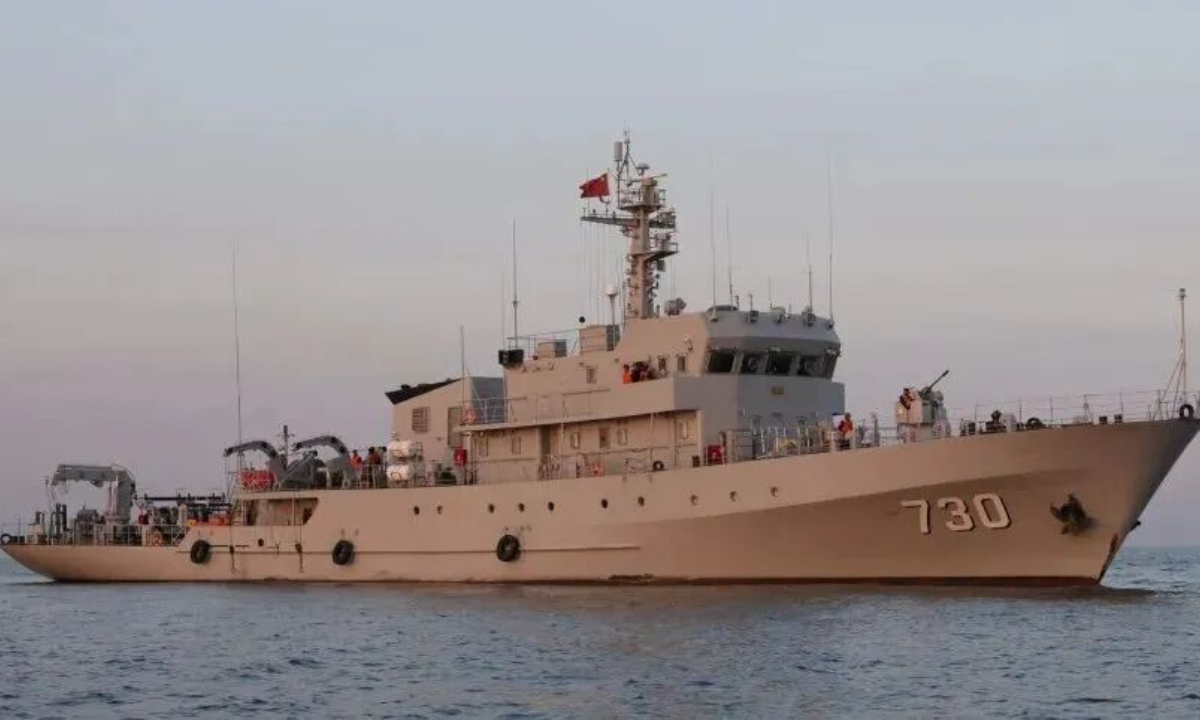
A file photo of the PLA Navy Type 081 mine countermeasures ship, the Qingzhou Photo: Screenshot from the official WeChat account of the CCTV News
Marking the 77th anniversary of the People’s Liberation Army (PLA) Navy on Thursday, the PLA Navy held open-ship events in more than a dozen cities nationwide, with over 40 active-duty vessels opened to the public. Several of them were opened to the public for the first time. Among them, the Type 081 mine countermeasures ship, the Qingzhou, which made its debut in Dalian, Northeast China's Liaoning Province, drew particular attention. Unlike aircraft carriers or large destroyers, mine countermeasures ships rarely appear in the public eye. Curious to learn more, the Global Times reporter stepped aboard the Qingzhou to explore the spirit behind this warship.
Moored in the naval harbor and dwarfed by nearby destroyers and frigates of several thousand tons, the Qingzhou appeared almost “compact.” With a full-load displacement of under 1,000 tons and a hull measuring only a few dozen meters, it lacks the imposing presence of larger vessels, yet exudes the quiet resilience of a “combat engineer at sea.”
“We are essentially a team of maritime engineers,” said Hong Jinyu, an officer aboard the ship. Naval mines — low-cost, easy to deploy, and difficult to clear — remain a critical threat in modern naval warfare, and mine countermeasures ships exist specifically to counter them.
“In wartime, we clear safe passages through mined waters for core combat ships such as aircraft carriers and large destroyers. After conflicts, we are responsible for thoroughly removing enemy mines. Just as landmine clearance protects civilians on land, mine countermeasures at sea ensure safe navigation and operations,” Hong said.
Unlike other combat vessels, the Qingzhou’s stern features neither a flight deck nor missile launchers. Instead, it resembles a floating workshop, equipped with deck cranes and multiple mooring posts used to deploy and retrieve mine countermeasure equipment.
On board, Hong demonstrated the ship’s specialized tools with ease, explaining how different systems work — some use magnetic or acoustic signals to trigger mines, while others employ underwater cables to cut the mooring lines of anchored mines. The ship’s forward deck is fitted with a manually operated naval gun, capable of engaging close-range targets, conducting patrol, fishery protection, and escort missions, and even destroying floating mines.
“Small, rolling, and cramped” are defining characteristics of a mine countermeasures ship. Compared with the spacious corridors of larger destroyers and frigates, the Qingzhou’s interior passageways are narrow, two people must turn sideways to pass each other, and living quarters are correspondingly compact.
In addition, with a displacement of only a few hundred tons, mine countermeasures ships are less stable in rough seas. “In strong winds and waves, the ship can roll more than 30 degrees. It’s extremely rough, and seasickness is common,” Hong said. During voyages, compartments are sealed with limited ventilation, further increasing the challenges faced by the crew during deployments.
The reporter also sensed Hong’s strong professional dedication and passion for mine countermeasure operations. He closely follows developments in both domestic and international mine-clearing technologies, noting trends toward unmanned and intelligent systems.
“For a long time to come, mine countermeasures ships will remain an important component of the PLA Navy,” Hong told the Global Times. “We will continue to adapt to evolving operational models as technology advances.”
RELATED ARTICLES