PLA announces vessel formation transit of Yokoate Waterway for Western Pacific training; move serves as deterrent to hostile forces: Chinese expert
By Liang Rui, and Guo Yuandan Published: Apr 19, 2026 10:45 PM

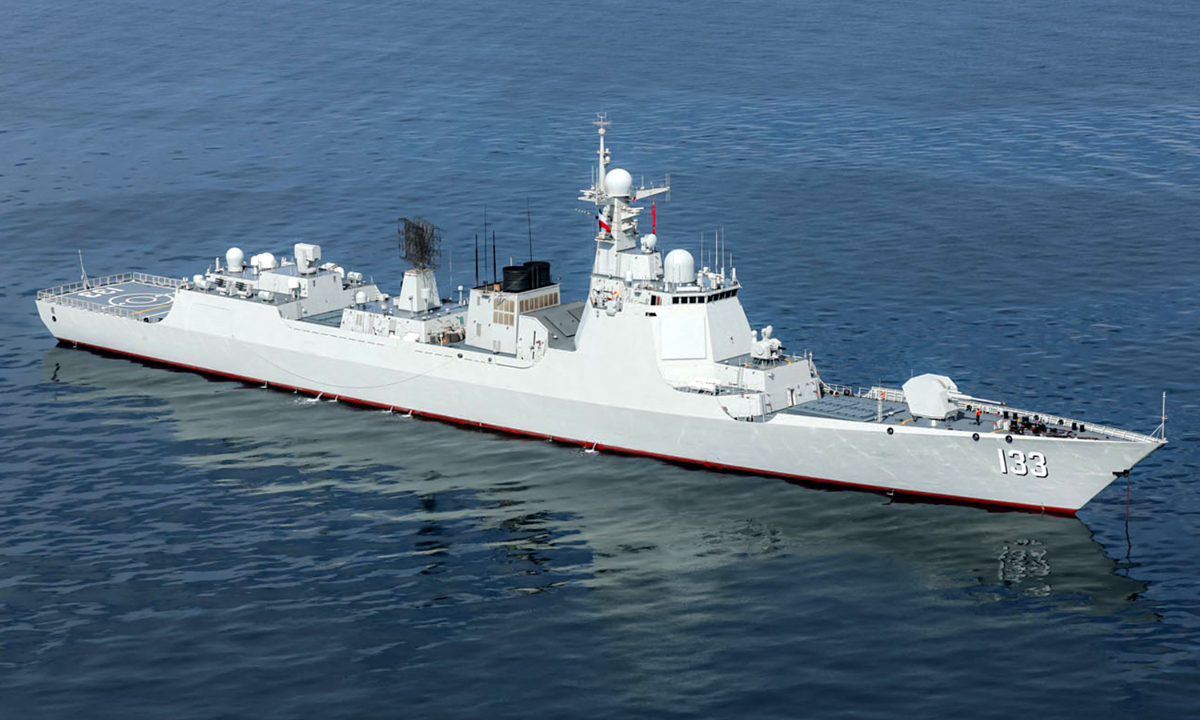
A file photo of the PLA Navy warship 133, the Baotou, an improved variant of the Type 052D destroyer Photo: VCG
Following the People's Liberation Army (PLA) Eastern Theater Command’s joint combat readiness patrol in the East China Sea on Saturday, the Command said on Sunday that it had organized vessel formation 133 to transit the Yokoate Waterway and conduct routine training exercises in the Western Pacific.
A Chinese military affairs expert told the Global Times on Sunday that while this is a regular training activity, it showcases the PLA Navy’s strong maritime combat capabilities. Timed right after a Japanese destroyer’s transit of the Taiwan Straits on Friday, the operation also serves as a clear deterrent to hostile forces with ill intentions, demonstrating China’s firm resolve to safeguard national sovereignty and maritime rights and interests, the expert said.
On Sunday, the PLA Eastern Theater Command dispatched vessel formation 133 to transit Yokoate Waterway and conduct training in the Western Pacific, in order to test the far-seas operations capabilities of forces. This is a routine training organized in accordance with the annual plan. It complies with international law and practice, and does not target any specific country or entity, said Senior Colonel Xu Chenghua, spokesperson of the PLA Eastern Theater Command, in a statement on Sunday.
Zhang Junshe, Chinese military affairs expert, told the Global Times on Sunday that the Yokoate Waterway lies between Japan’s Amami Oshima and Yokoate Island. In addition to the territorial seas around the islands, the waterway includes non-territorial sea areas. According to relevant international law, ships and aircraft of all countries enjoy the freedom of navigation and overflight in these non-territorial waters and the airspace above them.
The PLA Navy warship 133, the Baotou, is an improved variant of the Type 052D destroyer. The Type 052D is the PLA Navy’s mainstay guided-missile destroyer, excelling in air defense, anti-ship, and anti-submarine warfare. It is widely regarded as a “dagger escort” of aircraft carriers and a fully equipped versatile multi-role warship, according to the CCTV News.
It is a relatively new vessel, and this operation is part of routine training, Zhang said. Such actions demonstrate the PLA Navy’s strong maritime combat capabilities and its firm resolve to safeguard national sovereignty and maritime rights and interests. For countries with ill intentions, it undoubtedly delivers a certain deterrent effect.
The PLA warship formation’s Yokoate Waterway on Sunday came after Xu said on Saturday that the PLA Eastern Theater Command dispatched naval and air assets to conduct joint readiness patrols in relevant waters and airspace of the East China Sea. This was a routine arrangement organized in accordance with the annual plan, aiming at testing the joint operations capabilities. The troops of the Theater Command will routinely organize relevant military operations based on the need of the security situation, and safeguard state sovereignty and security as well as regional peace and stability.
This follows the Japanese Self-Defense Force destroyer JS Ikazuchi transiting the Taiwan Straits on Friday, to which both the Chinese Ministry of National Defense and the Ministry of Foreign Affairs responded strongly.
Zhang said that the purpose of the Eastern Theater Command’s joint combat readiness patrol announced on Saturday is also clear: when national sovereignty and security as well as territorial integrity face serious provocation, the PLA will demonstrate its stance through military actions, clearly stating the bottom line and drawing red lines.
"The Eastern Theater Command’s countermeasures are not directed at normal navigation, but at Japan’s deliberate provocative actions that threaten China’s sovereignty and security and send wrong signals to 'Taiwan independence' separatist forces," Zhang further analyzed.
The Eastern Theater Command’s measures constitute the lawful exercise of jurisdiction and the right of self-defense. The Taiwan Straits is not high seas or so-called "international waters." Under the United Nations Convention on the Law of the Sea and China’s domestic laws, the Taiwan Straits includes China’s internal waters, territorial sea, contiguous zone, and exclusive economic zone. China enjoys sovereign rights and jurisdiction over the straits while respecting the legitimate rights of other countries in relevant waters, Zhang said.
On April 17, 1895, the Qing government was forced to sign the unequal Treaty of Shimonoseki. The expert noted that, 131 years later on the same date, Japan’s dispatch of a warship through the Taiwan Straits was by no means a coincidence, exposing the dangerous intentions of some in Japan to potentially intervene militarily in the situation. China has the right to track, warn, and even expel such provocative actions.
According to the Eastern Theater Command, the Japanese destroyer JS Ikazuchi transited the Taiwan Straits from 4:02 am to 5:50 pm on Friday.
Zhang said that Japan deliberately chose the early morning hours to send the warship into the Taiwan Straits to avoid attention, which also reveals its probing intent. The Eastern Theater Command’s precise recording of the Japanese warship’s transit times clearly sends a signal to Japan that the Eastern Theater Command conducted full tracking and effective regulation of the Japanese warship transiting the Taiwan Straits. After entering the straits, the vessel’s movements remained completely under China’s tight monitoring and were overall in a controlled state. Relying on a land-sea-air integrated firepower system, Theater Command forces can exercise effective control over it. Should Japan take provocative actions, the troops will respond resolutely and, as appropriate, impose lawful punishment.
Judging from the timing, the Eastern Theater Command launched the joint combat readiness patrol the day after Japan’s provocation, demonstrating a high state of alert, rapid emergency response capability, and effective control over the Taiwan Straits. "The PLA has sufficient capability to respond quickly to any provocative actions and seize the initiative on site," Zhang said.
The expert added that the Eastern Theater Command’s action also aims to curb Japan’s gradual probing and provocations, issuing a warning to Japanese right-wing forces. Japan has previously transited the Taiwan Straits on three occasions: September 2024, February 2025, and June 2025. It has gradually shifted from sailing with allied vessels to acting alone - a typical pattern of incremental testing and escalating pressure.
"Japan is currently pushing for constitutional revision and military expansion, accelerating its 'remilitarization.' Its erroneous remarks on the Taiwan question and warship transits through the Taiwan Straits aim to gradually break through post-war constraints and re-establish a military presence in the Taiwan Straits, potentially enabling military intervention in the Taiwan question," Zhang emphasized. China will make no concessions on this matter. The Eastern Theater Command’s strong countermeasures serve as a strategic warning to Japanese right-wing forces: China will never allow history to repeat itself and will leave no strategic ambiguity for any "military intervention in the Taiwan Straits."
RELATED ARTICLES