IN-DEPTH / IN-DEPTH
Smart assistive tools and thoughtful emotional care brighten the lives of disabled elders in rural communities
Care reaches home
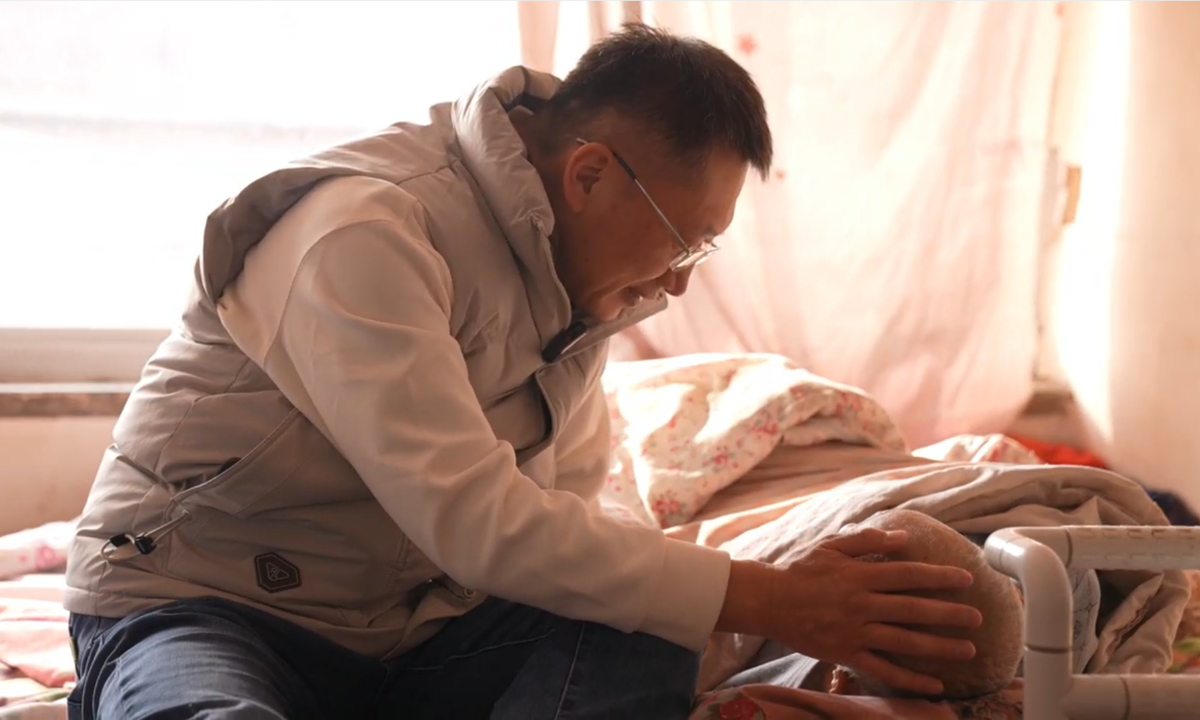
A hospice care specialist speaks to Fang Cai in Fengning, North China’s Hebei Province, on November 12, 2025. Photo: Courtesy of the China Foundation for Human Rights Development
Editor's Note:
China's human rights stories are unfolding in a new era of comprehensive deepening reform and historic changes. It is a key component of China's poverty alleviation and whole-process people's democracy, a thorough reformation in judicial, medical insurance, and other key sectors related to the national economy and people's livelihoods, as well as a combination of numerous impressive and inspiring individual stories.
To be nurtured in youth, educated, secure gainful employment, receive medical care when ill, cared for in old age, have a place to live, and supported when weak... these are the concrete embodiments of human rights, demonstrating that the greatest human right is the right to the happiness of the people.
For a long time, politicians and media outlets in a handful of countries have remained hostile and prejudicial toward China, leading to a lack of understanding among foreign audiences when it comes to the concepts and achievements of China's human rights development. But what is revealed in the daily lives of the Chinese people speaks to the most basic truth: Rights to survival and development are fundamental human rights.
The Global Times is launching a series of articles, telling vivid stories about upholding human rights in the new era. We expect the series to become a window through which more foreign readers will understand how Chinese people recognize human rights and what efforts they have made to fight for and fully enjoy human rights in their daily lives.
The minibus set off from the township and traveled for more than an hour along the main road before winding its way down a narrow dirt track, finally arriving at a village under the administration of Fengning county in North China’s Hebei Province.
On December 8, the Global Times accompanied a team from the China Foundation for Human Rights Development (CFHRD) to deliver a customized smart bed frame to Wang Yunxiang, a 69-year-old senior living with severe disabilities.
“You can use this remote control to adjust the bed frame. It will help you turn him over and move his limbs more easily... It doesn’t matter if you can’t read, the buttons are marked with symbols,” a CFHRD staff member explained patiently to Wang’s wife, who has been caring for him alone for many years. She listened attentively, committing every detail to memory.
In recent years, China has made sustained efforts to address the care challenges faced by senior citizens living with disabilities in rural areas.
The Recommendations of the Central Committee of the Communist Party of China for Formulating the 15th Five-Year Plan for National Economic and Social Development calls for the roll out of insurance schemes for long-term care, improvement of the care system for seniors who are functionally impaired, and expansion of rehabilitation services and hospice care, according to the Xinhua News Agency.
Aligned with these policy directions, the CFHRD launched a care program, focusing on senior citizens living with severe or partial disabilities who remain at home in rural areas. Through targeted financial and material assistance, localized volunteer cultivation, professional empowerment in rehabilitation and caregiving, and the establishment of sustainable mechanisms, the program aims to tangibly improve the quality of life of beneficiary senior citizens and translate the protection of senior rights into concrete action.
Since research for the program began in June 2025, pilot efforts – primarily in Fengning – have gradually shaped a more mature assistance model, alongside longer-term planning.
Highlighting care challenges
“Don’t be afraid. Let us help you turn over so I can check how the pressure sores on your lower back are doing...” After the examination, Zhou Zengding, associate chief physician at Ruijin Hospital affiliated with Shanghai Jiao Tong University School of Medicine, confirmed that all of Wang’s pressure sores had healed.
As a key recipient of assistance, Wang has suffered from cerebellar atrophy for six to seven years. In his early fifties, he contracted hepatitis B and has required long-term medication. About a year ago, a fall fractured his hip, leaving him paralyzed. He has a second-degree physical disability, impaired consciousness, and is unable to communicate normally.
During a visit in early October, the program team not only delivered daily necessities such as adult diapers and milk powder, but also brought triangular cushions designed to relieve pressure sores. Rehabilitation specialists from top-tier hospitals accompanied the team to provide in-home guidance.
“These cushions and methods are really useful,” Wang’s wife said. Wang’s bedding was spotless, clear evidence of the meticulous care she provides.
Such situations are far from isolated in villages in Fengning.
According to the CFHRD, China’s efforts to support senior citizen living with severe or partial disabilities in rural areas have made notable progress in policy support, infrastructure development, and basic service provision. Policy coverage has expanded, centralized care service systems have gradually improved, and, basically, care is now provided to all individuals living with severe or partial disability who are willing to receive centralized care.
However, due to objective constraints such as vast rural areas, dispersed populations, and relatively low overall levels of economic development, many seniors living with severe or partial disabilities still choose – or are compelled – to remain at home, facing greater challenges.
In one household visited, a “family doctor contract service card” was posted prominently on the living room wall, with the phone number of the township’s contracted doctor clearly visible. Yet the Global Times learned from the CFHRD that, due to long travel distances, villagers interact far more frequently with village doctors.
The Global Times saw nearly or already expired medications piled on tables or scattered on the floor in some households. “Many families previously paid little attention to expiration dates and had no formal prescriptions – they relied on instinct and experience to buy medicine,” Zhu Zhiying, a CFHRD staff member, told the Global Times.
Nearly all senior citizens assisted by the CFHRD are recipients of subsistence allowances. “Yet when we visit them, they rarely bring up financial needs proactively. What they want most is someone to talk to – emotional support,” Zhu said.
As the program team has gained deeper insight into the challenges confronting rural eldercare, it has continuously adjusted its approach, bringing high-quality medical expertise directly to patients’ bedsides.
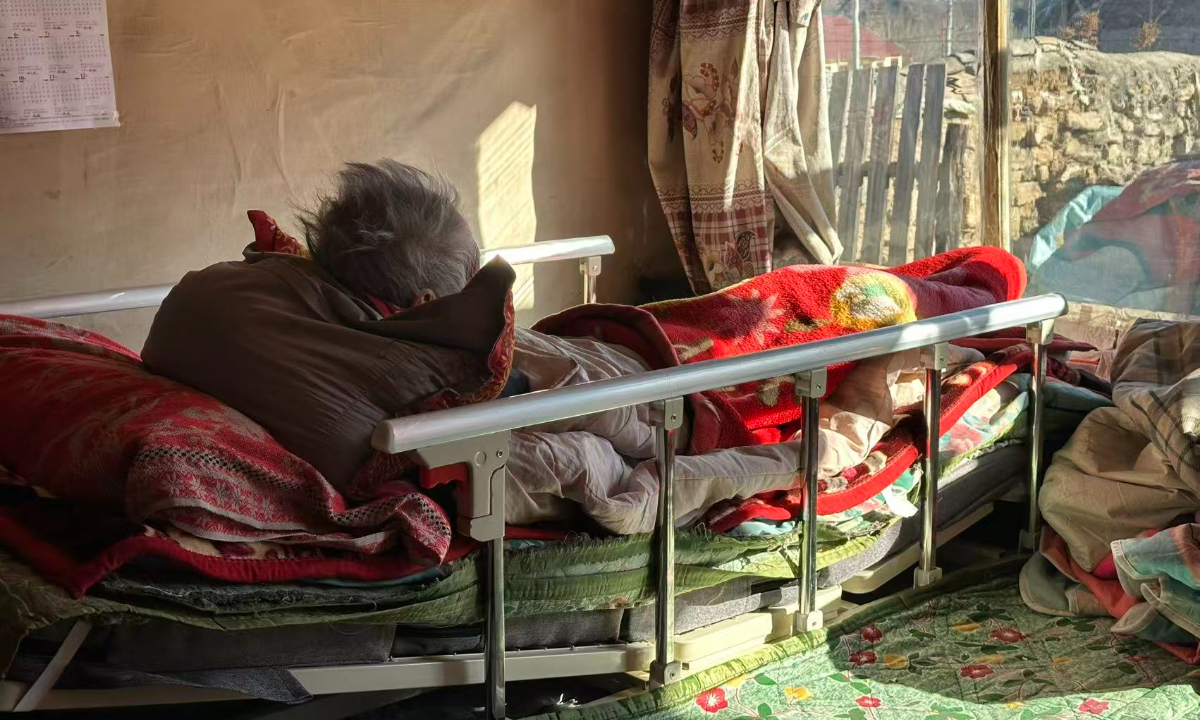
Wu Fenglan lies on a smart bed frame in Fengning, Hebei, on December 8, 2025. Photo: Liang Rui/GT
A path toward professionalization
Beyond material upgrades like the newly introduced smart bed frame designed for easier caregiving, each visit now includes specialists who conduct door-to-door examinations, carefully assessing limb function and health indicators. They provide tailored, household-specific guidance on professional caregiving techniques and proper use of assistive devices, while comprehensively documenting disability details and caregiving challenges to build a solid data foundation for customized follow-up support.
During this visit, medical experts examined dozens of elderly patients suffering from pressure sores and were pleased to observe a shared improvement: In many cases, open wounds had progressed to scabbing, indicating gradual recovery.
For caregivers like Wang’s wife, who experience emotional strain, the CFHRD previously provided psychological counseling and, at times, respite care through nursing volunteers. During this visit, Wang’s wife appeared to be in better spirits than earlier records indicated.
Beyond one-on-one guidance and companionship, strengthening grassroots medical capacity is essential for embedding support sustainably in rural areas.
On December 7, approximately 40 to 50 medical personnel participated in a training session at a hospital in Fengning, organized by the local health authority. Two experts shared specialized diagnostic and treatment experience from both Western and traditional Chinese medicine perspectives, while a nursing specialist demonstrated wound dressing techniques on site.
Through the training, Wu Chunxue, an attending physician at the Fengning hospital of traditional Chinese medicine, learned about additional external treatment methods. “In practice, elderly patients inevitably experience minor burns, and the most common issue we encounter is stage II pressure sores. Today’s training helped me understand the different presentations of stage II pressure sores and their corresponding treatments. This will enable us to better address such problems in our work and alleviate patients’ suffering,” she said.
Meanwhile, since November 2025, specialized hospice volunteer services and related training have been formally incorporated into the program. On one hand, these services provide professional psychological comfort to seniors in the final stage of life, easing physical and emotional suffering; on the other, they offer care and support to family members, helping them find solace in remembrance and reducing regret and grief.
An expanding circle of warmth
This care program can be seen as a microcosm of China’s broader efforts to provide targeted support for rural seniors living with moderate or severe disabilities.
After sustained development during the 13th and 14th Five-Year Plan periods, each county now has at least one county-level facility primarily serving people with disabilities. By the end of 2023, 180 million people had been enrolled in long-term care insurance, with 2.36 million individuals living with disabilities having received related benefits, according to a State Council report in September 2024 on the website of the National People's Congress of China.
Since July 2025, seven regions including East China’s Zhejiang Province, East China’s Shandong Province, and Southwest China’s Chongqing Municipality have launched pilot programs providing eldercare consumption subsidies to seniors with moderate to severe disabilities. Based on pilot outcomes, the Ministry of Civil Affairs and Ministry of Finance jointly plan to roll out the program nationwide by the end of 2025, Outlook Weekly reported.
Meanwhile, the CFHRD’s efforts continue to expand. Its work is extending beyond Fengning to other parts of the country.
In late October 2025, the project partnered with a local hospital in Hinggan League, North China's Inner Mongolia Autonomous Region. Leveraging the hospital’s experience in integrated medical and eldercare services, the project is accumulating practical experience for future expansion.
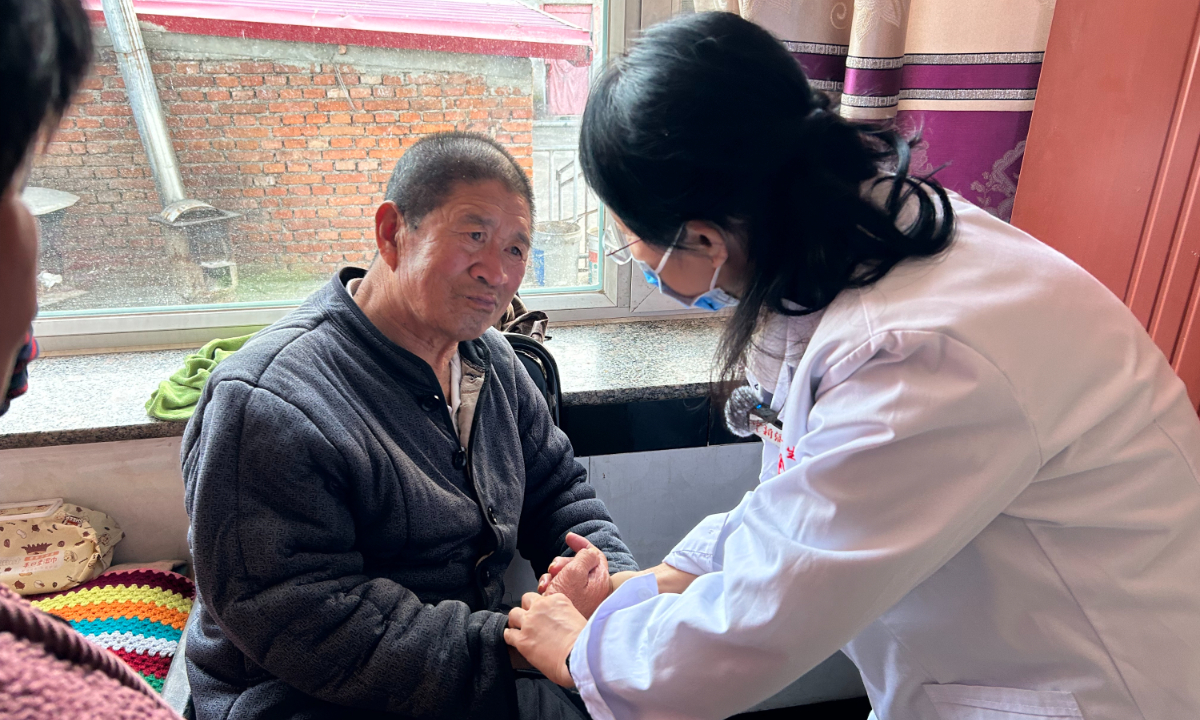
A medical expert expresses care and concern for Duan Shuqin, a senior living with severe disabilities, in Fengning, Hebei, on December 7, 2025. Photo: Liang Rui/GT
In Fengning, beyond government support, the team has received substantial help from local volunteers, an essential driving force behind the program’s smooth implementation.
“Our idea is to establish a volunteer base in the township to provide more systematic training and planning, so that goodwill can be translated into tangible support more effectively,” an operation staffer of the program told the Global Times.
She added that by the end of 2026, the team hopes to bring a more mature system to other regions and launch a second pilot as detailed and concrete as the one in Fengning.
One of the most encouraging moments of the visit was when 87-year-old Fang Cai, who had previously received hospice care from visiting experts and had been bedridden for a year, unexpectedly showed signs of improvement.
Unable to speak, he nevertheless struggled to open his mouth, responding with faint “ah, ah” sounds to each expression of concern from the doctor. A glimmer of light shone in his eyes.
“It is precisely these small sparks of hope that drive us forward,” the staff said. “These seniors cannot wait for us to figure everything out before taking action. We can only keep doing more, and trusting that we will eventually find a model that truly works.”
RELATED ARTICLES