USS Gerald R. Ford exposed by US media plagued by toilet issue en route to Iran; extended deployment, design issues hinder capability: Chinese expert
By and Liang Rui Published: Feb 25, 2026 12:41 PM

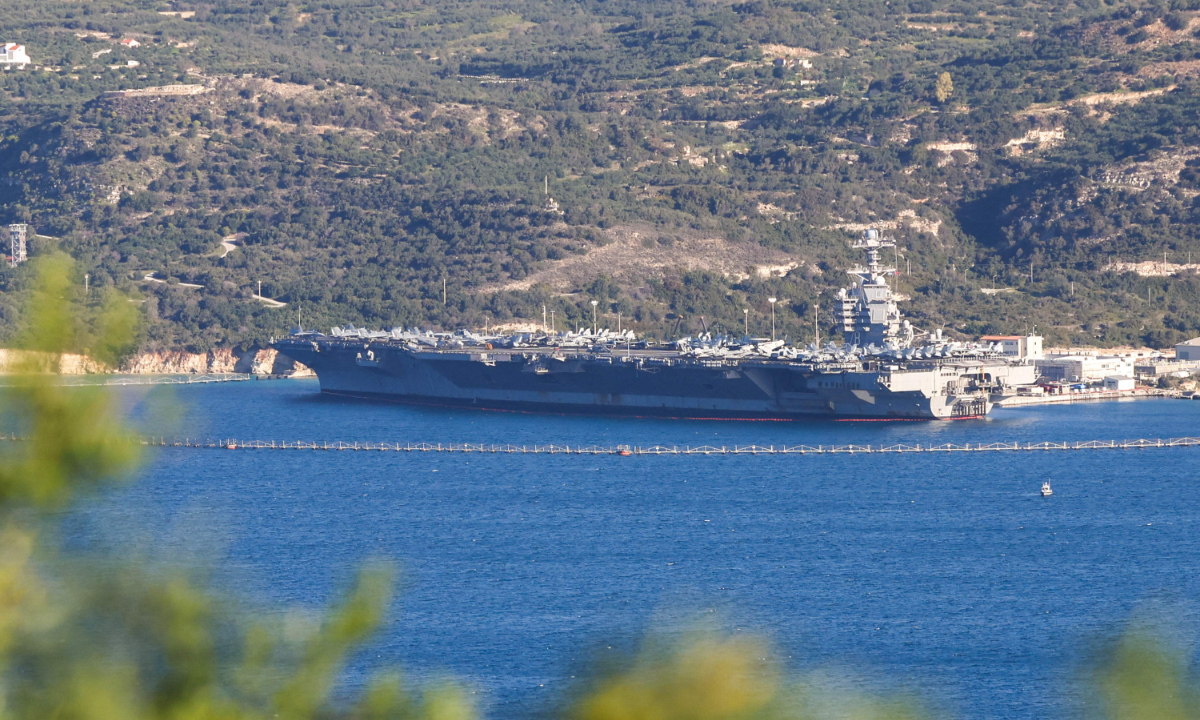
US aircraft carrier USS Gerald Ford is pictured docked at Souda Bay in the Greek Mediterranean island of Crete, on February 24, 2026. Photo: VCG
As the US is sending the aircraft carrier USS Gerald R. Ford to support potential military strike against Iran, media reports suggested that the extended eight-month deployment and blocked toilets are causing issues to the warship and its sailors, with the vessel making a stop in Greece earlier this week. A Chinese military affairs expert said on Wednesday that it exposes that extended deployments beyond scheduled limits, combined with crew members' failure to use the toilet system in accordance with operating procedures, have seriously undermined combat effectiveness.
The US side's decision to extend for a second time the deployment of the aircraft carrier USS Gerald R. Ford is taking a toll on the ship's sailors and their families, and leading some to consider leaving the Navy when they return to home port, the WSJ reported on Saturday, citing interviews with sailors on board the ship and their family members back home.
A US Navy official said that the Ford's sewage system, which uses vacuum technology to transport waste from roughly 650 toilets on board, has experienced issues during the deployment, averaging about one maintenance call a day, the WSJ reported.
According to the WSJ report, the Ford has been at sea since last June. In October, the Pentagon rerouted the ship from its scheduled Mediterranean mission to the Caribbean to support missions including the operation to forcibly seize Venezuelan President Nicolas Maduro in early January. Then the crew got word that their deployment would be extended again, taking them back across the Atlantic Ocean to the Middle East to support potential American airstrikes on Iran.
Citing a retired rear admiral, the WSJ noted that US carrier deployments during peacetime are typically six months long, with planners allowing for a few months of potential overrun if needed. But the Ford's sailors have been away from home for eight months already, setting up a possible deployment of 11 months. That would break the record for a continuous deployment by a US Navy ship.
An earlier report by NPR on January 17 already exposed the toilet problem. According to the report, the vacuum sewage system of the Ford means that a problem with one head can cause all of the toilets in that part of the ship to lose suction, making it difficult for the maintenance crews to isolate a problem. The crews find everything from T-shirts to a four-foot piece of rope clogging the system. But the most common problem seems to be a part of the back of the toilet that comes loose.
The Ford transited the Strait of Gibraltar on Friday, heading east, the WSJ reported, citing a satellite photo. But then, instead of sailing directly toward waters near Iran, the Ford arrived at Souda Bay on the island of Crete, Greece, according to a report by Reuters.
It might be regarded as a forced stop for recuperation, Wang Yunfei, a Chinese military affairs expert, told the Global Times on Wednesday. On the one hand, the Greek bay provides facilities for repairs; on the other, some temporary toilets can be installed onboard to ease immediate pressure.
This incident can be seen as the result of multiple overlapping factors, the expert said.
According to Wang, prolonged deployment at sea undermines crew morale and mental well-being, thereby weakening combat effectiveness. Moreover, malfunctions in the Ford's toilet system itself further amplified the problem. Crew members throwing objects into the toilets also exposes lax discipline within the ranks.
Wang explained that vacuum sewage systems are in fact an advanced technology and are widely used on most commercial vessels today. However, they depend on strict compliance with operating regulations by crew members.
When personnel are subjected to prolonged, high-intensity readiness tasks, their mental state inevitably changes, making it difficult to maintain strict discipline over an extended period, Wang said.
The Ford's forced over-extension beyond its scheduled deployment also exposes the strain on the US's actually deployable aircraft carriers, underscoring the gap between its global hegemonic ambitions and its practical capacity, Wang added.
RELATED ARTICLES