Two new types of Chinese anti-drone laser weapons revealed in official media report; expert sees China's laser-based counter-drone technologies at global forefront
By Liang Rui and Published: Mar 26, 2026 12:08 AM

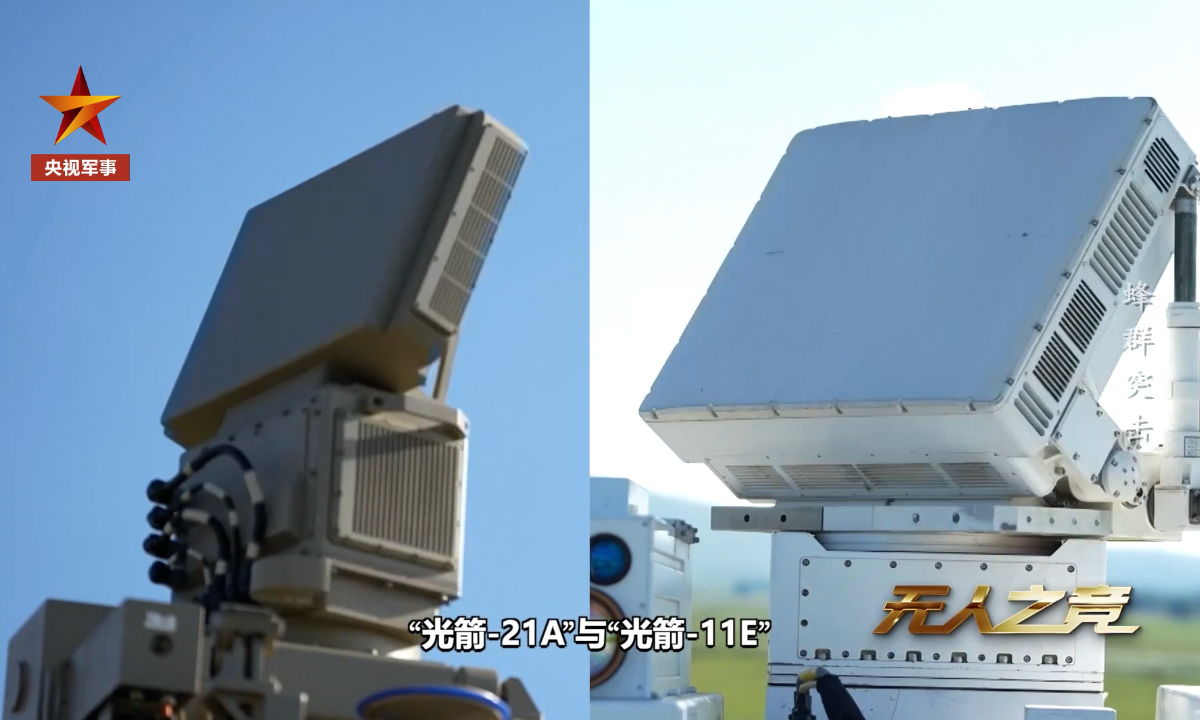
Radar systems of the “Guangjian-11E” multi-mode terminal jamming system (left) and the “Guangjian-21A” vehicle-mounted laser counter-drone system Photo: Screenshot from the military channel of CCTV News
A report by official Chinese media on Wednesday unveiled two new types of anti-drone laser weapons. A developer said such laser weapon systems, supported by intelligent targeting and multi-sensor integration, demonstrate strong responsiveness and adaptability, while enabling coordinated operations within an integrated combat network.
Footage released in the CCTV News report showed how the systems countered low-altitude, slow-flying small drones simulating covert penetration on the battlefield, flying at an altitude of 50 to 80 meters, which is within the blind spot of conventional radar systems.
More advanced threats such as fiber-optic drones, capable of transmitting real-time data and video through physical links and thus resistant to electronic interference, pose additional challenges and often require physical destruction, according to the CCTV News report.
In response to such threats, multiple counter-drone systems were featured. A container-like platform identified as the “Guangjian-11E,” or Light Arrow-11E, multi-mode terminal jamming system can rapidly lock onto targets and disrupt their onboard sensing and targeting functions, the report said.
The “Guangjian-21A”, or Light Arrow-21A, system, meanwhile, operates in a “shoot-on-the-move” mode, allowing it to maintain sustained firepower while reducing exposure to counterattacks, reported CCTV News.
In terms of engagement methods, the “Guangjian-21A” specializes in “hard-kill” capabilities, generating high-density energy beams over several kilometers to penetrate drone structures and destroy internal circuits or propulsion systems within seconds. By contrast, the “Guangjian-11E” employs a soft-kill approach, using pulsed laser energy to precisely disable key components, effectively blinding drones and disrupting their reconnaissance and data transmission functions, reported CCTV News.
These complementary “soft” and “hard” kill methods address targets at different ranges and threat levels, filling gaps in each other’s operational coverage, CCTV News said.
Both systems are equipped with phased-array radar and infrared detection systems, and can interconnect via both wired and wireless links to enable real-time data sharing and precise target identification and engagement, according to the CCTV News report.
The laser systems, as next-generation equipment, feature multi-source detection and intelligent identification, enabling rapid response and adaptive targeting. Integrated into a broader combat system, the platforms can coordinate “soft” and “hard” kill methods and link with radar and electro-optical sensors to form a rapid “detect-to-destroy” chain, Zhou Shuiliang from the Aviation Industry Corporation of China was quoted by the CCTV as saying.
Previously, multiple types of anti-drone equipment were reviewed in formations at China's V-Day military parade on September 3, 2025 to mark the 80th anniversary of the victory in the Chinese People's War of Resistance Against Japanese Aggression and the World Anti-Fascist War, addressing the importance of anti-drone warfare on the modern battlefield.
Anti-drone missile and artillery systems, high-energy laser weapons, and high-power microwave weapons reviewed at the parade are a powerful "iron triangle" that can both "soft kill" and "hard destroy" unmanned aerial vehicles.
Given the widespread deployment of drones on the battlefield, countries are now prioritizing the development of efficient counter-drone systems and platforms, Wang Yunfei, a Chinese military affairs expert, told the Global Times.
The inclusion of high-energy laser and high-power microwave counter-drone systems in the parade indicates that both have demonstrated strong performance in realistic training, and suggests that China’s laser- and microwave-based counter-drone technologies are at the forefront globally.
Zhang Xuefeng, another Chinese military affairs expert, told the Global Times that high-energy laser weapons can quickly and accurately detect, aim, and track targets. Using high-energy lasers, it only takes a few seconds to shoot a drone down.
"This genre of anti-drone systems has high accuracy, minimal collateral damage, the advantage of unlimited ammunition, and very low operating costs, making it the lowest cost anti-drone equipment in a single deployment," Zhang said.
RELATED ARTICLES