In a post on social media platform X, Pezeshkian expressed sorrow for the death of Khatib, Secretary of the Supreme National Security Council Ali Larijani, who was killed on Tuesday, Defence Minister Aziz Nasirzadeh, who was targeted on Feb. 28, some family members of the officials, accompanying personnel, and multiple members of the military and the Basij forces.
Pezeshkian said the deaths of the Iranian officials and others are "cowardly assassinations."
"I firmly believe that their path will continue with even greater resolve than before," said the Iranian president.
According to the semi-official Mehr news agency, Khatib, 65, had originally been appointed to lead the ministry in 2021 under former President Ebrahim Raisi, and was retained by the incumbent administration. He previously served in the office of Iran's late Supreme Leader Ali Khamenei and headed the judiciary's protection and intelligence center.
In a statement, the IRGC said facilities, including the Samref refinery in Saudi Arabia and the Al-Hosn gas field in the UAE, could become "direct and legitimate targets" and may be struck in the coming hours.
The statement urged residents and personnel in surrounding areas to leave immediately and move to safe locations without delay.
It said that prior warnings had been issued to the leaders of the countries concerned, urging them not to pursue what it described as a "dangerous course of action or risk the well-being of their populations."
Earlier on Wednesday, several Israeli media reported that the Israeli air force has struck Iran's major natural gas facility, located in Bushehr in the south of the country.
Katz said, during a situation assessment with senior military officers, that "Khatib was in charge of the regime's internal assassination and repression system in Iran and of promoting external threats."
"Prime Minister Benjamin Netanyahu and I have authorized the military to thwart any senior Iranian official who is cornered, by intelligence or operation, without the need for further authorization," he added.
Katz also stated that "significant surprises" are expected in the Iran and Lebanon arenas throughout the day, which "will escalate the war we are waging against Iran and Hezbollah in Lebanon," and that "the war has reached its final, decisive phase."
The Israel Defense Forces also confirmed Khatib's death in a separate statement.
In a phone interview with the British daily, Trump again pressed European allies by urging them to join U.S. operations concerning the strait, a key global oil shipping route.
He said Europe was a major beneficiary of navigation through the waterway and should help to make sure that "nothing bad happens there." He also warned that NATO's future would be "very bad" if allies gave "no response" or a "negative response" to Washington's request.
Trump argued that the United States had previously helped Europe on the Ukraine issue and that now it was time to "see if they help us."
Trump noted he had long believed NATO was "a one-way street," meaning that the United States would stand by its allies, but they might not come to Washington's aid when needed.
"I'm demanding that these countries come in and protect their own territory, because it is their own territory," Trump told reporters aboard Air Force One, referring to the strait.
Trump didn't name the countries the White House is negotiating with.
In an interview with The Financial Times on Sunday, Trump said that NATO members should send warships to help open up the Strait of Hormuz or face a "very bad" future.
"If there's no response or if it's a negative response, I think it will be very bad for the future of NATO," he told the British newspaper.
Australia is well-prepared for the "economic crisis" caused by the ongoing conflict in the Middle East and would not be sending a warship to the region, said Minister for Infrastructure, Transport, Regional Development and Local Government Catherine King, also a member of Prime Minister Anthony Albanese's Cabinet, according to the Australian Broadcasting Corporation (ABC) radio.
King said that Australia's fuel stockpile was sitting at 37 days of petrol, 30 days of diesel and 29 days of jet fuel as of Monday after the government reduced minimum stockholding obligations and temporarily amended fuel quality standards to allow higher sulfur levels.
"We're well-prepared here in this country to weather the economic crisis that is occurring as a result of the Middle East," she said.
The federal government on Saturday issued a warning to citizens not to transit through Bahrain, Iran, Iraq, Israel, Kuwait, Lebanon, Palestine, Qatar, Syria, Yemen and the United Arab Emirates (UAE).
During the conversation, Starmer stressed the importance of reopening the strategic waterway to help restore normal shipping routes and ease rising global costs, a statement from 10 Downing Street said.
Both leaders agreed to remain in close contact regarding developments in the region.
British Energy Secretary Ed Miliband said earlier on Sunday that ending the ongoing conflict is the "best and most conclusive way" to reopen the Strait of Hormuz, a strategic chokepoint through which roughly one-fifth of the world's oil passes, warning that the situation is harming the global economy.
"The spike in oil and gas prices that we're seeing is caused by the closure of the Strait," Miliband told British media, adding that Britain wants to work with allies to seek to get the Strait reopened.
The plan, which remains under discussion, could be unveiled "as soon as this week," the report said.
Publicly, many governments have been noncommittal to such an escort mission until hostilities end, given the risks involved, according to the report.
Iran's Supreme Leader Mojtaba Khamenei on Thursday called for the continued closure of the Strait of Hormuz and pledged to open new fronts in his country's conflict with the United States and Israel.
The United States and Israel began military attacks on Iran on Feb. 28, disrupting global shipping, sending oil prices soaring and shaking the global economy.
"We will obtain compensation from the enemy, and if he refuses, we will take as much of his property as we determine, and if that is not possible, we will destroy the same amount of his property," read a post on the supreme leader's Telegram account.
On Feb. 28, Israel and the United States launched joint attacks on Tehran and other Iranian cities, killing Iran's then Supreme Leader Ali Khamenei, senior military commanders, and civilians. Iran responded with waves of missile and drone strikes targeting Israel and U.S. bases and assets across the Middle East.
Mojtaba Khamenei, son of Ali Khamenei, was selected as Iran's new supreme leader, the Assembly of Experts announced on March 8. Mojtaba Khamenei delivered his first public message on Thursday since taking office, outlining Iran's key strategies in its ongoing war with the United States and Israel.
In an interview with CBS News aired Sunday, Araghchi rejected claims that Iran has sought an end to hostilities.
"We never asked for a ceasefire, and we have never asked even for negotiations. We are ready to defend ourselves as long as it takes," said the minister.
He noted that Iran will continue its operations until U.S. President Donald Trump "comes to the point that this is an illegal war with no victory."
"We don't see any reason why we should talk with Americans, because we were talking with them when they decided to attack us, and that was for the second time," Araghchi added.
"Iran wants to make a deal, and I don't want to make it because the terms aren't good enough yet," he said of ending the war with Iran in an interview with NBC News, adding that any terms will have to be "very solid."
Trump, though declining to tell what his terms would be, said that a commitment from Iran to completely abandon any nuclear ambitions would be part of those terms for a ceasefire.
His remarks came two weeks after the United States and Israel started massive attacks on Iran on Feb. 28, which are disrupting global shipping, sending oil prices soaring, and shaking the global economy.
As the strikes entered the third week, they are wreaking increasingly severe havoc on global energy and economic markets.
"U.S. forces successfully struck more than 90 Iranian military targets on Kharg Island, while preserving the oil infrastructure," CENTCOM said in a post on X.
The strike destroyed naval mine storage facilities, missile storage bunkers, and multiple other military sites, the post said.
Kharg Island lies in the Persian Gulf about 25 km off Iran's coast and accounts for about 90 percent of Iran's crude exports.
U.S. President Donald Trump said Friday night on social media that the bombing "totally obliterated" the military targets in Kharg Island, and threatened to target the strategic island's oil infrastructure if shipping through the Strait of Hormuz is disrupted.
"Many Countries, especially those who are affected by Iran's attempted closure of the Hormuz Strait, will be sending War Ships, in conjunction with the United States of America, to keep the Strait open and safe," he wrote in a post on Truth Social.
He added that "the United States will be bombing the hell out of the shoreline, and continually shooting Iranian Boats and Ships out of the water. One way or the other, we will soon get the Hormuz Strait OPEN, SAFE, and FREE!"
The U.S. president told reporters on Friday that his country's Navy will soon start escorting tankers through the strait. "It'll happen soon, very soon," he said.
Iran's new Supreme Leader Mojtaba Khamenei on Thursday called for the continued closure of the Strait of Hormuz, a shipping route carrying one-fifth of oil consumed globally, and pledged to open new fronts in his country's conflict with the United States and Israel.
Alireza Tangsiri, commander of the Islamic Revolutionary Guard Corps (IRGC) Navy, said in a statement that claims by the United States about destroying Iran's navy or providing safe escort for oil tankers were false, Iran's semi-official Tasnim news agency reported.
"The Strait of Hormuz has not been militarily blocked and is merely under control," the statement said.
Iranian Foreign Minister Abbas Araghchi echoed the message, telling U.S. media that the strait remained open for international shipping except for vessels belonging to the United States, Israel, and their allies.
"The Strait of Hormuz is open. It is only closed to the tankers and ships belonging to our enemies, to those who are attacking us and their allies. Others are free to pass," Araghchi said.
Iranian Foreign Minister Abbas Araghchi on Tuesday said that talks with the United States are no longer on Tehran's agenda.
Speaking to U.S. PBS News, Araghchi emphasized that Iran is prepared to continue its missile operations for as long as necessary, signaling a firm stance against immediate negotiations with Washington following U.S. President Donald Trump's claim that the conflict with Iran would end "very soon."
He made the remarks in a post on social media platform X while highlighting Iran's readiness for any U.S. "plot."
Araghchi derided the name "Operation Epic Fury" chosen by the United States for its ongoing anti-Iran attacks by calling it "Operation Epic Mistake," saying nine days into the operation, "oil prices have doubled while all commodities are skyrocketing."
"We know the U.S. is plotting against our oil and nuclear sites in hopes of containing huge inflationary shock," he said, adding, "Iran is fully prepared. And we, too, have many surprises in store."
On Feb. 28, Israel and the United States launched joint attacks on Tehran and several other Iranian cities, killing Iran's Supreme Leader Ali Khamenei, along with senior military commanders and civilians. Iran responded by launching waves of missile and drone strikes targeting Israeli and U.S. bases in the Middle East.
When asked whether the strikes could be over this week at a press conference in Florida, Trump said no.
"But soon. Very soon," he said.
Trump presented what sounded like a contradictory message, declaring that U.S. goals were largely accomplished while supporting U.S. Defense Secretary Pete Hegseth's earlier warning that the battle is only beginning.
"Well, I think you could say both," Trump said. "It's the beginning of building a new country."
The leaders made the remarks via video conference in an emergency meeting called by the European Union regarding current regional developments, with the participation of leaders and officials from the Gulf Cooperation Council (GCC) countries, Jordan, Lebanon, Syria, Türkiye, Iraq, Armenia, and Azerbaijan.
During the conference, Egyptian President Abdel-Fattah al-Sisi stressed the importance of all parties exercising restraint, working to reduce escalation, prioritizing the language of dialogue, and pushing for a diplomatic path, according to a statement from the Egyptian Presidency.
Sisi emphasized that settling crises and conflicts through peaceful means is the correct choice for achieving the desired stability and security. He also affirmed the necessity of an immediate halt to "all attacks" on Arab countries.
Jordanian King Abdullah II underscored the importance of relying on diplomacy and dialogue to curb mounting tensions in the region, according to a Royal Court statement.
Speaking at a press briefing, Defrin also confirmed that a second person was killed earlier on Monday in an Iranian missile attack in Israel, bringing the total death toll from Iranian attacks in the country to 12 civilians, in addition to two soldiers killed in combat with Hezbollah militants in Lebanon.
According to the Israeli Health Ministry, a total of 2,238 people in Israel have been evacuated to hospitals since the beginning of U.S.-Israeli strikes on Iran, with 91 of them still in hospitals.
Defrin said the air force continued its attacks on Monday with strikes in Tehran, Isfahan and southern Iran.
Since the beginning of the U.S.-Israeli attack on Feb. 28, Israeli warplanes have struck six military airports in Iran and targeted the Quds Force's transportation aircraft array, destroying 16 cargo aircraft that, according to Defrin, were used to transport weapons and money to Iran's allies in the region.
"President Trump called President Putin to discuss a number of critically important topics related to current developments in the international situation," Ushakov told the media following the phone conversation.
He said the conversation focused on the Iran conflict and the trilateral negotiations on a Ukraine settlement.
He described the conversation as "businesslike, frank and constructive."
Trump reiterated his interest in seeing the Ukraine conflict end quickly with a ceasefire to achieve a long-term settlement, Ushakov said.
In a post on social media platform X, the ministry said the sounds heard in various parts of the country were the result of air defense systems intercepting missiles and drones.
The message was later reposted by the UAE Ministry of Interior.
He added that the decision would be made jointly with Israeli Prime Minister Benjamin Netanyahu, according to The Times of Israel.
In a statement, the assembly confirmed Mojtaba Khamenei's election as the country's third supreme leader, citing "the decisive vote of the respected representatives" of the assembly.
"In today's extraordinary session, Ayatollah Seyyed Mojtaba Hosseini Khamenei ... is appointed and introduced as the third leader of the sacred system of the Islamic Republic of Iran," the statement said.
Following the announcement, Iran's Islamic Revolutionary Guard Corps (IRGC) immediately pledged allegiance to the new supreme leader, voicing its readiness to follow his instructions.
Mojtaba Khamenei, born in 1969, is the son of Iran's late Supreme Leader Ali Khamenei, who was killed in the joint U.S.-Israeli strikes.
In a statement, the assembly confirmed Mojtaba Khamenei's election as the country's third supreme leader, citing "the decisive vote of the respected representatives" of the assembly.
"In today's extraordinary session, Ayatollah Seyyed Mojtaba Hosseini Khamenei ... is appointed and introduced as the third leader of the sacred system of the Islamic Republic of Iran," the statement said.
Mojtaba Khamenei, born in 1969, is the son of Iran's late Supreme Leader Ali Khamenei, who was killed in the joint U.S.-Israeli strikes.
The United States and Israel launched surprise airstrikes on Tehran and other Iranian cities on Feb. 28, killing Ali Khamenei, along with some of the leader's family members, Iran's senior military commanders and civilians. Iran responded through several waves of missile and drone attacks targeting Israel and U.S. assets across the Middle East.
The appointment comes just days after his predecessor was killed in the exchange of fire triggered by U.S.-Israeli strikes on Iran starting on Feb. 28, according to the statement.
Israeli Defense Minister Israel Katz was briefed on Babayian's killing during a situation assessment with army chief Eyal Zamir and other senior officers.
On Feb. 28, Israel and the United States launched joint attacks on Tehran and several other Iranian cities, killing Iran's Supreme Leader Ali Khamenei, along with several senior military commanders and civilians. Iran later launched multiple waves of missile and drone strikes targeting Israeli and U.S. bases in the Middle East.
On Sunday, Iran's Assembly of Experts has finalized a decision on its new supreme leader, the semi-official Mehr news agency reported.
In a statement published on its official news outlet Sepah News, the IRGC said the missiles used in the attacks belong to its Aerospace Division, adding the infrastructure at the Al-Azraq airbase, which is "the biggest and most active base of the U.S. aggressive fighter jets," was targeted several times.
It noted that the military targets in Tel Aviv and Beersheba were hit by the Kheibar missiles equipped with ultra-heavy warheads.
In another statement earlier in the day, the IRGC said its Ground Force hit with its precision-guided missiles the positions of "separatist groups" near the country's northwestern border as well as a U.S. troops' base in Camp Arifjan in Kuwait.
Meanwhile, the Iranian army said Sunday its air force and navy have launched drone attacks toward targets in the Israeli cities of Haifa and Tel Aviv, as well as U.S. bases and military centers in Camp Arifjan.
The statement added that, in a broad wave of intelligence-led strikes, the Israeli air force on Saturday targeted compounds where the jets were stored.
Detection and defense systems were also struck, it added.
This strike follows the Israeli air force's destruction of 16 aircraft belonging to Iran's elite Quds Force at Tehran's Mehrabad Airport on Friday.
A majority consensus over a successor to the late Iranian Supreme Leader Ayatollah Ali Khamenei has more or less been reached, Ayatollah Mohammadmehdi Mirbaqeri, a member of the Assembly, was quoted as saying.
But some obstacles remain to be addressed regarding the process, he said, adding that the work must be accurate to avoid controversy.
U.S. President Donald Trump said earlier that he must be personally involved in selecting Iran's next leader, the U.S. news website Axios reported Thursday.
On Feb. 28, Israel and the United States launched joint attacks on Tehran and several other Iranian cities, killing Khamenei, as well as many others, including some of the leader's family members, high-ranking military commanders and civilians.
The attack was carried out by the Israeli air force using precise intelligence, it added.
The United States and Israel on Feb. 28 launched what they described as "major combat operations" against Iran. Iran has since retaliated with a series of counterattacks against Israeli and U.S. targets across the region.
In a statement published on its official news outlet Sepah News, the IRGC said the Haifa refinery was hit by Kheibarshekan missiles in response to the attack.
Meanwhile, the National Iranian Oil Refining and Distribution Company said energy infrastructure in the country came under the U.S.-Israeli attacks Saturday night.
A number of oil depots in the provinces of Tehran and Alborz were hit by missiles and caught fire, the company said, adding that firefighting teams are containing the fire.
Tehran came under a new wave of heavy attacks Saturday night, with huge explosions heard in different parts of the Iranian capital.
A rocket barrage struck the US embassy location, triggering its defense systems, with no immediate reports OF casualties or losses, the source told Xinhua on condition of anonymity.
Shortly after the attack, Iraqi Prime Minister Mohammed Shia' al-Sudani, also the commander-in-chief of the Iraqi armed forces, ordered all military and security commanders to pursue those responsible for the "terrorist act of launching projectiles toward the US Embassy" in Baghdad and bring them to justice.
A statement by Sabah al-Numan, spokesperson for Iraq's commander-in-chief, said that targeting diplomatic missions and embassies in Iraq is an act that cannot be justified or accepted under any circumstances, adding that such actions undermine national security and stability.
Decisions related to war and military action remain exclusively within the authority of the state, which alone embodies the national decision, it said.
The Islamic Resistance, the armed wing of Hezbollah, said the projectiles were fired from Lebanese territory toward Israeli targets during the day.
Israeli media reported that rockets continued to be launched from Lebanon toward northern Israeli settlements, with sirens sounding in Kiryat Shmona and Margaliot.
Hezbollah said in separate statements that its fighters targeted radar systems of the Iron Dome air defense system at the Kiryat Eliezer site, described as the main air defense base in the city of Haifa, at 8:00 p.m. local time with a salvo of what it called "precision rockets."
In another statement, the group said it also targeted the Stella Maris base, a strategic facility used for maritime monitoring and surveillance along Israel's northern coast, with a similar rocket barrage at the same time. The group also renewed its warning to residents of Nahariyya and Kiryat Shmona, urging them to evacuate.
Hours earlier, Trump said on Truth Social that "there will be no deal with Iran except unconditional surrender."
"What the president means is that when he, as commander in chief of the U.S. armed forces, determines that Iran no longer poses a threat to the United States of America, and the goals of Operation Epic Fury have been fully realized, then Iran will essentially be in a place of unconditional surrender, whether they say it themselves or not," Leavitt told reporters.
On Thursday, Iranian Foreign Minister Seyed Abbas Araghchi told NBC News that his country is not requesting a ceasefire and does not see any reason to negotiate with Washington.
The United States and Israel launched joint military attacks on Iran on Feb. 28, killing Iran's Supreme Leader Ali Khamenei, multiple senior military commanders and hundreds of civilians. Iran has responded with multiple waves of missile and drone attacks targeting Israel and U.S. assets across the region.
The announcement follows a claim by Iran on Thursday that drones had struck the carrier, an assertion quickly rejected by U.S. officials, who said there was no evidence the vessel was hit.
He made the remarks in an interview with U.S. broadcaster NBC News aired on Thursday.
"We are not asking for a ceasefire, and we don't see any reason why we should negotiate with the United States when we negotiated with them twice, and every time, they attacked us in the middle of the negotiations," Araghchi said.
Regarding the possibility of a ground invasion by the United States against Iran, Araghchi said, "We are waiting for them because we are confident that we can confront them, and that would be a big disaster for them."
He added that Iran was fully ready for the ongoing conflict and is prepared for any other eventuality, even a ground invasion, emphasizing that the country's armed forces are ready for any scenario.
Videos circulating on local media showed that a fire broke out at one location. In the Jerusalem area, a building was also damaged.
The missiles triggered sirens across central Israel, and residents reported that loud explosions were heard.
The police and Magen David Adom rescue service said their teams were operating at scenes where fragments of a missile had fallen. There were no immediate reports of casualties.
Israel's state-owned Kan TV reported the first missile landed in the sea. Citing a security source, it said a second appeared to be a cluster missile. Kan aired video footage from the Jerusalem area that showed the projectile splitting into multiple parts in the sky.
In a post on social media platform X, Larijani said, "Some American officials have stated that they intend to enter Iranian territory on the ground with several thousand troops."
He added that Iran's "valiant" armed forces are waiting for the U.S. troops.
His remarks follow joint U.S.-Israeli strikes on Tehran and several other Iranian cities starting Saturday morning, leading to the death of Iran's Supreme Leader Ali Khamenei, some of his family members, top military commanders, and civilians. Iran responded through several waves of missile and drone attacks targeting Israel and U.S. assets in the region.
Macron said in a post on social media X that he had spoken earlier in the day with Israeli Prime Minister Benjamin Netanyahu, Lebanese President Joseph Aoun and Prime Minister Nawaf Salam to discuss the situation in Lebanon, which he described as "very worrying."
He said he had called on the Israeli prime minister to preserve Lebanon's territorial integrity and to refrain from a ground offensive, stressing that it was important for the parties to return to the ceasefire agreement.
Macron also said that, in response to the humanitarian emergency in southern Lebanon, France would take initiatives to support displaced Lebanese people.
At least 20 people were killed and 283 others injured in Israeli attacks across Lebanon over the past 24 hours, raising the casualty toll since Monday to 72 deaths and 437 injuries, Lebanon's Public Health Emergency Operations Center at the Ministry of Public Health said Wednesday.
By a 53-47 vote, the Republican-led upper chamber blocked the resolution, which is intended to prevent Trump from ordering further military strikes on Iran without congressional approval.
In floor speeches before the vote, Democrats largely lashed out at the military strikes against Iran while Republicans predominately defended the president.
Veteran Democratic Senator Tim Kaine, who co-sponsored the measure, said that "the administration and their shifting set of rationales, and even in a classified setting, could produce no evidence, none, that the U.S. was under an imminent threat of attack from Iran."
"Have we learned nothing from 25 years of war in the Middle East? 14,000 American troops and contractors killed in Iran and Afghanistan ... hundreds of thousands of civilian deaths ... in Iran and Afghanistan, more than 8 trillion spent that could have been spent on American health care, on American housing, on American education, spent on the war in Afghanistan and Iraq. And what did we get for it?" said Kaine.
"We expect to have complete and total dominance over Iranian airspace in the coming hours," Leavitt said at the White House daily press briefing.
She added that deploying U.S. ground troops to Iran is not currently planned, though U.S. President Donald Trump said earlier he is open to the option in the future.
Earlier in the day, U.S. Defense Secretary Pete Hegseth said at a Pentagon briefing that the U.S.-Israeli military operation against Iran is still in its early stages.
Dan Caine, chairman of the Joint Chiefs of Staff, said U.S. forces will begin striking progressively deeper into the Iranian territory as operations expand.
According to the official Lusa News Agency, Montenegro also emphasized that "the Portuguese state defends diplomatic and negotiation pathways to guarantee international peace."
The statement follows controversy over U.S. military operations at Lajes Air Base in the Azores, with opposition parties and experts questioning whether proper authorization was obtained for operations potentially supporting the Iran strikes.
According to Lusa, 15 U.S. KC-46 Pegasus refueling aircraft have been stationed for more than one week at Lajes Air Base on Terceira Island, a volcanic island in the Azores archipelago that is approximately 1,500 km west of mainland Portugal in the mid-Atlantic. Thirteen aircraft departed the base on Sunday, one day after the U.S. and Israeli joint attack on Iran.
The Left Bloc party in the Azores "vehemently" condemned the U.S. use of Lajes Base for Iran-related operations, criticizing "total submission" to American interests.
The Israel Defense Forces (IDF) said in a statement that for the 11th wave of strikes and the second time on Wednesday, the IDF attacked Iran's military infrastructure throughout Tehran.
Earlier in the day, the IDF said it carried out large-scale airstrikes in eastern Tehran, targeting facilities used as headquarters for the Islamic Revolutionary Guard Corps (IRGC), the elite Quds Force, the Intelligence Directorate, the Basij volunteer force affiliated with the IRGC, internal security units, and the cyber warfare.
Also on Wednesday, the IDF said it is continuing to "deepen" its attacks across Iran, revealing that it had dropped more than 5,000 munitions on the country since the joint U.S.-Israeli operation began on Saturday.
The joint U.S.-Israeli military operation against Iran, entering its fifth day, has triggered a sharp escalation across the Middle East, setting off waves of missile exchanges, mounting casualties, and far-reaching political, security, and economic repercussions.
"The spokeswoman may speak for the White House, but I am the foreign minister of Spain," Albares said when asked about remarks made earlier by White House press secretary Karoline Leavitt. "I categorically deny it."
The Spanish prime minister's office, the Moncloa Palace, also rejected the claim that Spain had agreed to "cooperate militarily," describing the White House statement as "false," the report said.
On March 3, U.S. President Donald Trump, during a meeting with visiting German Chancellor Friedrich Merz at the White House, criticized Spain for refusing to raise its defense spending to the NATO target of 5 percent of GDP and for declining to allow the United States to use Spanish bases in its military strikes against Iran.
Trump described Spain's stance as "unfriendly" and threatened to cut off all trade ties with the country.
Abolfazl Shekarchi, a spokesman for Iran's armed forces, made the remarks in reaction to Israel's recent threat against Iran's embassy in Lebanon.
Shekarchi stressed, "If Israel commits such a crime and targets Iran's embassy in Lebanon, it will force us to consider all Israeli embassies across the world as legitimate targets, and we will definitely take countermeasures."
Shekarchi said that except for the United States and Israel, Iran has no hostility toward other countries and advances its foreign relations based on engagement.
The remarks came as the joint U.S.-Israeli military operation against Iran entered its fifth day. The operation has triggered a sharp escalation across the Middle East, setting off waves of missile exchanges, mounting casualties, and far-reaching political, security, and economic repercussions.
Writing on social media platform X, Larijani said U.S. President Donald Trump dragged the American people into an "unjust" war with Iran.
He added, "Now he must calculate: with over 500 American soldiers killed in just the past few days, does America still come first -- or Israel?"
Khamenei, along with some of the leader's family members, as well as several senior Iranian military commanders, was killed on Saturday during the joint U.S.-Israeli strikes on Iran. Iran responded through waves of missile and drone attacks targeting Israel and U.S. assets across the Middle East.
According to figures released by the UAE Ministry of Defense, air defense forces detected 189 ballistic missiles, eight cruise missiles and 941 drones during the recent attacks. Of the total, 175 ballistic missiles and all the eight cruise missiles were intercepted, while 876 drones were shot down.
Meanwhile, UAE Minister of State for International Cooperation Reem bint Ibrahim Al Hashemi reaffirmed the country's balanced approach in confronting regional conflicts, emphasizing that the UAE does not seek to widen the scope of confrontation.
"Despite the gravity of the events, our position remains balanced: we do not seek to expand the circle of confrontation, nor do we believe that military solutions create lasting stability," she said in remarks reported by local media.
The development came as a joint U.S.-Israeli military operation against Iran entered its fifth day. The operation has triggered a sharp escalation across the Middle East, setting off waves of missile exchanges, mounting casualties, and far-reaching political, security, and economic repercussions.
Al-Thani called for an immediate halt to Iran's attacks targeting countries in the region that have kept themselves outside the conflict, stressing the need to prioritize the interests of their peoples, read the statement.
He reiterated that Qatar has consistently supported dialogue and diplomacy and has dealt with all parties in good faith, but will respond to any attack that threatens its sovereignty, security and national interests, read the statement.
Al-Thani stated that the recent Iranian missile attacks struck civilian and residential areas inside Qatar, including areas near Hamad International Airport, vital infrastructure and industrial zones that include liquefied natural gas production facilities, calling the moves a "clear violation" of Qatar's sovereignty and the principles of international law.
He added that the attacks were not limited to missiles, noting that drone operations are continuing and that planes had entered Qatari airspace and were intercepted by the Qatari armed forces, read the statement.
"An American submarine sunk an Iranian warship that thought it was safe in international waters," Hegseth said at the Pentagon briefing on Wednesday. "Instead, it was sunk by a torpedo."
He further said it was the first sinking of an enemy vessel by a torpedo since World War II.
At least 80 people on board the Iranian frigate IRIS Dena were killed after the vessel was attacked and sunk by the U.S. submarine in the Indian Ocean off the southern coast of Sri Lanka, Sri Lanka's Deputy Minister of Foreign Affairs Arun Hemachandra said Wednesday.
The Iranian warship had taken part in a naval exercise held in the Bay of Bengal from Feb. 18 to 25, according to the drill's website.
The Israeli military said it carried out large-scale airstrikes in eastern Tehran on Wednesday, targeting a sprawling military compound that houses multiple command centers for Iran's security and intelligence organizations.
In a statement, the military said the operation was directed at facilities used as headquarters for the Islamic Revolutionary Guard Corps (IRGC), the elite Quds Force, the Intelligence Directorate, the Basij volunteer force affiliated with the IRGC, internal security units, and the cyber warfare.
Iranian personnel responsible for operating the facility were also targeted, it said.
Earlier in the day, the Israeli military said it is "continuing to deepen" its attacks across Iran, revealing that it had dropped more than 5,000 munitions on the country since the joint U.S.-Israeli operation began on Saturday.
Meanwhile, Iran said 1,045 people have been killed in the country since Saturday as a result of the U.S.-Israeli operation.
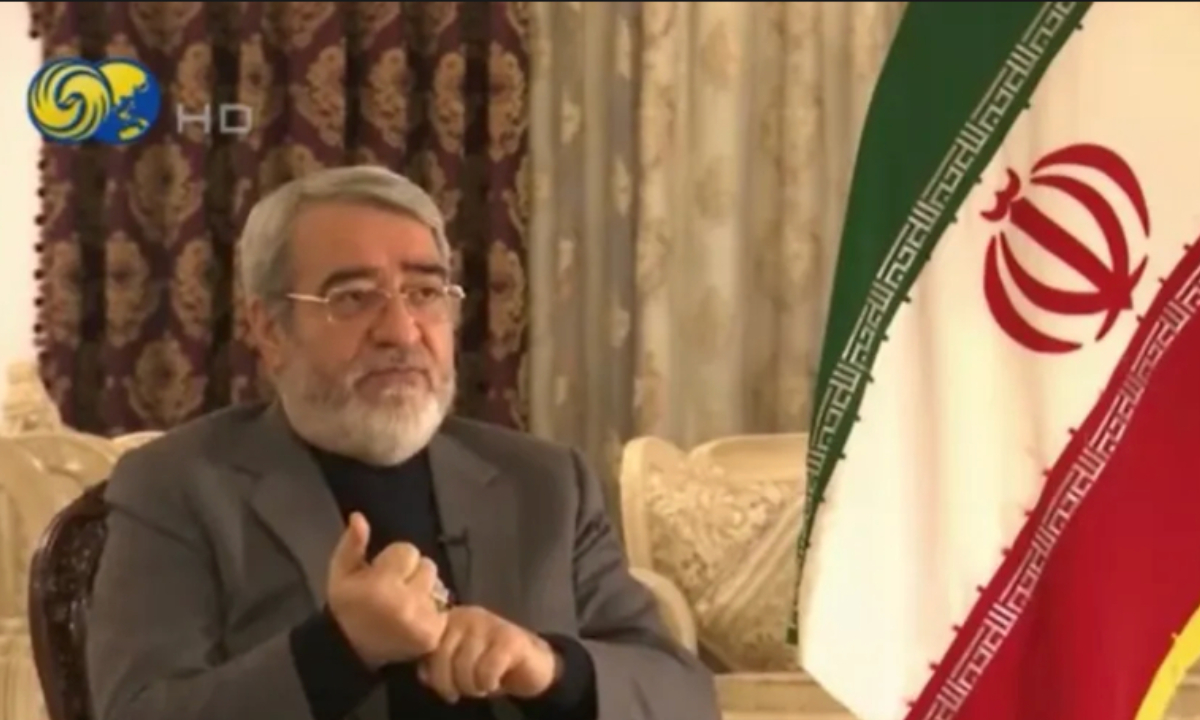
Ambassador of Iran to China Abdolreza Rahmani Fazli in an exclusive interview with Phoenix TV in Beijing on March 4, 2026. Photo: Screenshot from Phoenix TV
Ambassador of Iran to China Abdolreza Rahmani Fazli told Phoenix TV in Beijing on Wednesday that Iran will decisively retaliate against the US and Israel for their attacks and could strike the continental US if possible.
Following the death of Iran's Supreme Leader Ayatollah Ali Khamenei, the Iranian Embassy in China lowered its flag to half-staff in tribute. When the conflict entered its fifth day on Wednesday, Fazli talked in an exclusive interview with Phoenix TV, criticizing the US and Israel for brazenly launching attacks on Iran at a time when progress had been made in US-Iran negotiations, calling the move an act of power politics and blatant bullying.
Fazli also reiterated that Iran would decisively retaliate against US and Israeli interests worldwide, and stressed that, if possible, the retaliation would also include the continental US.
The US and Israel have carried out airstrikes on targets inside Iran for several consecutive days. The US President Donald Trump also claimed that Iran's “air defense, Air Force, Navy and Leadership are gone,” and he refused to rule out deploying US ground troops to Iran.
The Israel Defense Forces said Tuesday it had deployed troops deeper into southern Lebanon to conduct operations, increasing the risk of the war spilling over and becoming protracted, the Times of Israel reported.
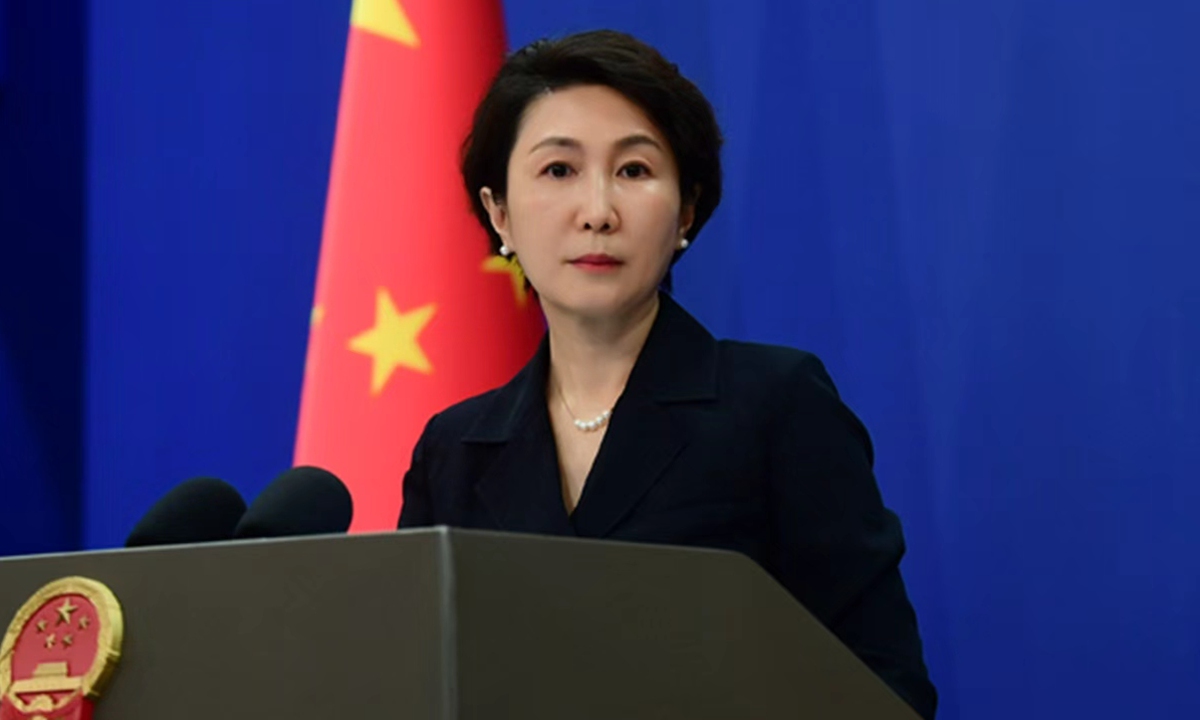
Chinese foreign ministry spokesperson Mao Ning
Since the security situation in Iran became tense, China has repeatedly made representations to relevant parties, urging all sides to ensure the safety of Chinese citizens in Iran and neighboring countries, Chinese Foreign Ministry spokesperson Mao Ning said on Wednesday's press briefing while responds to measures that the Chinese government has taken to protect Chinese citizens in Iran and neighboring countries.
The Chinese Ministry of Foreign Affairs and its embassies and consulates in the relevant countries have issued multiple reminders, carried out work through various means, called on and assisted Chinese citizens in Iran to evacuate as soon as possible, and advised those in other countries to stay safe. Chinese embassies and consulates in Iran and neighboring countries have remained on duty around the clock, assisting multiple groups of Chinese citizens in evacuating. Since the outbreak of the conflict, over 470 Chinese nationals have been safely evacuated under the organization of the Chinese Embassy and and consulates in Iran, Mao said.
Considering the severe security situation in Iran, we once again solemnly remind Chinese citizens in Iran to strengthen personal protection, evacuate safely as soon as possible, and promptly register their information with the Chinese Embassy in Iran.
Currently, the Astara crossing in Azerbaijan, the Agarak crossing in Armenia, the Van Province, Agri, and Hakkari crossings in Turkey, the Shalamcheh crossing in Iraq, and the Bajgiran crossing in Turkmenistan are accessible. Chinese citizens with passports can enter Azerbaijan, Armenia, and Turkey visa-free, can enter Iraq after applying for an electronic visa in advance, and can enter Turkmenistan after submitting materials and obtaining a visa in advance.
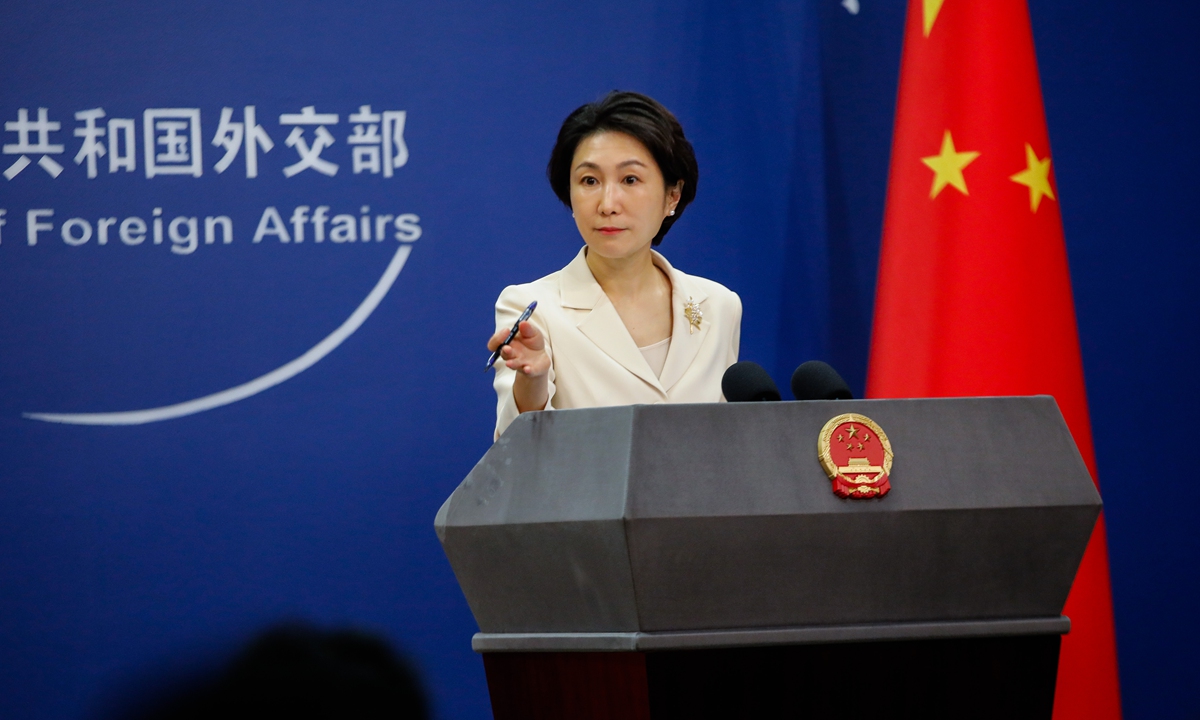
Chinese foreign ministry spokesperson Mao Ning
In response to a media question that Iran's Islamic Revolutionary Guard Corps had claimed that they currently control the Strait of Hormuz, an important route for oil and gas transportation, and had noted that any vessel attempting to pass through the strait could be subject to missile or drone attacks, Chinese Foreign Ministry spokesperson Mao Ning said that the Strait of Hormuz and its surrounding waters are important international channels for cargo and energy trade, emphasizing that safeguarding security and stability in this region is in the common interest of the international community.
China urges all parties to immediately cease military operations, avoid further escalation of tensions, prevent further turbulence, and avoid causing greater impacts on the global economy, the spokesperson said.
Global Times
"It's been four days since the Trump administration launched the U.S. into a war most Americans oppose, and his administration can't explain the reasons we did it. I left the intelligence briefing more concerned than reassured," Senate Minority Leader Chuck Schumer told reporters at a press briefing on the Capitol Hill.
"The rationales change by the hour, regime change, nuclear weapons, missiles, defense, preemptive, which is it? When the justification keeps shifting, a strategy is missing. There is no strategy," said Schumer.
Senator Patty Murray, vice chair of the Senate Appropriations Committee, who also attended the press briefing, said that "Donald Trump started an unconstitutional war that no one asked for."
"Congress should end this war now. Republicans should grow a spine and vote with Democrats in support of the War Powers resolution," Murray said.
Pham Thu Hang, spokesperson for the Vietnamese Ministry of Foreign Affairs, made the statement on Tuesday in response to media questions regarding Vietnam's reaction to escalating tensions in the Middle East.
Such actions have caused severe damage and continue to threaten the lives, safety and legitimate interests of people, including Vietnamese citizens in the region, while undermining economic activities as well as peace and stability in the region and beyond, she said.
Vietnam calls on all relevant parties to act responsibly, strictly comply with international law, the Charter of the United Nations and relevant UN resolutions, and respect the sovereignty and territorial integrity of countries, the spokesperson said.
Vietnam also urges the parties to resume negotiations and create favorable conditions for dialogue aimed at resolving differences through peaceful means for the benefit of the people and for regional and global peace, stability and development, she said.
"Canada calls for a rapid de-escalation of hostilities and is prepared to assist in achieving this goal," he told reporters in Sydney during his visit to Australia, according to a statement issued Tuesday.
Despite decades of UN Security Council resolutions and efforts by the International Atomic Energy Agency, Iran's nuclear threat remains, he said. However, the United States and Israel have acted without engaging the United Nations or consulting with allies, including Canada, he added.
Canada reaffirms that international law binds all belligerents, Carney said, noting that "resolution of this crisis requires commitment to a broader political solution" and diplomatic engagement "is essential to avoid a wider and deeper conflict."
The report suggests that the Trump administration has, at least for the time being, shifted away from diplomatic efforts while continuing military actions against Iran.
Witkoff has not spoken with Iranian Foreign Minister Seyed Abbas Araghchi in the days "since this thing went kinetic," the report quoted a senior Trump administration official as saying.
Earlier in the day, U.S. President Donald Trump wrote on social media that it's too late for U.S.-Iran negotiations, arguing that the United States held the military advantage.
In another post, the U.S. president boasted "unlimited supply" of weapons, dismissing a Wall Street Journal report that highlighted the rapid depletion of air-defense interceptors and other munitions in strikes against Iran, which is reportedly "straining its stockpiles."
"Many of you may remember the shock and awe strikes of 2003. The first 24 hours of this operation were nearly double the scale, and we continue with 24/7 strikes into Iran, from seabed to space and cyberspace," Brad Cooper, commander of CENTCOM, said in a video posted on the social platform X.
"Now we're less than 100 hours into this operation, and we've already struck nearly 2,000 targets with more than 2,000 munitions. We have severely degraded Iran's air defenses and destroyed hundreds of Iran's ballistic missiles, launchers and drones," said Cooper.
"We are also sinking the Iranian Navy, the entire navy. Thus far, we've destroyed 17 Iranian ships, including the most operational Iranian submarine that now has a hole in its side," he said.
CENTCOM also said that the Iranian side has launched over 500 ballistic missiles and over 2,000 drones since the start of U.S.-Israeli strikes.
The government said any related measures must respect business autonomy, international law and bilateral agreements between the European Union and the United States.
It noted that Spain is an important member of NATO and a major exporting country within the European Union, maintaining long-term trade relations with 195 countries, including the United States. The government stressed that it will support sectors that may be affected and promote supply chain diversification.
Second Deputy Prime Minister Yolanda Diaz described Trump's remarks as "unacceptable," saying Spain would not accept external pressure.
Trump on Tuesday threatened to "cut off all trade with Spain" over Spain's refusal to allow the U.S. military to use its bases for attacks on Iran. He made the remarks to reporters at the start of his talks with German Chancellor Friedrich Merz in the Oval Office.
In a televised address on the situation in Iran and the Middle East, Macron confirmed that the aircraft carrier Charles de Gaulle was en route to the Mediterranean Sea. The vessel had been in Sweden for military exercises.
"We're going to cut off all trade with Spain. We don't want anything to do with Spain," Trump told reporters at the beginning of his talks with German Chancellor Friedrich Merz in the Oval Office.
"By the way I'm not happy with the UK either," Trump said. "This is not Winston Churchill that we're dealing with."
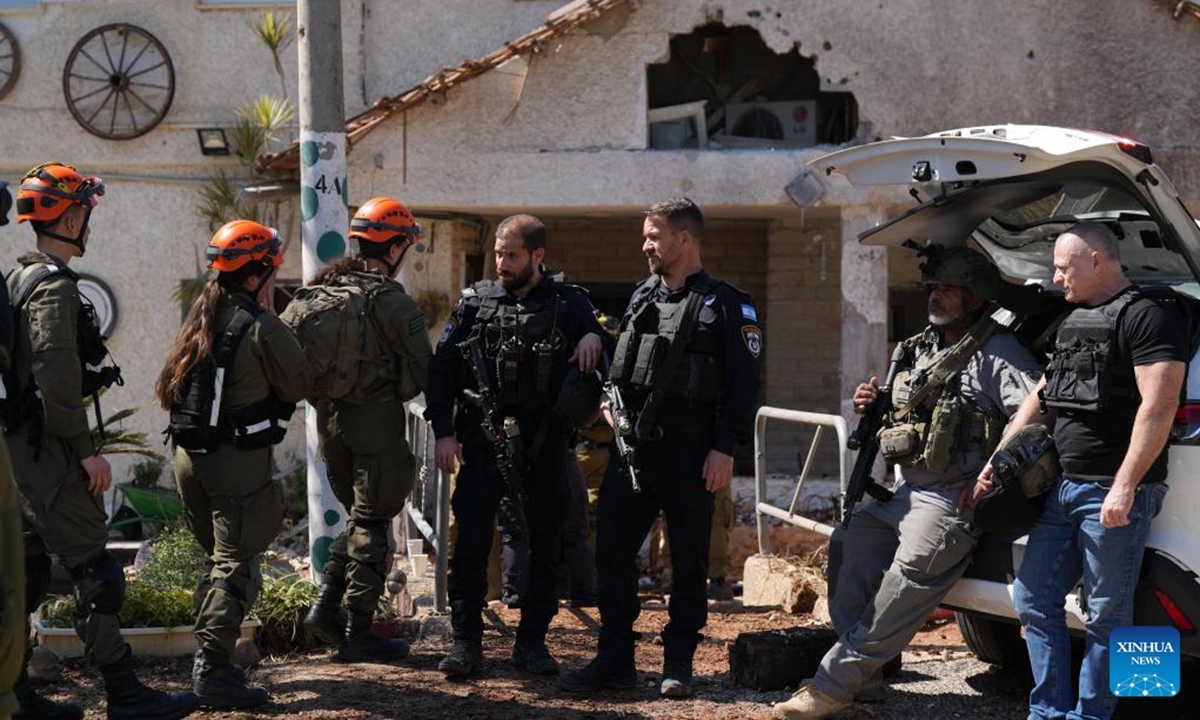
Israeli security personnel operate at a house affected during attacks in Moshav Kfar Yuval in northern Israel, near the border with southern Lebanon, on March 3, 2026. Hezbollah said on Tuesday that it launched a rocket barrage toward northern Israel in response to what it described as ongoing Israeli attacks on Lebanese areas. (Ayal Margolin/JINI via Xinhua)
Hezbollah said Tuesday evening that it has launched a rocket attack on an Israeli naval base in the northern Israeli city of Haifa, describing the move as a response to ongoing Israeli airstrikes on Lebanese territory.
In a statement, the group said its fighters targeted the naval base with a salvo of what it described as advanced rockets.
Hezbollah said that the attack was carried out in retaliation for what it called "criminal Israeli aggression" that has struck dozens of Lebanese cities and towns, including Beirut's southern suburbs.
"If necessary, the United States Navy will begin escorting tankers through the Strait of Hormuz, as soon as possible," Trump said in a post on social media.
Trump said he has ordered the U.S. International Development Finance Corporation (DFC) to provide so-called political risk insurance and guarantees for maritime trade, especially energy, "traveling through the Gulf."
Nestled between the Gulf and the Gulf of Oman, the Strait of Hormuz serves as the only sea passage from the Gulf to the open ocean, cementing its status as one of the world's most strategically vital chokepoints.
Iranian media reported that Iran's Islamic Revolutionary Guard Corps had closed the Strait of Hormuz to shipping, declaring the vital oil and gas waterway unsafe due to U.S. and Israeli attacks.
Iran's Islamic Revolutionary Guard Corps launched "a large-scale drone and missile attack at dawn on the US air base in the Sheikh Isa area of Bahrain," IRNA said in a post on Telegram.
Meanwhile, the US embassy in Riyadh confirmed it was hit by an attack, adding it would be closed on Tuesday.
The US State Department said on Tuesday it has ordered the departure of non-emergency US government personnel and family members from Bahrain, Iraq and Jordan.
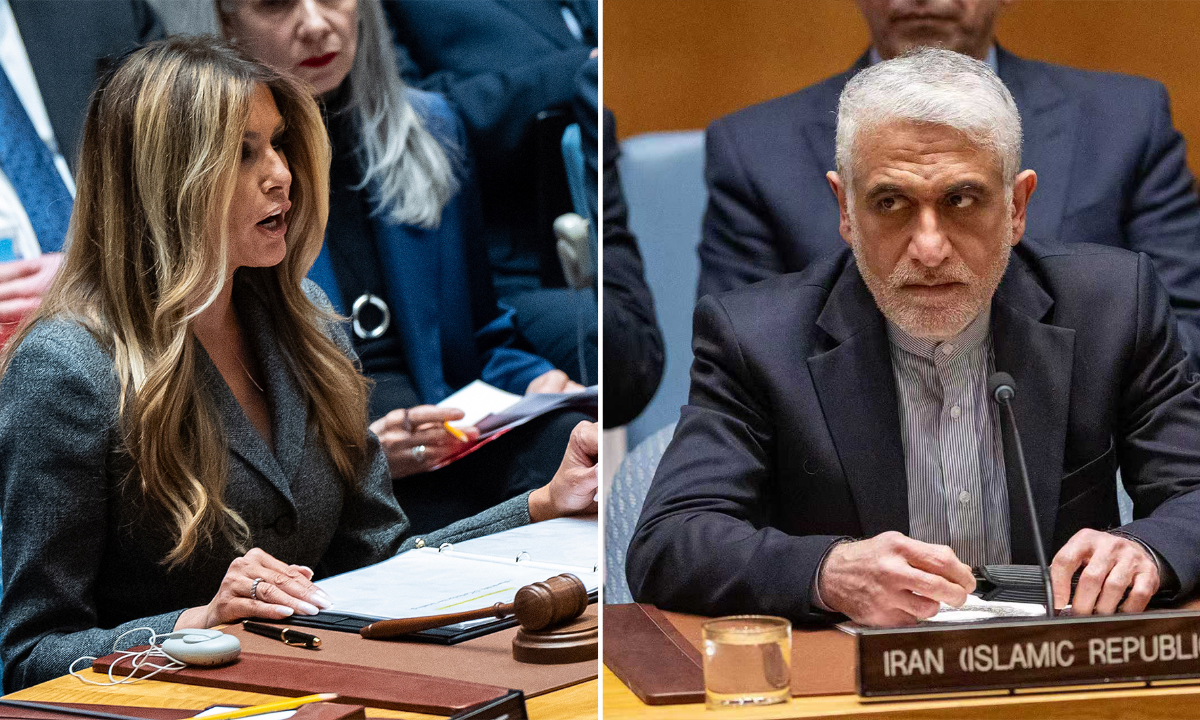
Melania Trump (left), first lady of the United States, presides over the United Nations Security Council at United Nations headquarters, Monday, March 2, 2026. File photo of Amir Saeid Iravani (right), the Permanent Representative of the Islamic Republic of Iran to the United Nations. Photo: VCG
US first lady Melania Trump became the first spouse of a sitting world leader to preside over the UN Security Council (UNSC) on Monday. Yet her calling on member states to protect children's access to education has sparked wave of sarcasm and criticism after media reported that an airstrike killed at least 165 people at a girls' school in southern Iran.
Melania presided over a UNSC meeting on children and education in conflict in New York. Her remarks centered around the role of education for children in "advancing tolerance and world peace," according to BBC.
BBC and the Guardian noted it is the first time the spouse of any world leader has presided over the meeting, which Trump did on behalf of the US as it assumed the rotating presidency of the UN council this month.
The first lady also offered her condolences to families of US service members who have been killed, though she did not explicitly mention any particular military action.
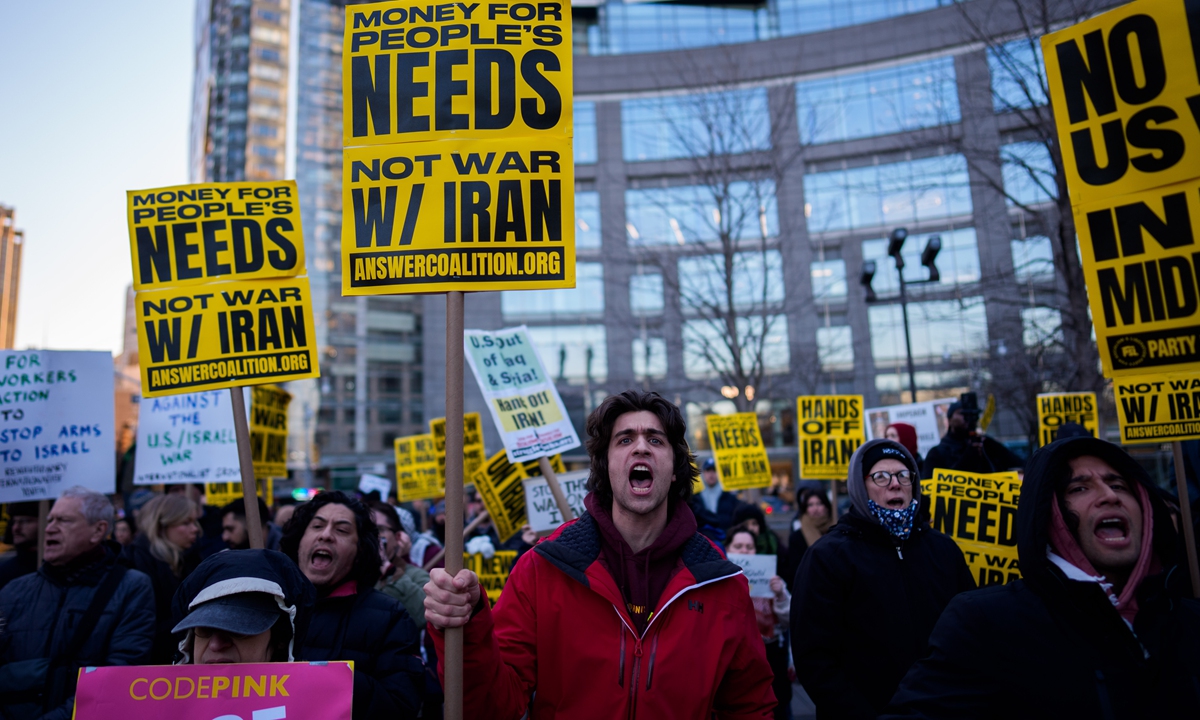
People protest against the war in Iran on March 2, 2026 in New York, the US. Photo: VCG
US President Donald Trump claimed in an interview with the New York Post on Monday that he is not ruling out sending US ground troops into Iran "if they were necessary," adding that the operation was "way ahead of schedule" after killing dozens of Iran's top officials. The messaging, along with similar remarks by the US defense chief, appears aimed at exerting psychological pressure on Iran and weakening its resolve to resist, as the anticipated rapid regime change has not materialized and Washington may yet to make sufficient preparations for deploying ground troops amid mounting pressure, said a Chinese expert."I don't have the yips with respect to boots on the ground — like every president says, 'There will be no boots on the ground.' I don't say it," Trump claimed after launching strikes Saturday to decapitate Iran's military and political leadership. "I say 'probably don't need them,' [or] 'if they were necessary,'" according to the New York Post report.
Trump told the Daily Mail on Sunday that he estimated the war would last "four weeks or so," but hinted to the New York Post on Monday that the timeframe could be shortened. Trump also claimed he wasn't concerned about Iran using terrorism to repay America for the weekend's attack. "We'll take it out. Whatever. It's like everything else, we'll take it out," Trump said.
US Defense Secretary Pete Hegseth also declined to rule out the deployment of ground troops during a press briefing Monday in his first public comments on the strikes in Iran at the Pentagon in Washington, D.C.
When asked specifically about whether American forces could be sent to Iran, Hegseth claimed that it would be "foolishness" to expect US officials to say publicly "here's exactly how far we'll go." "We're not going to go into the exercise of what we will or will not do," he added, according to the Time magazine.
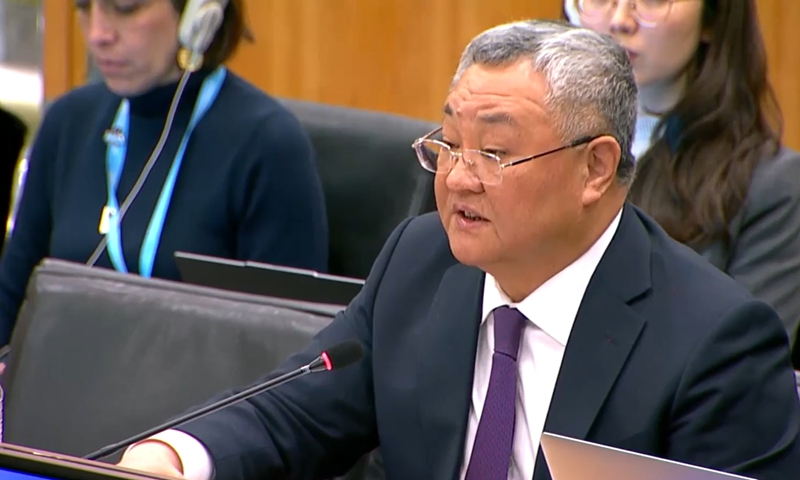
China's permanent representative to the United Nations Fu Cong delivers speech on February 18, 2025 at a meeting of the Special Committee on the Charter of the United Nations and on the Strengthening of the Role of the Organization. Photo: screenshot from UN website
Fu Cong, China's permanent representative to the UN, said that China strongly condemns the targeting of children in attacks and urges parties to the conflict to fulfill their obligations under international humanitarian law, at a UN Security Council (UNSC) meeting presided by US first lady Melania Trump on Monday.
Fu said that China strongly condemns the targeting of children in attacks and urges parties to the conflict to fulfill their obligations under international humanitarian law, protect children from the ravages of war and uphold the most basic moral conscience of humanity, according to China Central Television reports.
Attacks on schools are one of the six grave violations against children identified by the UN and should be firmly condemned and resolutely opposed, said Fu, noting that the international community should step up investigations into and accountability for incidents involving the harm to children and the destruction of schools, and work together to prevent further atrocities.
Melania's speech centered around the role of education for children in "advancing tolerance and world peace," according to BBC.
Earlier, the ministry said that two drones hit the US embassy in Riyadh, resulting in "limited" fire and material damage.
The department "urges Americans to DEPART NOW from the countries below using available commercial transportation, due to serious safety risks," Mora Namdar, Assistant Secretary of State for Consular Affairs, wrote in a post on X.
The locations with "serious safety risks" include Bahrain, Egypt, Iran, Iraq, Israel, the West Bank and Gaza, Jordan, Kuwait, Lebanon, Oman, Qatar, Saudi Arabia, Syria, the United Arab Emirates and Yemen.
The United States and Israel began massive airstrikes against Iran on Saturday morning. Iran confirmed on Sunday that its Supreme Leader Ayatollah Ali Khamenei was killed in U.S.-Israeli airstrikes the previous day.
Meanwhile, Secretary of State Marco Rubio said that U.S. objectives in the operation against Iran "can be achieved without ground forces."
The drone attack resulted in "limited" fire and material damage, the ministry said.
Previous reports said loud explosions were heard in Riyadh's diplomatic quarter.
The airstrikes came less than an hour after the military posted a warning in Farsi on social platform X, urging residents near the government-run radio and television headquarters in the Evin neighborhood to evacuate the area.
"Over the years, the Iranian Broadcasting Authority called for the destruction of the State of Israel and for the use of nuclear weapons," the military said, adding that the activities at the center were directed by the Islamic Revolutionary Guards Corps.
The military said it will continue to strike Iranian government infrastructure across Tehran.
In a statement to the press, Iravani said the United States, in full coordination with Israel, launched "a second deliberate and unprovoked" military attack against Iran, which was "a calculated act of aggression."
"Major cities and densely populated civilian areas were targeted. Hundreds of innocent civilians lost their lives, many more were wounded," he said.
"This is a flagrant violation of the Charter of the United Nations ... which strictly prohibits the threat or use of force against the sovereignty and territorial integrity of any state," Iravani said.
"It is a direct assault on the foundations of international law," he said. "The facts were clear. The aggression was clear. Responsibility also was clear."
"As of 4 pm ET, March 2, six U.S. service members have been killed in action. U.S. forces recently recovered the remains of two previously unaccounted for service members from a facility that was struck during Iran's initial attacks in the region," the command said in a post on X.
In another post earlier in the day, the command said the U.S. forces have sunk 11 Iranian naval vessels operating in the Gulf of Oman.
The United States and Israel began massive airstrikes against Iran on Saturday morning. Iran confirmed on Sunday that its Supreme Leader Ayatollah Ali Khamenei was killed in the airstrikes the previous day.
U.S. President Donald Trump said on Monday the military campaign against Iran has "capability to go far longer" than four to five weeks.
The embassy described the move as a precautionary measure amid heightened regional tensions triggered by a large-scale joint attack launched by the United States and Israel on Iran, which in turn prompted Iranian counter-attacks, including strikes on sites in Israel and U.S. military bases in Gulf states and Jordan.
Meanwhile, Jordan's Public Security Directorate urged residents living in the vicinity of the embassy to remain inside their homes until the threat has been cleared, as security forces continue to take precautionary measures in the area.
On Monday, King Abdullah II of Jordan received a phone call from U.S. President Donald Trump, during which the king reaffirmed Jordan's absolute rejection of Iran's attacks on its territory and on several countries in the region.
The Israeli Air Force struck "dozens" of headquarters belonging to the government's internal security bodies. Among the targets were over 10 headquarters of the Ministry of Intelligence -- Iran's primary intelligence body -- along with numerous Quds Force facilities.
The military specifically highlighted strikes on regional command centers and Basij headquarters, adding that it will continue to target Iran's official systems.
In addition to the command centers, the air force continued to target surface-to-surface missile launchers, weapons production sites, and various Iran's Islamic Revolution Guard Corps' Air Force assets.
The strike in the Iranian capital follows a day of heavy escalation, which included the mobilization of 110,000 Israeli reservists and intensive strikes in Lebanon, including in Beirut, after the Iran-aligned Hezbollah fired missiles and drones toward Israel.
"We have capability to go far longer than that. We'll do it," Trump said at an event in the White House, referring to his earlier remarks that the attacks may last four to five weeks.
"I don't get bored. There's nothing boring about this," Trump said amid the war across the Middle East region.
Earlier, Trump told the New York Post that he is not ruling out sending U.S. ground troops into Iran "if they were necessary".
A Reuters/Ipsos poll conducted Saturday and Sunday found that some 43 percent of U.S. citizens disapproved of the strikes and just 27 percent approved.
In a statement on its official Sepah News outlet, the IRGC described the operation, the 12th wave of attacks against U.S. bases in the region, as "decisive and targeted."
The statement said that 12 drones struck Camp Arifjan in Kuwait in two stages, while six drones and five ballistic missiles hit the U.S. command and control center at Al Minhad Air Base in the UAE. Six more drones targeted U.S. naval facilities in Bahrain.
The IRGC added that its navy fired two drones at the Athena Nova fuel tanker, which it described as "an ally of the United States" in the Strait of Hormuz, leaving the vessel ablaze.
Israel and the United States launched large-scale strikes on Iran on Saturday, killing Supreme Leader Ali Khamenei and several senior officials. The attacks, which hit most Iranian provinces, have killed more than 550 people, according to Iranian media. Iran has since retaliated with multiple waves of drone and missile strikes targeting Israel and U.S. positions across the region.
Speaking to the British parliament, Starmer said making decisions like this requires "a lawful basis for what the United Kingdom is doing" and "a viable thought-through plan."
He said this is the principle he applied to the decision not to get involved in the "offensive strikes" of the United States and Israel on Iran, adding, "This government does not believe in regime change from the skies."
"President Trump has expressed his disagreement with our decision not to get involved in the initial strikes, but it is my duty to judge what is in Britain's national interest," he said.
U.S. President Donald Trump said he is "very disappointed" in Starmer for blocking him from using the military base in Diego Garcia to carry out strikes on Iran, according to British media reports on Monday.
"I don't have the yips with respect to boots on the ground -- like every president says, 'There will be no boots on the ground,' I don't say it," Trump told New York Post in an interview.
"I say 'probably don't need them,' (or) 'if they were necessary,'" he said.
Trump claimed that the military campaign launched on Saturday morning was "way ahead of schedule" in terms of killing dozens of senior Iranian officials.
On Sunday, Trump told The New York Times that he estimated the war would last four to five weeks.
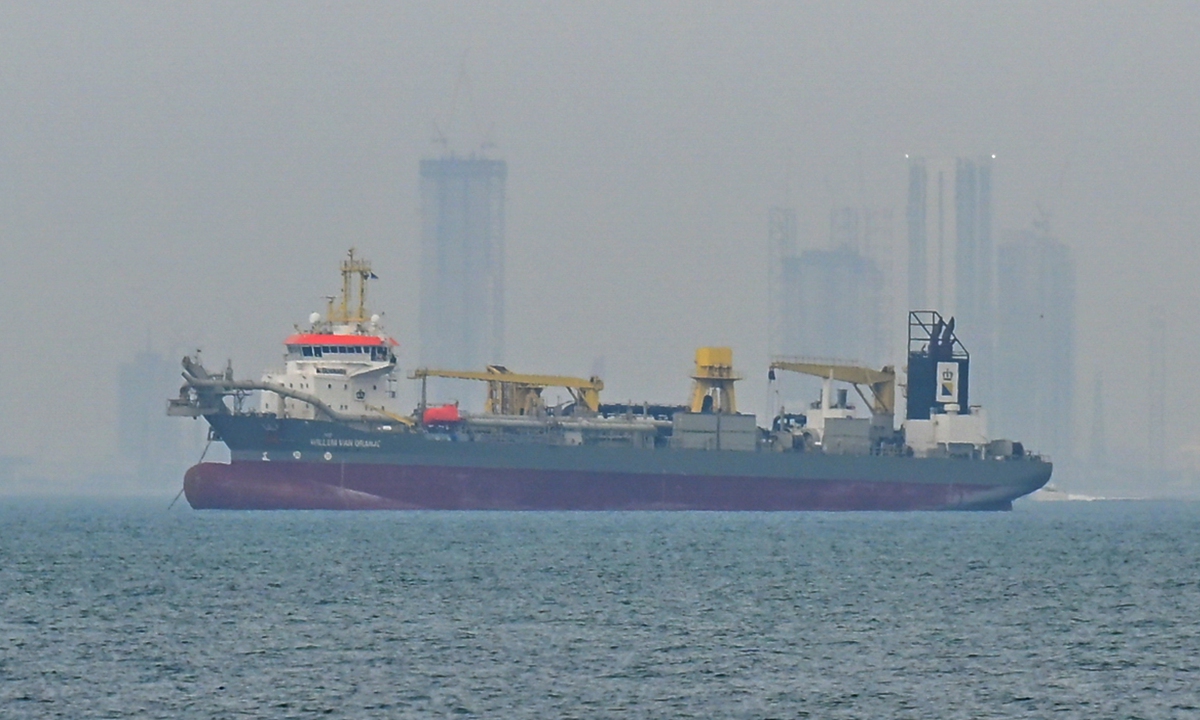
A commercial vessel anchors off the coast of Dubai, UAE, on March 2, 2026, amid ongoing navigational disruptions in the Strait of Hormuz. Photo: VCG
As one of the most important oil export routes in the world, the Strait of Hormuz has drawn intense attention since Iran reportedly claimed that no ships would be allowed to pass through on Saturday. A Chinese military affairs expert told the Global Times that Iran's ability to enforce a blockade is not technically complex, but such a move could have consequences beyond global energy markets.
No vessel is allowed to cross the Strait of Hormuz following the attacks launched by the US and Israel against Iran, reported Tasnim News Agency on Saturday. Vessels in the area are receiving repeated messages from the Islamic Revolution Guards Corps telling them that no ship is allowed to cross the strategic strait, the report said.
The Strait of Hormuz, located between Oman and Iran, connects the Persian Gulf with the Gulf of Oman and the Arabian Sea. The strait is deep and wide enough to handle the world's largest crude oil tankers, and it is one of the world's most important oil chokepoints, according to the US Energy Information Administration.
On Monday, real-time tracking data from vessel-tracking website VesselFinder showed that the central channel of the strait was relatively empty, while oil tankers and other vessels were clustered along both sides.
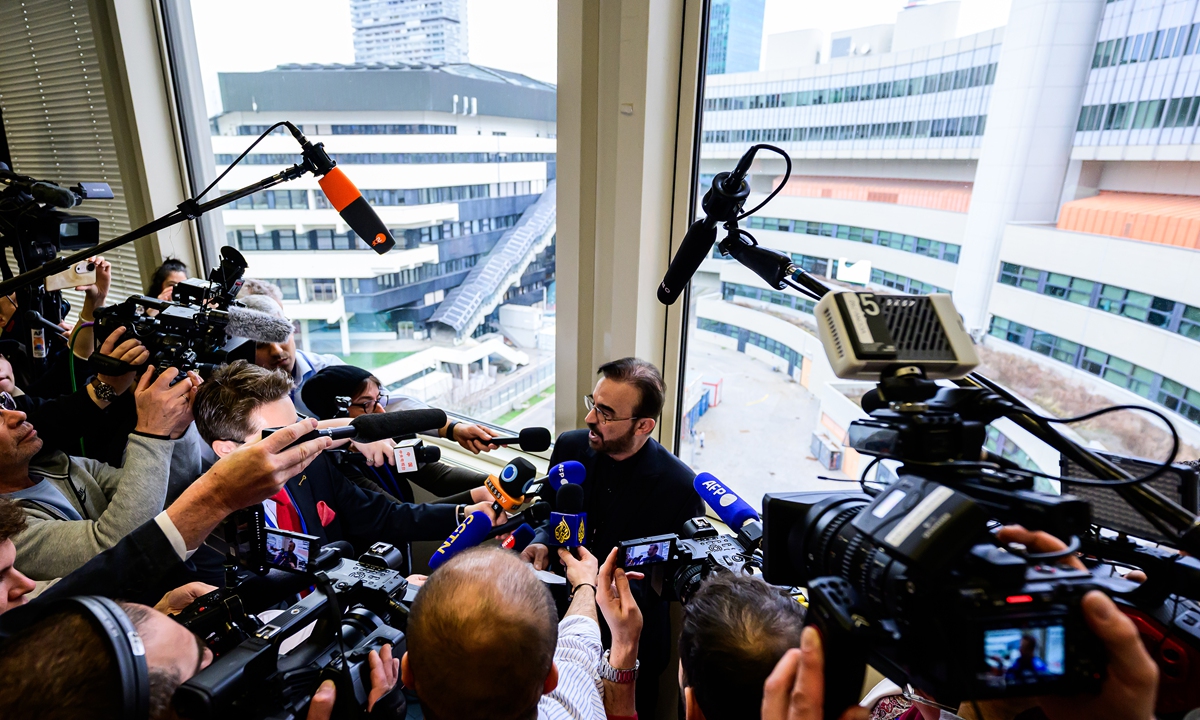
Iran's ambassador to the International Atomic Energy Agency (IAEA) Reza Najafi speaks to media during a meeting of the IAEA Board of Governors on March 02, 2026 in Vienna, Austria. Photo: VCG
As the US Israeli military operation against Iran entered its third day on Monday, fighting and mutual retaliatory attacks intensified, with rising casualties on all sides and growing risks of a wider regional war. Amid the tense situation, China has intensified diplomatic efforts.
Chinese Foreign Minister Wang Yi on Monday held intensive phone talks with counterparts of several countries. According to the Xinhua News Agency, Chinese Foreign Minister Wang Yi on Monday held phone calls with Iranian Foreign Minister Seyed Abbas Araghchi, French Foreign Minister Jean-Noel Barrot and Omani Foreign Minister Sayyid Badr bin Hamad Al Busaidi.
Wang affirmed China's support to Iran in safeguarding its sovereignty, security, territorial integrity and national dignity, during his phone call with Araghchi, urged joint efforts with France to de-escalate Middle East tensions when talking to Barrot. And he also said that the spillover of war does not serve the fundamental and long-term interests of the Gulf countries during the phone conversation with the Omani foreign minister.
Chinese Foreign Ministry spokesperson Mao Ning also elaborated China's position when responding on Monday a barrage of relevant questions, urging parties to stop the military operations and prevent further spread of the conflict. According to the Chinese Foreign Ministry web page of the Monday press conference, Mao took at least 11 questions concerning the situation in Iran.
Addressing a question of how China plays a role in preventing the US from carrying out unilateral actions, such as assassinating leaders of sovereign countries, Mao said that China is deeply concerned over the current situation. China firmly opposes the use of force in international relations or infringement on other countries' sovereignty and security. The priority now is to immediately stop military operations and prevent the spread and spillover of the conflict.
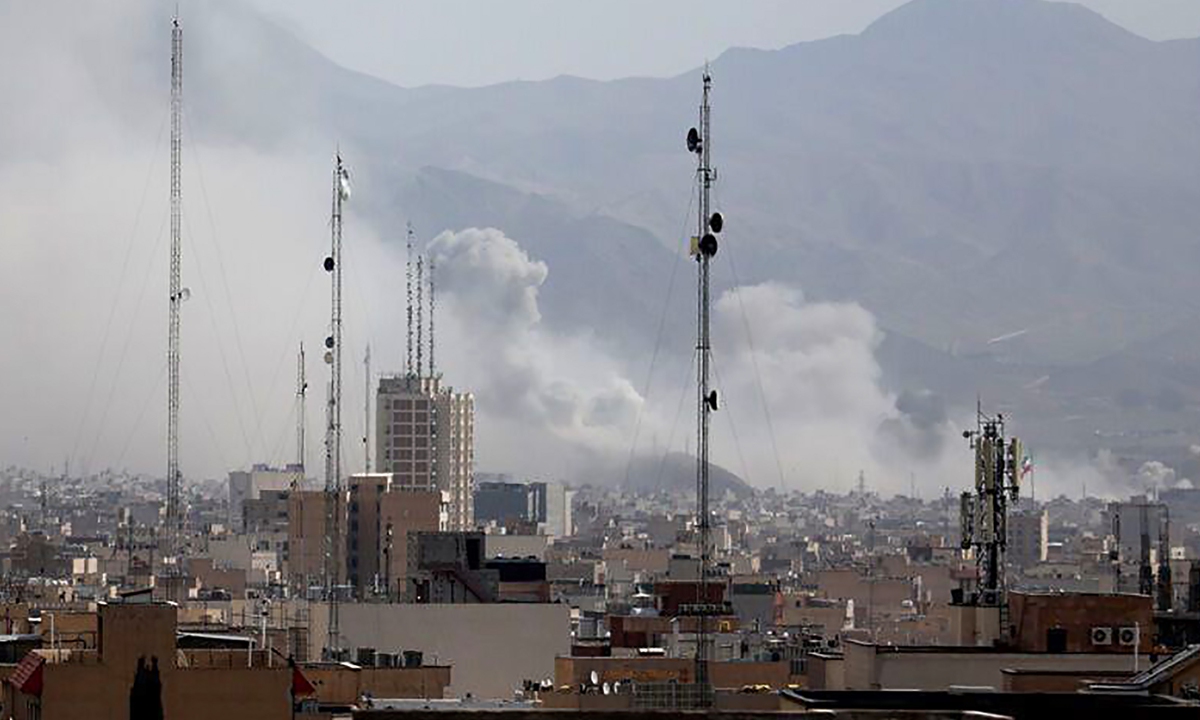
Smoke rise over central Tehran and other areas on February 28, 2026 after Israel and the US launched strikes. Photo: VCG
The escalation of the conflict between the US-Israel and Iran has shocked the world following confirmation on Sunday of the death of Iran's Supreme Leader, Ayatollah Ali Khamenei. Iran's nuclear facilities have become an unavoidable focal point in this conflict.
Amid recent failed talks before the heated conflict, the US demands that Tehran dismantle its main nuclear facilities and hand over its entire stockpile of enriched uranium to Washington, as Anadolu Ajans reported. Iran, however, rejected the idea of transferring uranium stockpiles abroad during talks in Geneva on February 26 and objected to ending uranium enrichment, dismantling its nuclear facilities, and imposing permanent restrictions on its program, according to The Wall Street Journal, citing people familiar with the talks.
The US-Iran rift over the nuclear issue has spanned decades, yet it is hard to imagine that the US, which now spare no effort to obstruct Iran's nuclear development, was once the earliest backer of Iran's nuclear energy program. Why did US support for Iran's nuclear development, which began in 1957, later turn into comprehensive sanctions and military strikes? How did the former allies end up facing each other in armed confrontation? How does US policy toward Iran expose the hegemonic and unilateralist core of its global dominance?
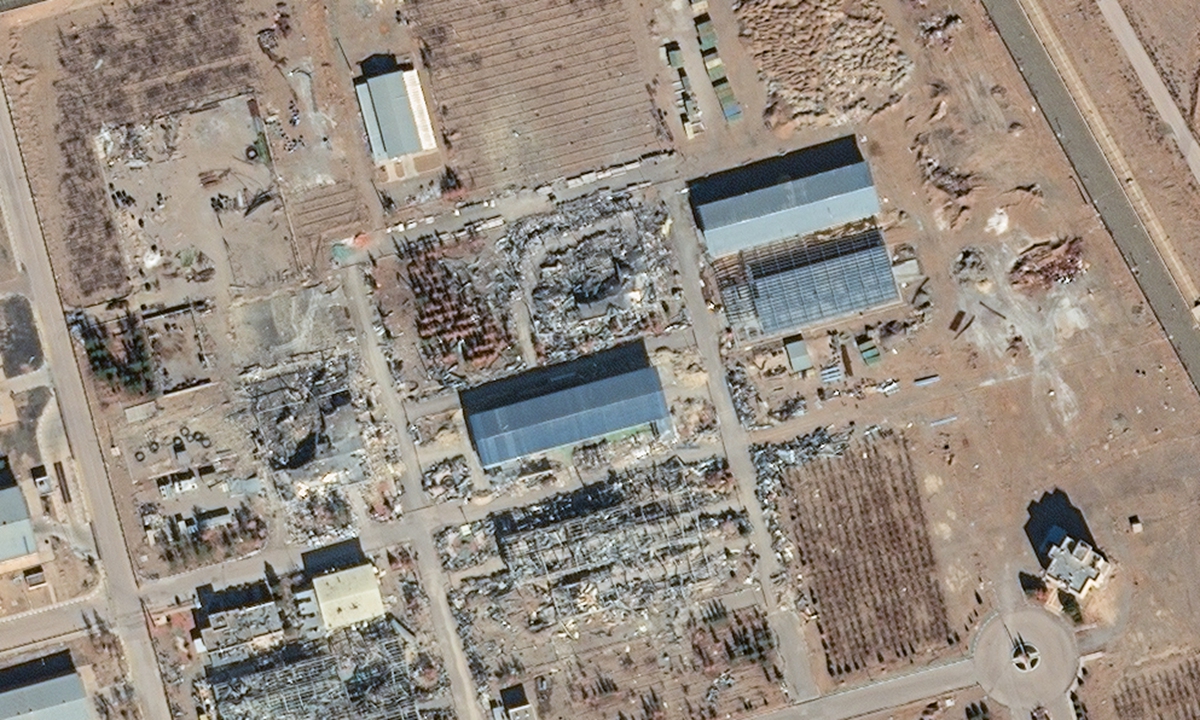
Satellite imagery shows repair and reconstruction activity at the Isfahan nuclear complex in Iran months after US airstrikes in June 2025. Photo: VCG
From honeymoon to bitter enmity"The US stance on Iran's nuclear program has shifted from embrace to strangulation, a transformation inextricably linked to the changing nature of the regime in Tehran," Sun Degang, director of the Center for Middle East Studies at Fudan University, told the Global Times.
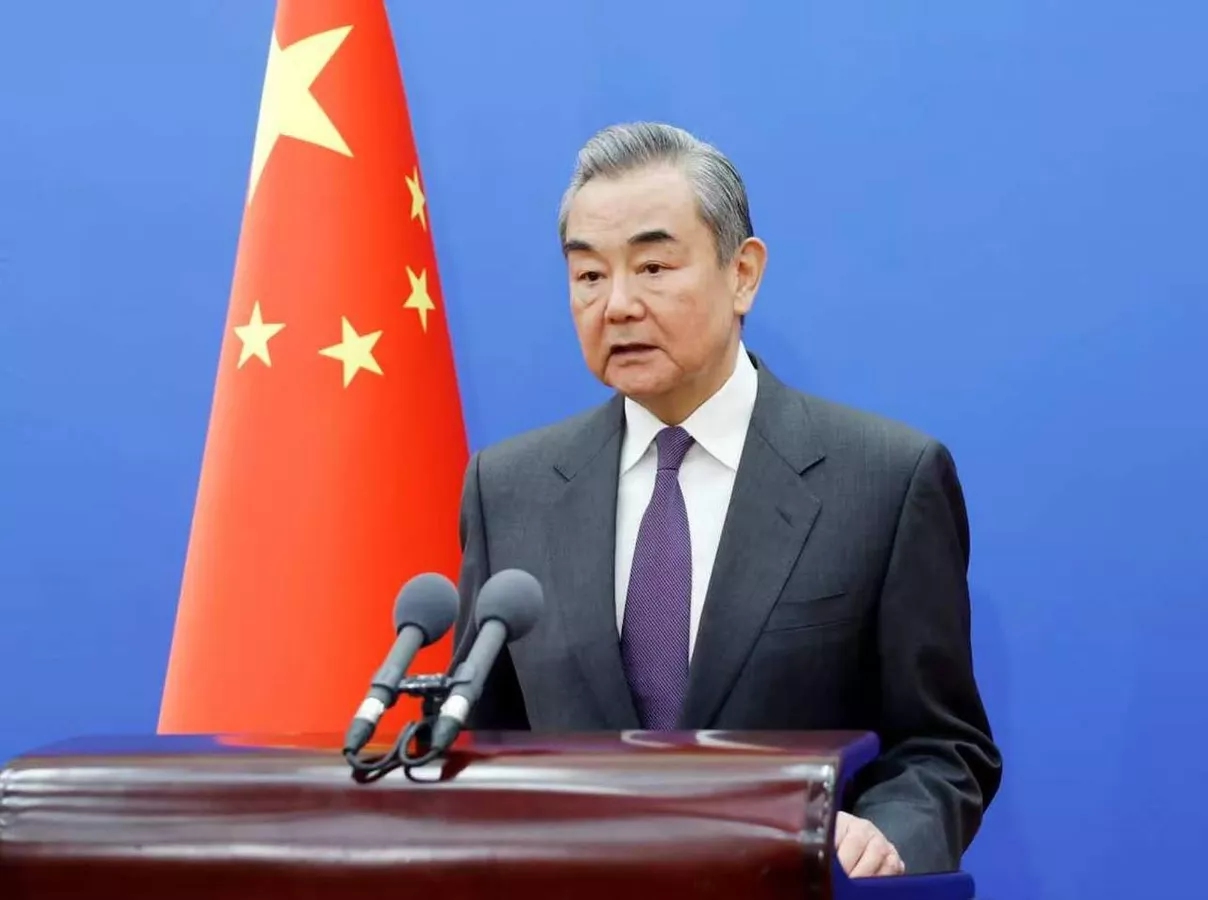
Chinese Foreign Minister Wang Yi file photo:fmprc
Chinese Foreign Minister Wang Yi on Monday held phone conversations separately with Iranian Foreign Minister Seyed Abbas Araghchi, French Foreign Minister Jean-Noel Barrot and Omani Foreign Minister Sayyid Badr bin Hamad Al Busaidi as the military operation launched by the US and Israel on Iran entered its third day.
The readout statements of the three phone calls were released on the website of the Chinese foreign ministry.
Araghchi briefed Wang on the latest developments in the regional situation, stating that the US has launched war against Iran for the second time during Iran–US talks. The current round of talks had made positive progress, but US actions violate all international law and trample on Iran's red lines. Iran has no choice but to defend itself with all its strength.
Wang, also a member of the Political Bureau of the Communist Party of China Central Committee, told his Iranian counterpart that China values the traditional friendship between China and Iran and supports Iran in safeguarding its sovereignty, security, territorial integrity and national dignity.
Wang said that China has urged the US and Israel to immediately cease military actions, prevent further escalation of tensions and avoid the spread of the conflict throughout the Middle East. China believes that Iran will be able to maintain national and social stability in the current challenging and complex situation, address the legitimate concerns of neighboring countries, and ensure the safety of Chinese nationals and institutions in Iran. Araghchi said that Iran is committed to fully safeguarding the security of Chinese personnel and institutions.
A statement issued by the authority said the extension, effective from 12:00 p.m. local time (0900 GMT) Monday until 12:00 p.m. (0900 GMT) Wednesday, applies to all arriving, departing and transiting aircraft.
The authority described the measure as a "temporary and precautionary" step taken following a comprehensive review of all relevant factors.
The decision will be reassessed as new developments arise, the statement added, noting that airlines and stakeholders will be notified of updates.
The extension came after Israel and the United States launched strikes on Iran, prompting Iran's retaliation. Tehran confirmed Sunday that its Supreme Leader, Ayatollah Ali Khamenei, was killed in Saturday's attacks.
The world should not revert to the law of the jungle, Wang, also a member of the Political Bureau of the Communist Party of China Central Committee, made the remarks when holding a phone conversation with French Foreign Minister Jean-Noel Barrot.
Wang, also a member of the Political Bureau of the Communist Party of China Central Committee, made the remarks when holding a phone conversation with Iranian Foreign Minister Seyed Abbas Araghchi.
Wang, also a member of the Political Bureau of the Communist Party of China Central Committee, made the remarks when holding a phone conversation with Omani Foreign Minister Sayyid Badr bin Hamad Al Busaidi.
Wang, also a member of the Political Bureau of the Communist Party of China Central Committee, made the remarks in phone talks with Omani Foreign Minister Sayyid Badr bin Hamad Al Busaidi.
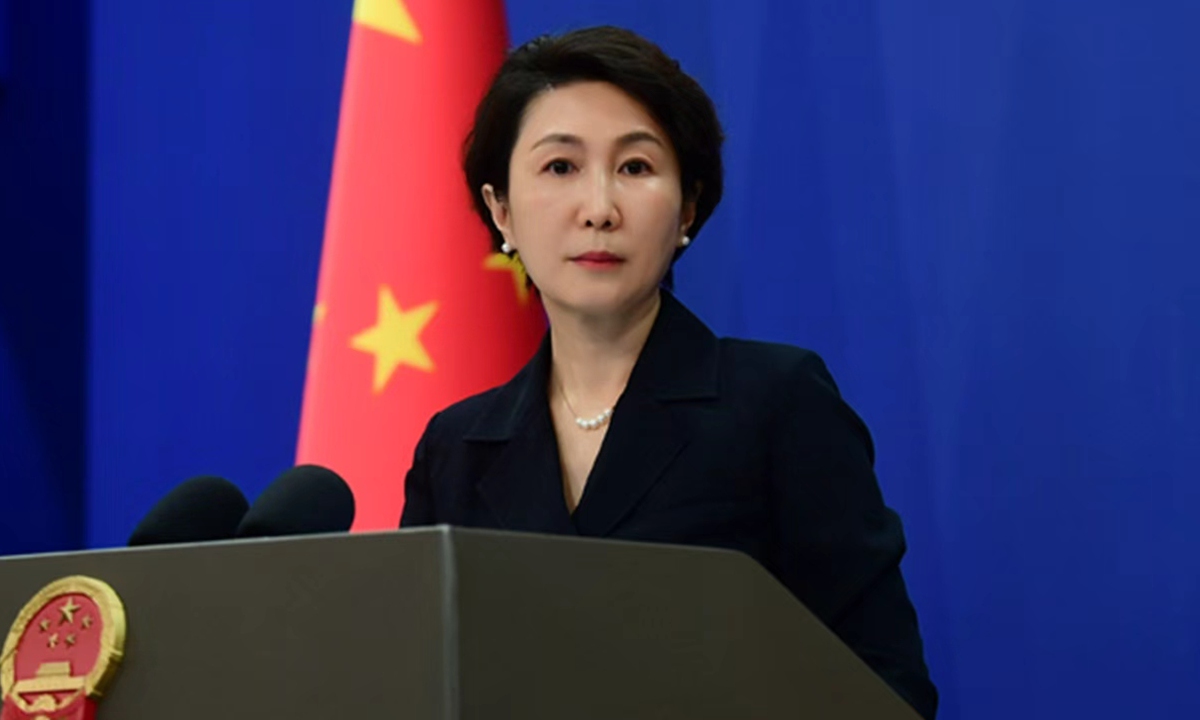
Chinese foreign ministry spokesperson Mao Ning
When asked to confirm foreign media reports that Iran and China are close to reaching an agreement on the purchase of CM-302 supersonic anti ship missiles, which, if delivered, would be among the most advanced weapons China has provided to Iran in recent years, Chinese Foreign Ministry spokesperson Mao Ning said at a press conference on Monday that the relevant reports are not true. Mao said as a responsible major country, China has always fulfilled its international obligations, adding that China opposes malicious association and hype, and hopes relevant parties will do more to help ease tensions.
Global Times
According to the announcement on Sunday, an emergency energy monitoring center has been established to closely track developments in the Middle East and assess potential impacts.
Auttapol stated that relevant agencies have been instructed to monitor effects on Thailand's oil reserves and prices, and formulate short- and long-term response plans. These include activating the oil fund to subsidize domestic fuel prices, easing pressure on consumer prices and living costs caused by rising global oil prices.
The ministry also plans to boost natural gas production in the Gulf of Thailand and delay maintenance at gas fields. Meanwhile, coal-fired and hydropower plants have been ordered to operate at full capacity to secure energy supply.
The minister confirmed that Thailand's oil reserves remain sufficient, and the current situation in the Middle East has not yet affected domestic oil stockpiles or prices. However, the public is urged to conserve energy.
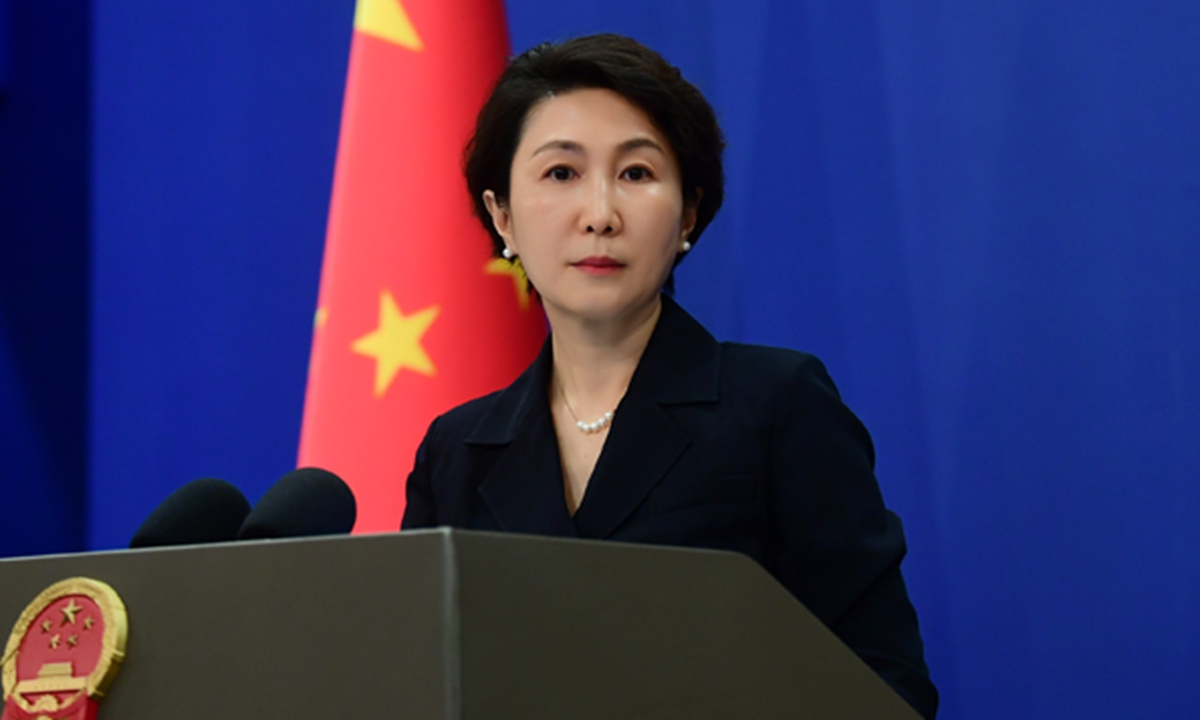
Chinese foreign ministry spokesperson Mao Ning
China was not notified in advance regarding the US military action, Chinese Foreign Ministry spokesperson Mao Ning said, in response to a media inquiry about whether China had any contact with the US during or prior to the US and Israel's military strikes against Iran.
Global Times
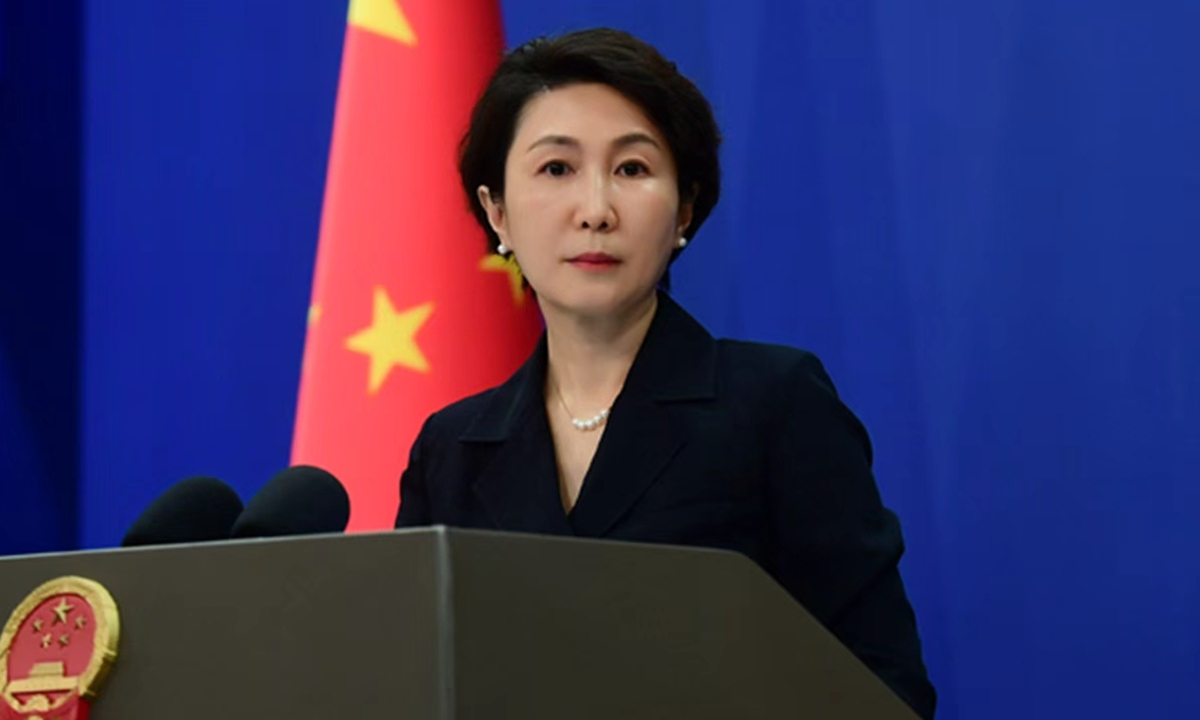
Chinese foreign ministry spokesperson Mao Ning
Since the tense security situation in Iran began, the Chinese Foreign Ministry and the Chinese Embassy and consulates in Iran have issued multiple reminders and carried out work in various forms, calling on and assisting Chinese citizens to evacuate as soon as possible, Chinese Foreign Ministry spokesperson Mao Ning said at a press conference on Monday, in response to media inquiry over the measures that China would take in the next stage to protect Chinese citizens in Iran.As of March 2, more than 3,000 Chinese citizens have evacuated from Iran. Chinese embassies and consulates in countries neighboring Iran have dispatched work groups to border crossings to provide assistance to Chinese citizens evacuating from Iran, Mao said.
In light of the current situation in Iran, we once again solemnly remind Chinese citizens in Iran to strengthen personal precautions, evacuate safely as soon as possible, and contact the Chinese Embassy or consulates in Iran or dial the 12308 consular protection hotline if assistance is needed, the spokesperson noted.
Speaking at the press conference, Mao confirmed that a Chinese citizen in Tehran had unfortunately been killed amid the ongoing military conflicts.
"We express our condolences for the deceased compatriot and our sympathies to the family," Mao said. The Chinese Embassy in Iran has been instructed to provide assistance to the individual involved and the family, she said.
"We must prepare for many days of combat ahead," Zamir said during a situational assessment at the military's headquarters in Tel Aviv.
"This requires strong defensive readiness and sustained offensive readiness, operating in continuous waves while constantly utilizing opportunities," he said.
The announcement came after Hezbollah, the Iran-aligned Lebanese group, joined the conflict by launching overnight missile and drone attacks toward Israel. No injuries or damage were reported, but the incident marked the first such attack since the November 2024 ceasefire between Israel and Lebanon that formally ended the conflict with Hezbollah, Israel's public broadcaster reported.
The move came two days after U.S. and Israeli strikes on Iran. The Israeli military has mobilized 100,000 reservists to prepare for what it described as a "multi-arena" conflict.
The ministry's official military spokesperson said the crash occurred earlier in the day, without specifying the location or the number of aircraft involved.
Authorities at the base said personnel were informed that a "small drone" had impacted the airfield and that the base was responding to the incident, noting that there were no casualties but "minor damage" was reported.
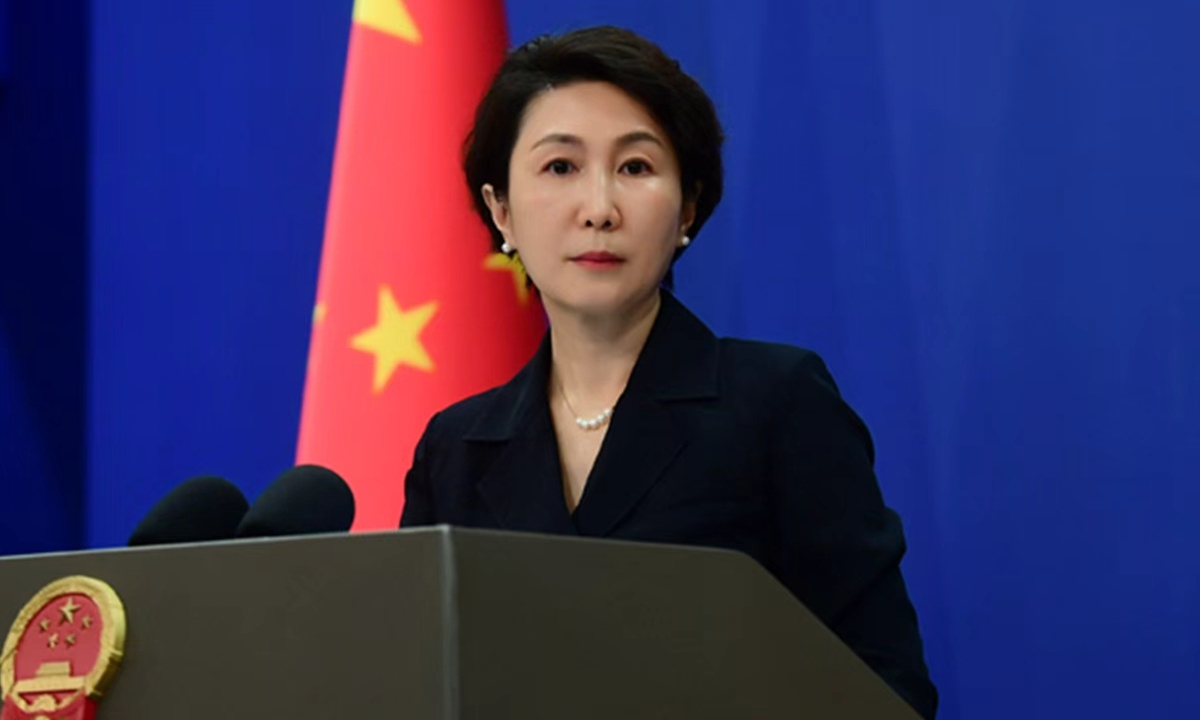
Chinese foreign ministry spokesperson Mao Ning
When asked by foreign media about the current situation in Iran and the impact that the closure of the Strait of Hormuz could have on China's imports and energy security, Mao Ning, a spokesperson for China's Ministry of Foreign Affairs, said at a regular press conference on Monday that the Strait of Hormuz and its surrounding waters are vital international channels for the trade of goods and energy, and that safeguarding security and stability in this region serves the common interests of the international community.
China urges all parties to immediately cease military actions, prevent further escalation of tensions, and avoid regional instability that could have a greater impact on global economic development, the spokesperson said.
Global Times
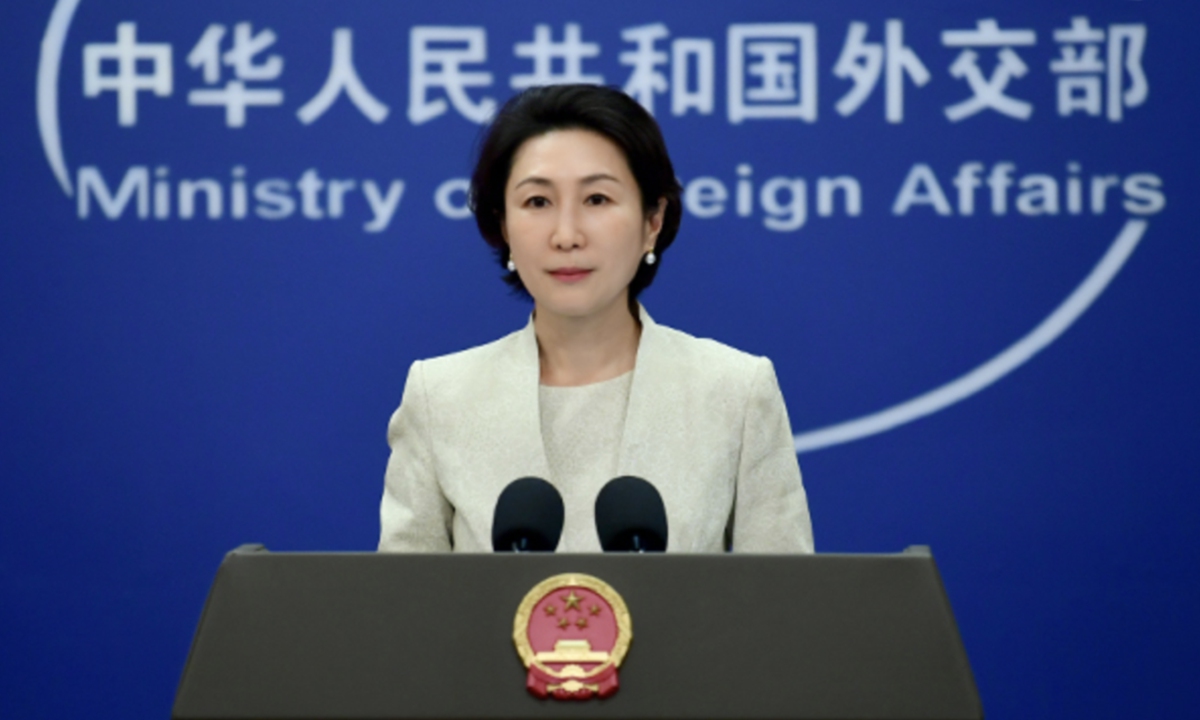
Chinese FM spokesperson Mao Ning
The Chinese Foreign Ministry spokesperson Mao Ning confirmed on Monday that a Chinese citizen in Tehran had unfortunately been killed amid the ongoing military conflicts when asked about more details on injured citizen that Chinese Foreign Ministry confirmed yesterday.
"We express our condolences for the deceased compatriot and our sympathies to the family," Mao said. The Foreign Ministry has instructed the Chinese Embassy in Iran to provide assistance to the individual involved and the family, she said.
Chinese foreign ministry spokesperson Mao Ning
The US and Israel carried out military strikes against Iran without authorization from the UN Security Council, which violates the international law. China is deeply concerned about the spillover of the conflict affecting neighboring countries. China believes that the sovereignty, security and territorial integrity of Gulf countries should also be fully respected. We urge all parties to cease military actions and prevent further escalation of the conflict, Chinese Foreign Ministry spokesperson Mao Ning said, in response to a question on that since the US and Israel launched military strikes against Iran on February 28, US military targets in Gulf Cooperation Council (GCC) countries and Jordan have been attacked, which relevant countries have issued statements to condemn.Mao said China appreciates that the extraordinary meeting of the GCC foreign ministers emphasized that dialogue and diplomacy are the only way to overcome the current crisis and safeguard regional security. Given the complex and sensitive situation in the region, China supports regional countries in strengthening communication and coordination in the spirit of good-neighborliness and friendship, and jointly working toward regional peace and stability.
Global Times
In a statement, the Turkish Trade Ministry said that same-day visits have been mutually suspended at three main land border gates as a precautionary measure.
The ministry emphasized that there is no extraordinary situation at the crossings, and commercial cargo continues to move between the two countries in a controlled and orderly manner.
It added that Iran is permitting its citizens to enter its territory through Türkiye, and Türkiye continues to allow entry for its own citizens as well as third-country nationals arriving from Iran.
Highlighting its preparedness, the ministry said that all relevant units remain on high alert, with additional personnel and control infrastructure strengthened.
A statement issued by the President's Media Division (PMD) said tourists currently in Sri Lanka will receive a free two-week extension of visa validity to ease practical difficulties caused by travel disruptions in the Middle East. The government also instructed the Ministry of Foreign Affairs to work with relevant embassies to provide necessary facilities for tourists and ensure their safety and welfare.
With airspace closures reported in several Middle Eastern countries, the Foreign Affairs Ministry will coordinate with airlines to explore alternative routes to help tourists return home. Officials also said they will discuss alternative travel options to ensure visitors planning to come to Sri Lanka can arrive without disruption.
Meanwhile, the Sri Lanka Bureau of Foreign Employment opened a special operations center for migrant workers abroad, the PMD said. The Foreign Affairs Ministry said it has coordinated with Sri Lankan diplomatic missions across the Middle East to establish an integrated mechanism, with missions and the foreign employment bureau on standby to respond to emergencies.
Israel began striking Beirut and other areas in Lebanon overnight, after Hezbollah fired missiles and drones towards Israel in retaliation for the killing of Iran's Supreme Leader Ali Khamenei.
"We will take steps to defend our interests and those of our allies in the region," said a joint statement released on Sunday, "potentially through enabling necessary and proportionate defensive action to destroy Iran's capability to fire missiles and drones at their source."
"We have agreed to work together with the U.S. and allies in the region on this matter," it added.
Also on Sunday, British Prime Minister Keir Starmer said Britain has accepted the U.S. request to use British bases "for that specific and limited defensive purpose."
"Our partners in the Gulf have asked us to do more to defend them ... We have British jets in the air as part of coordinated defensive operations which have already successfully intercepted Iranian strikes," said Starmer.
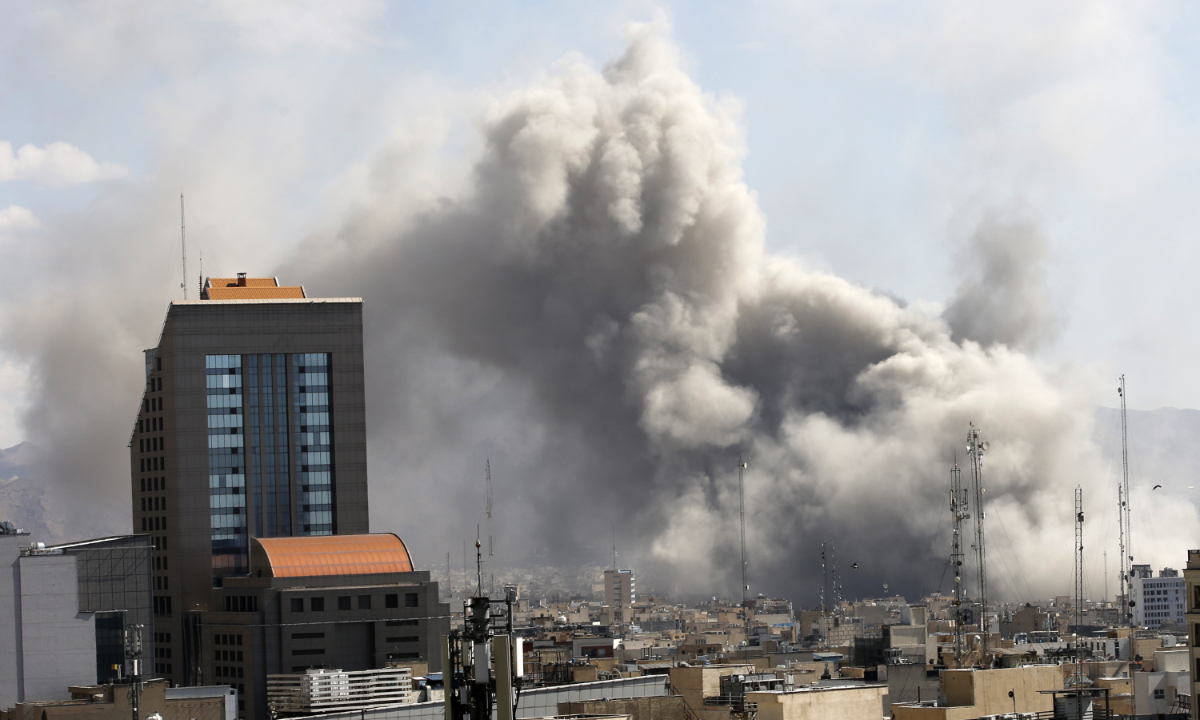
Plumes of smoke rise over the residential areas of the Iranian capital following airstrikes amid ongoing US-Israeli attacks as multiple explosions are heard across the city in Tehran, Iran, on March 01, 2026. Photo: VCG
As Washington signaled that its conflict with Iran could last up to four weeks on Sunday local time, media scrutiny over US ammunition stockpiles has risen. A Chinese military affairs expert told the Global Times that although the US made relatively large-scale preparations for its strikes on Iran, limited ammunition reserves and declining defense industrial capacity may constrain its ability to sustain a prolonged high-intensity war.
The US President Donald Trump said on Sunday that the US military intends to sustain its assault on Iran for "four to five weeks" if necessary, insisting that it "won't be difficult" for Israel and the US to maintain the intensity of the battle even as he warned of the possibility of more American casualties, the New York Times reported.
However, the report said that Trump made no mention of the Pentagon's concerns that the conflict could further deplete reserves that military strategists have said are critical to retain.
Before the US-Israeli attacks began, media reports had already raised concerns about the state of US ammunition stockpiles.
The Israeli strikes targeted Dahieh, a Hezbollah stronghold in the southern suburbs of the Lebanese capital, prompting residents to flee their homes amid fears of further escalation, according to the report. Ambulances rushed to the affected areas to evacuate casualties. No official toll was immediately available.
Lebanon's Hezbollah group said in a statement that it had launched rockets and drones toward Israel in retaliation for the Saturday killing of Iran's Supreme Leader Ayatollah Ali Khamenei in joint Israeli-U.S. strikes on Iran.
"In retaliation for the pure blood of the Guardian of the Muslims ... which was unjustly and treacherously shed by the criminal Zionist enemy, and in defense of Lebanon and its people ... the Islamic Resistance (in Lebanon) targeted, shortly after midnight between Sunday and Monday, March 2, 2026, the Mishmar HaCarmel missile defense site south of the occupied city of Haifa with a salvo of advanced rockets and a swarm of drones," the group said.
Lebanese Prime Minister Nawaf Salam condemned the rocket attack and warned against dragging the country into further conflict.
"They want to talk, and I have agreed to talk, so I will be talking to them," Trump was quoted as saying by The Atlantic magazine in a phone interview.
"They should have done it sooner. They should have given what was very practical and easy to do sooner. They waited too long," said Trump. He did not specify whom he would speak with.
Asked whether his conversation with the Iranian side would happen in two days, Trump said, "I can't tell you that."
He said that some of the previous Iranian negotiators were no longer alive.
One rocket was intercepted by air defenses while the others fell in open areas, the military said in a statement. The launches triggered air raid sirens across northern Israel.
Israel's Magen David Adom rescue service said there were no immediate reports of casualties from the strikes, though several people sustained minor injuries while running to shelters.
Fire from Lebanon has been rare since a fragile ceasefire between Israel and Hezbollah came into effect in November 2024. Israel has continued to carry out frequent airstrikes in southern and eastern Lebanon, claiming they are aimed at thwarting "threats."
The rocket fire followed a formal eulogy from Hezbollah on Sunday, in which the group's chief, Naim Qassem, described the Israeli assassination of Iranian Supreme Leader Ali Khamenei as "the height of crime."
U.S. President Donald Trump said in a post early Sunday morning that Iran should not retaliate.
"Iran just stated that they are going to hit very hard today, harder than they have ever hit before. THEY BETTER NOT DO THAT, HOWEVER, BECAUSE IF THEY DO, WE WILL HIT THEM WITH A FORCE THAT HAS NEVER BEEN SEEN BEFORE!" Trump wrote on his social media platform Truth Social.
In response, Araghchi told ABC News: "I don't think any leader of a country has the right to say so. No."
"We are defending ourselves, and we have every right, every legitimate right, to defend ourselves," said Araghchi. "What we are doing is the act of self-defense. There are huge differences between these two," he said.
Penny Wong told the Australian Broadcasting Corporation television that the federal government is awaiting updates on the resumption of commercial flights through the Middle East before committing to repatriation flights for stranded citizens.
"Given the number of people in the region, people will get home most quickly if we can facilitate people getting on commercial flights at the moment," she said.
In a statement issued earlier on Monday, Wong said that the government is now advising Australians not to travel to Bahrain, Iran, Iraq, Israel, Kuwait, Lebanon, Palestine, Qatar, Syria, the United Arab Emirates and Yemen.
Additionally, she said that Australians should reconsider the need to travel to Jordan, Oman and Saudi Arabia.
A strong blast was heard in the vicinity of the British air base, with sirens activated and aircraft seen taking off from the facility, according to Philenews.
Meanwhile, Cyprus Mail reported that around midnight, UK military personnel stationed at the base were instructed to take cover after the explosion was heard.
According to the report, personnel were informed of the situation and advised to return to their residences and remain indoors until further notice.
It remains unclear whether there have been any casualties or the extent of the damage caused.
"I have just been informed that we have destroyed and sunk 9 Iranian Naval Ships, some of them relatively large and important," Trump said in a post on Truth Social.
"In a different attack, we largely destroyed their Naval Headquarters," Trump said, adding that the U.S. military is going after the rest of the Iranian navy's fleet.
Earlier on Sunday, Trump told Fox News that 48 senior Iranian officials have been killed in the U.S.-Israeli strikes on Iran.
The U.S. Central Command also said on Sunday that U.S. forces struck an Iranian Jamaran-class corvette at the start of the military campaign dubbed Operation Epic Fury on Saturday morning.
The Daily Mail said Trump "broke his silence" on the first U.S. casualties in the conflict. Three U.S. soldiers were killed in action and five others seriously injured as part of the military operation against Iran, the U.S. Central Command said Sunday.
Trump acknowledged the deaths were the first casualties of his second term, the report said.
On the potential duration of the war, Trump suggested the fighting could continue for weeks. "It's always been a four week process. We figured it will be four weeks or so. It's always been about a four week process so -- as strong as it is, it's a big country, it'll take four weeks -- or less," he said.
Trump told the Daily Mail he was not surprised by the outcomes of the strikes so far.
The Islamic Revolutionary Guard Corps said a precision missile destroyed a radar of the Terminal High Altitude Area Defense (THAAD) in Al-Ruwais, Tasnim reported, citing the IRGC.
In a separate strike, a U.S. carrier group refueling ship was hit by drone and missile fire 700 km off Iran's southeastern city of Chabahar, leaving it "non-operational," the report said.
Tasnim said IRGC anti-submarine missile units are tracking the U.S. naval fleet in the region. It provided no further details.
The strikes are part of what Iran calls "Operation True Promise 4," retaliatory attacks following joint U.S.-Israeli strikes on Saturday that killed Iran's Supreme Leader Ali Khamenei, several other high-ranking officials, and more than 100 civilians.
A PMF statement blamed the attack on "Israeli-American bombardment" targeting its 41st Brigade near the town of Miqdadiyah, some 90 km northeast of the capital Baghdad.
A provincial security source told Xinhua on condition of anonymity that two additional PMF members were wounded in the strike on a rural position.
The PMF held a funeral procession in Baghdad later on Sunday, with senior PMF leadership and citizens in attendance.
The strike comes amid sharply heightened tensions following a joint U.S.-Israeli attack on Iran on Saturday and subsequent retaliatory missile and drone launches by Tehran toward Israel and U.S. assets across the Middle East.
In a statement on its official outlet Sepah News, the IRGC said it also targeted U.S. military installations in Kuwait and Bahrain. It said strikes on Ali Al Salem Air Base in Kuwait rendered it completely out of service, destroyed three naval infrastructure structures at the Mohammed Al-Ahmad naval base, and hit a U.S. naval command and backup center in Bahrain.
Another U.S. base in Bahrain was reportedly hit by two ballistic missiles. The IRGC claimed the attacks caused 560 U.S. casualties, though the U.S. has not confirmed the report.
Following the announcement, International Maritime Organization Secretary General Arsenio Dominguez urged shipping companies to exercise "maximum caution" and, where possible, avoid the affected region. He stressed that freedom of navigation is a "fundamental principle of international maritime law."
The strikes came a day after U.S. and Israeli forces launched large-scale attacks on Iran, killing Supreme Leader Ali Khamenei and several senior officials, prompting retaliatory attacks by Iran on U.S. and Israeli targets across the Middle East.
Several others sustained minor shrapnel injuries and concussions, said the command in a statement on social media, adding that they are "in the process of being returned to duty."
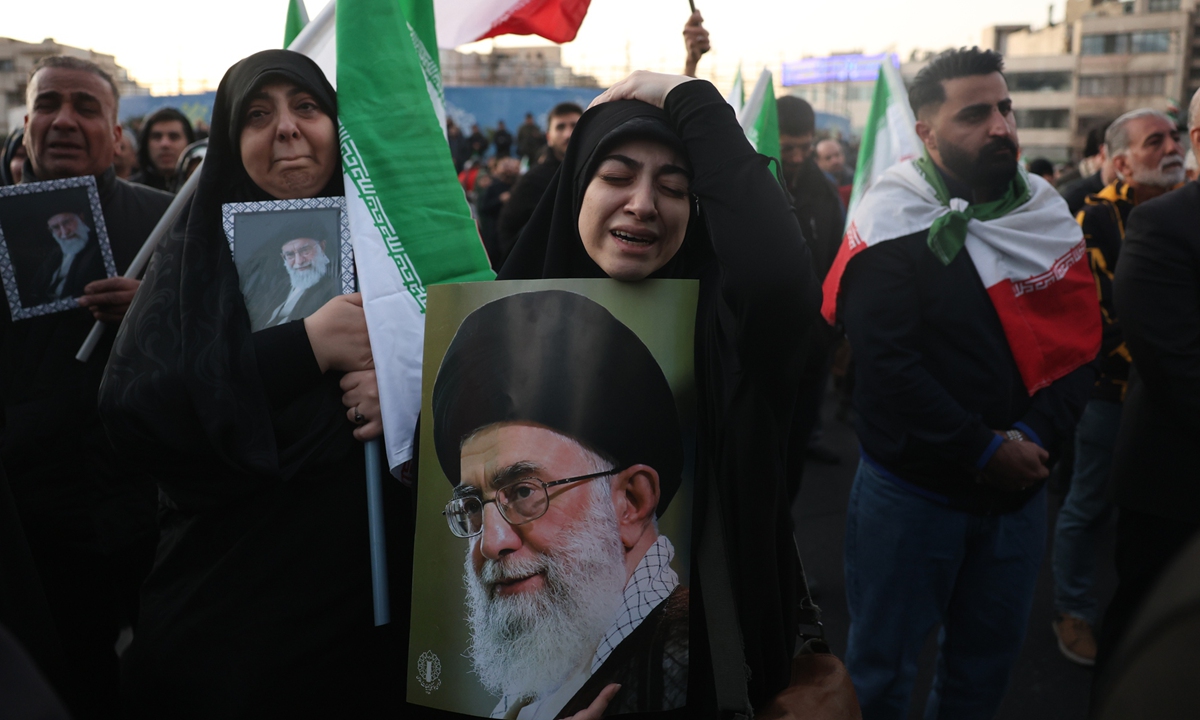
Mourners hold pictures of Iranian Supreme Leader Ayatollah Ali Khamenei at Enqelab Square in Tehran on March 1, 2026 after local media confirmed his death. Photo: VCG
China on Sunday strongly condemned the killing of Iran's Supreme Leader Ayatollah Ali Khamenei, calling the move "a grave violation of Iran's sovereignty and security."The US-Israeli strikes against Iran have drawn widespread attention and condemnation from international observers and media outlets, with Al Jazeera describing them as "the most aggressive escalation yet of US reliance on military force to pressure foreign governments."
Chinese experts warned that the operation represents a high-stakes gamble that could draw Washington into a prolonged and widening crisis it may struggle to control. They also warned that the US' killing of another country's leader, if becoming a pattern of behavior, would further complicate the global security landscape and provoke even more extreme acts of retaliation.
A spokesperson with the Chinese Foreign Ministry said on Sunday in a statement that the attack and killing of Iran's supreme leader is a grave violation of Iran's sovereignty and security. It tramples on the purposes and principles of the UN Charter and basic norms in international relations.
"China firmly opposes and strongly condemns it. We urge for an immediate stop to the military operations, no further escalation of the tense situation and joint effort to maintain peace and stability in the Middle East and the world at large," read the statement.

Photo: courtesy of the Azerbaijani Overseas Chinese Association

Photo: courtesy of the Azerbaijani Overseas Chinese Association
The first batch of 18 Chinese nationals from Iran had crossed the Astara border and are traveling by bus to Baku, the capital of Azerbaijan, Bao Lijun, president of the Azerbaijani Overseas Chinese Association, told the Global Times at around 11 pm on Sunday. He added that in about four hours, another roughly 50 Chinese nationals in Iran would also evacuate overland to Baku.
The evacuation was organized by the Chinese Embassy in Azerbaijan and supported by the Azerbaijani Overseas Chinese Association, Bao noted.

latest news
On February 28, the US and Israel launched military operations against Iran. Iranian forces carried out strikes on US military bases in the Middle East region. Some neighboring countries to Iran have closed their airspace, and international flights have been suspended. There has been Chinese national injured in the attacks, and some temporary travelers are stranded locally.
Against the backdrop, the Chinese Ministry of Foreign Affairs reminded Chinese citizens Sunday evening to closely monitor developments in the situation and temporarily avoid traveling to countries and regions around Iran that have been affected by military actions.
Chinese citizens already in the above-mentioned countries and regions should further strengthen personal safety precautions, and avoid going to military facilities, protest gatherings, or other sensitive areas, the ministry urged on Sunday.
Global Times
"We offer our condolences to the Iranian people and the entire Islamic nation," al-Awadi said in a statement, calling for a halt to military operations that are escalating the region.
Iraq also declared three days of national mourning for Khamenei, the killing of whom sparked violent protests near the U.S. Embassy in Baghdad.
An Iraqi Interior Ministry source told Xinhua that demonstrators attempted at dawn to storm the U.S. embassy's entrance near the Suspension Bridge, protesting the U.S.-Israeli attack.
Riot police used tear gas and water cannons to disperse crowds attempting to breach the U.S. embassy, the source said on condition of anonymity, noting that hand-to-hand skirmishes occurred as protesters tried to push through the perimeter.
Wang, also a member of the Political Bureau of the Communist Party of China Central Committee, made the remarks during a phone conversation with Russian Foreign Minister Sergei Lavrov.
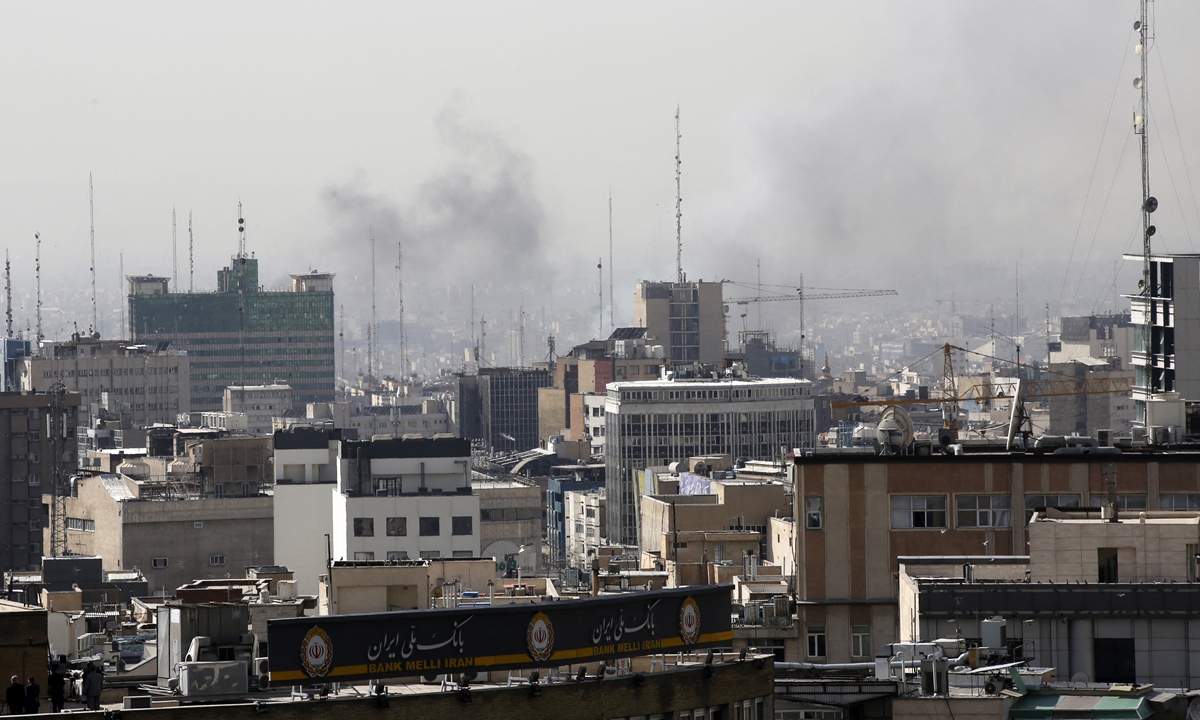
Multiple targets are attacked and an explosion occurs in Tehran, Iran on February 28, 2026. Photo: IC
After Iran's state media confirmed Sunday that Supreme Leader Ayatollah Ali Khamenei was killed in US-Israeli attacks on Saturday, a Chinese military affair expert analyzed the military tactics deployed by the US to the Global Times, noting that the US has amassed forces around Iran and gathered intelligence, before simultaneously targeting Iranian military facilities and top leadership figures in the first wave of attacks. Meanwhile, Iran likely also has pre-planned its counter-strike strategy, launching missile attacks on an unprecedented scale.
In terms of US forces gathered around Iran over the past month, US media outlet the Military Times reported on Friday, a day before the initial strikes on Saturday, that the US built up the largest force of American warships and aircraft in the Middle East in decades.
The aircraft carrier USS Abraham Lincoln and three guided-missile destroyers have been in the Arabian Sea since the end of January. Two weeks later, US administration ordered the world's largest aircraft carrier, the USS Gerald R. Ford, along with three destroyers and more than 5,000 additional service members to head there, said the report.
According to the Military Times, numerous additional US fighter jets and support aircraft also have touched down in the Middle East and bases in Europe. More than 100 fighter jets, including F-35s, F-22s, F-15s and F-16s, left bases in the US and Europe and were spotted heading toward the Middle East.
The clashes erupted on Mai Kolachi Road when demonstrators tried to enter the premises, prompting security forces to respond, according to Rescue 1122 Sindh.
The injured were shifted to nearby hospitals, Hassan Ul Haseeb, spokesperson for Rescue 1122 Sindh, told Xinhua. Many of them are in critical condition.
Who opened fire was uncertain at the moment, the spokesperson said, adding that most of the injured sustained bullet wounds while others suffered baton injuries.
According to a statement by the Edhi rescue service, law enforcement personnel resorted to teargas shelling and baton charge to control the situation.
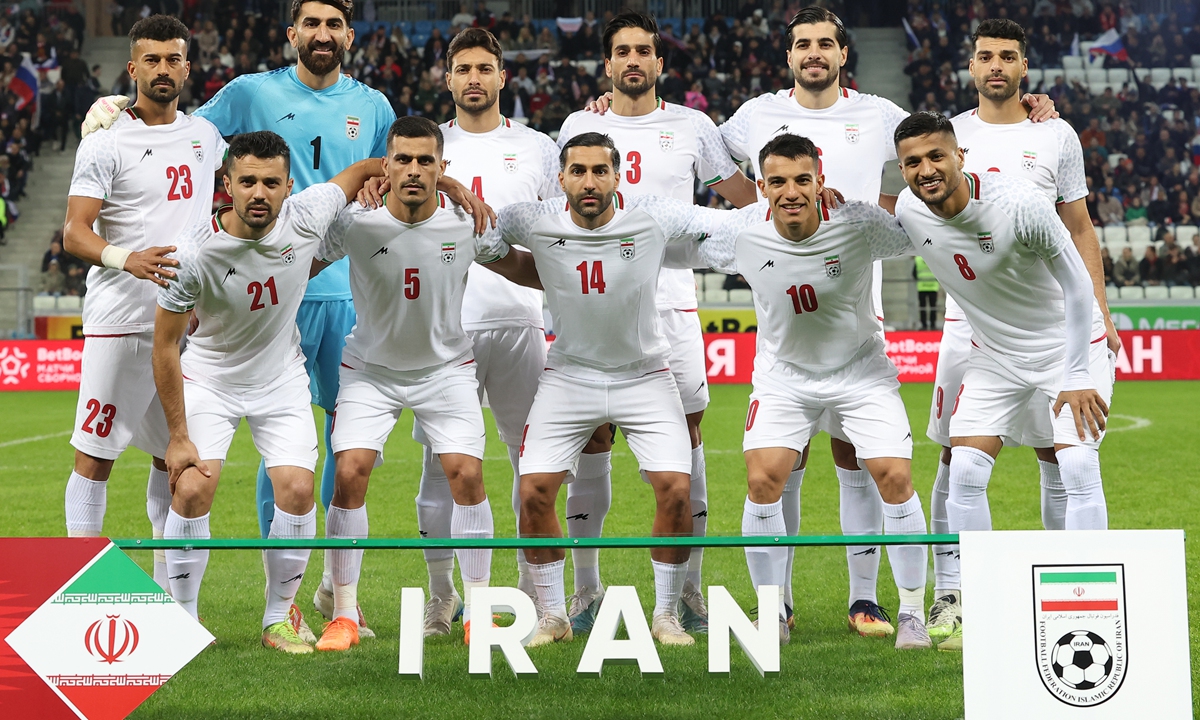
Iranian national football team players pose for a photo ahead of a friendly match between Russia and Iran at Volgograd Arena in Volgograd, Russia, on October 10, 2025. Photo: VCG
Iran's participation to the upcoming FIFA World Cup, set to be co-hosted by the US, Canada and Mexico this summer, is hanging under a heavy cloud amid escalating military tensions after the joint US and Israeli strikes on Iranian targets.
The attacks, which began on Saturday and resulted in the death of Iran's Supreme Leader Ayatollah Ali Khamenei and several other high-ranking officials, have prompted discussions about whether the Iranian national team can safely compete, particularly with group-stage matches scheduled on US soil.
Iran secured its spot in the tournament through the Asian Football Confederation qualifiers, topping Group A in the third round with 23 points, ahead of Uzbekistan and the United Arab Emirates.
Drawn into Group G alongside Belgium, New Zealand and Egypt, Iran is slated to play two matches at SoFi Stadium in Inglewood, California, against New Zealand on June 15 and Belgium on June 21, followed by a third against Egypt in Seattle on June 26. The team had planned to base its training camp in Tucson, Arizona.
FIFA Secretary General Mattias Grafstrom was quoted by ESPN stating that the FIFA will "monitor developments" in Iran ahead of the tournament, emphasizing a focus on "everybody participating" while prioritizing safety.
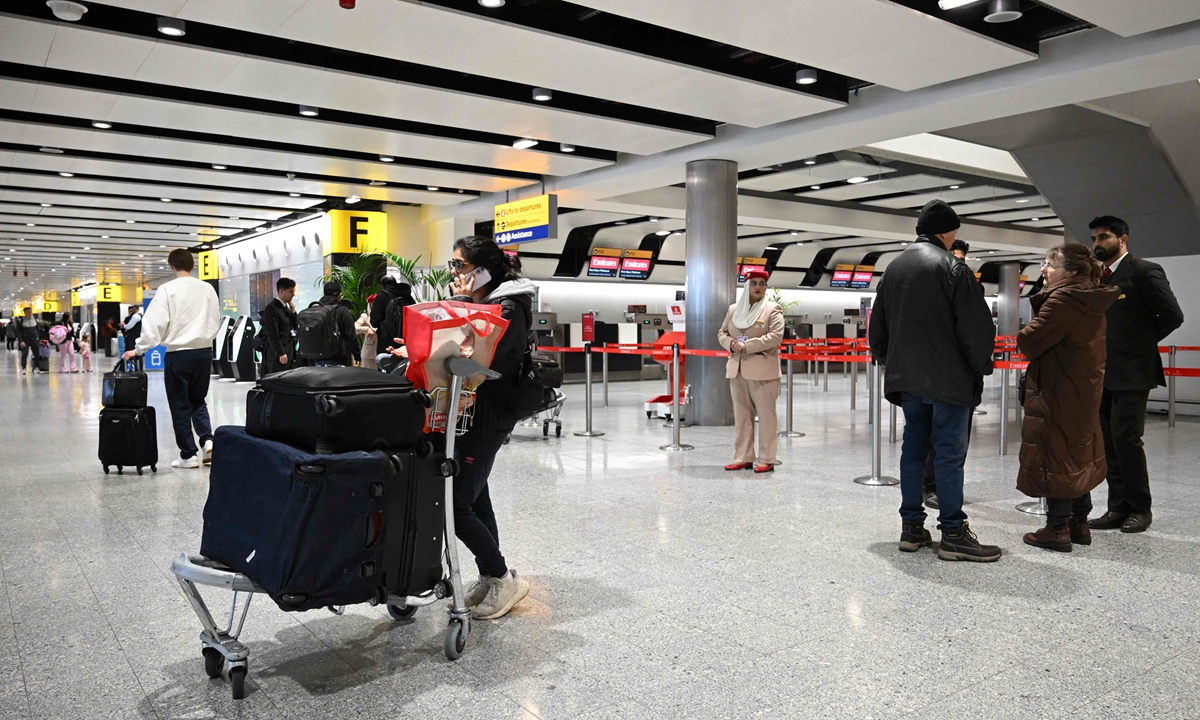
Passengers gather at the closed Emirates check-in area at London Heathrow Airport in west London on March 1, 2026, as flights are severely disrupted following the US and Israeli strikes on Iran. Photo: VCG
Air raid sirens sounded in Kuwait, the United Arab Emirates, Qatar and Bahrain in the early hours, news agencies reported, according to Iran International.
In Kuwait, civil aviation authorities confirmed that the country's main airport was struck. Kuwait's Directorate General of Civil Aviation, through its official spokesperson Abdullah Al-Rajhi, said a drone attacked Kuwait International Airport, causing minor injuries among several employees and limited material damage to the passenger terminal (T1), according to Erem News, a media outlet in Abu Dhabi.
A Chinese traveler stranded at Kuwait International Airport who requested anonymity told the Global Times that on Saturday evening local time, he heard a sound like "an explosion from an adjacent departure lounge." Airport staff later instructed passengers to wait for hotel arrangements and subsequently transferred him to a hotel near the airport.
Another stranded Chinese traveler at Kuwait International Airport surnamed Wu said the drone strike mainly affected Terminals 1 and 2, while Terminal 4 was relatively less impacted. He said more than 20 Chinese travelers joined a mutual-assistance group for Chinese nationals. All are currently accommodated in airport-arranged hotels awaiting further updates.
Secretary of Iran's Supreme National Security Council Ali Larijani made the remarks in an interview with state-run IRIB TV hours after the country confirmed the death of its Supreme Leader Ali Khamenei in strikes launched by the United States and Israel on Saturday in Tehran.
Larijani said that according to Article 111 of Iran's Constitution, if the country lacks leadership, its president, judiciary chief and a jurist from the Constitutional Council will temporarily assume the leader's responsibilities.
He added that the council will be set up as soon as possible.
The security council chief said that the entire nation has become mournful and angry, and will respond to the Israeli and U.S. actions.
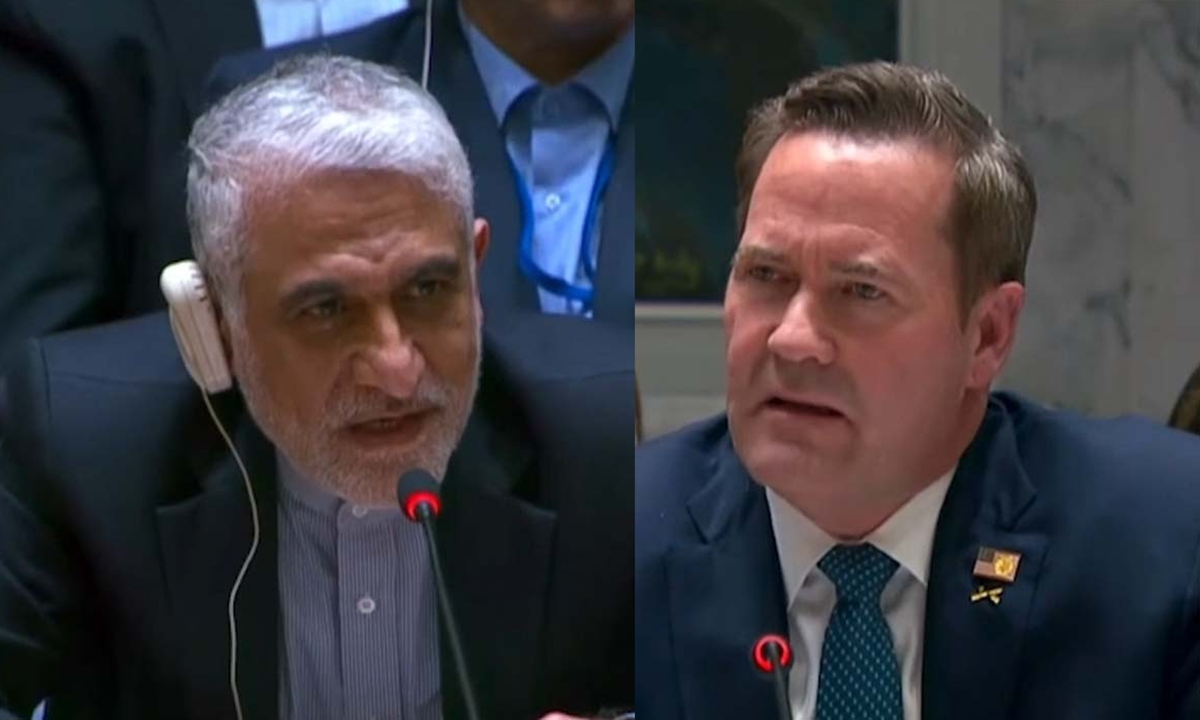
Amir Saeid Iravani (left), Iran's ambassador to the United Nations, and Mike Waltz, the US ambassador, engage in a tense back-and-forth at an emergency meeting of the UN Security Council on February 28 local time. Photo: Screenshot from the website.
In the afternoon of Saturday local time, just hours after the US and Israel launched the military campaign against Iran, the UN Security Council convened an emergency meeting on the situation in Iran, during which representatives of Iran and the US collided head on and engaged in a fierce war of words.
Amir Saeid Iravani, Iranian ambassador to the UN, said hundreds of civilians have been killed or injured on the first day of the US and Israel's "unprovoked and premeditated aggression against Iran."
"The aggression and atrocious crimes of the US regime and the Israeli regime, and their deliberate and persistent targeting of civilian infrastructure, are ongoing," he said during the emergency UN Security Council session. "This is not only an act of aggression; it is a war crime and a crime against humanity."
US Ambassador Mike Waltz pushed back, claiming that Iran's menacing activities directly endanger the interests of the US and its partners and allies, and that actions taken by the US and Israel are consistent with the UN Charter.
After US Ambassador responded to Iranian claims that America had violated international law, Tehran's diplomat to the UN asked to speak again to issue a warning: "I advise to the representative of the US to be polite. It will be better for yourself and the country you represent."
The strikes on Tehran also killed Chief Commander of the Islamic Revolutionary Guard Corps Mohammad Pakpour, Secretary of the country's Defense Council Ali Shamkhani, and Defense Minister Aziz Nasirzadeh.
Additional names of victims will be released subsequently, according to local media reports.

The bus used to transfer Chinese nationals in Iran to Baku, the capital of Azerbaijan Photo: courtesy of Azerbaijani Overseas Chinese Association
Bao Lijun, president of the Azerbaijani Overseas Chinese Association, told the Global Times on Sunday that the first batch of more than 10 Chinese nationals in Iran have arrived at the Astara border crossing. Next, according to the arrangements, they will be safely transported to Baku, the capital of Azerbaijan.On February 28, the US and Israel launched military strikes against Iran, prompting retaliatory operations. Chinese Ministry of Foreign Affairs and Chinese embassy and consulates in Iran on Sunday reminded Chinese nationals in Iran to closely monitor changes in the situation, strengthen personal safety precautions, and evacuate to safe areas as soon as possible through appropriate means.
The feasible evacuations routes are through Azerbaijan, Armenia, Turkey and Iraq, per the statement.
Global Times
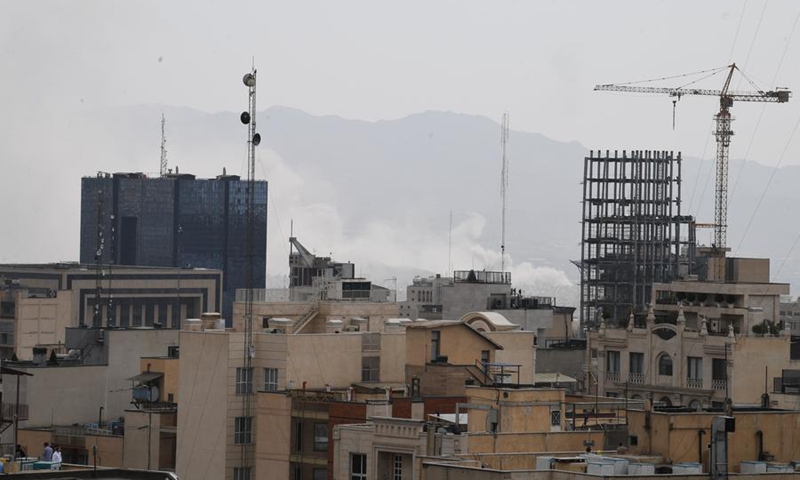
This photo taken on Feb. 28, 2026 shows thick smoke rising in downtown Tehran, Iran. (Xinhua/Shadati)
Multiple world leaders expressed concerns after the United States and Israel on Saturday launched "major combat operations" against Iran and Iran retaliated with a series of counterattacks against Israel and U.S. targets across the region.
Casualties were reported and airspace closures spread across parts of the Middle East. The sharp escalation prompted swift international reactions, raising fears of a wider regional conflict and urging an immediate return to diplomacy.
Russian Foreign Ministry denounced the U.S. and Israeli airstrikes as a "premeditated and unprovoked act of armed aggression" against a sovereign United Nations member state in violation of international law, calling for an immediate return to political and diplomatic efforts to resolve regional tensions.
Leaders of the European Union issued a joint statement, expressing concerns over "the developments in Iran" and reaffirming commitments to "safeguarding regional security and stability."
"We call on all parties to exercise maximum restraint, to protect civilians, and to fully respect international law," said the statement.
The attack also left 95 people wounded, local prosecutor Ebrahim Taheri was quoted as saying.
He said the majority of the victims of the brutal attack were pupils, with teachers, school staff and students' parents also among the dead.
On Saturday morning, Israel and the United States launched joint attacks on Tehran and several other Iranian cities, including Tabriz, Qom, Isfahan, Kermanshah, and Karaj. Iran responded with missile and drone strikes targeting Israel and U.S. bases across the region.
The attacks on Tehran killed Iran's Supreme Leader Ali Khamenei, Secretary of the country's Defense Council Ali Shamkhani and Mohammad Pakpour, chief commander of the Islamic Revolutionary Guard Corps.
Multiple targets are attacked and an explosion occurs in Tehran, Iran on February 28, 2026. Photo: IC
According to Mehr News Agency on Sunday, the Iranian government issued a statement following the martyrdom of Iran's Supreme Leader, Ayatollah Ali Khamenei, vowing to make the enemies "pay a heavy price" with "all its strength and determination." The statement declared a 40-day period of national mourning and a 7-day shutdown of public institutions, Xinhua News Agency reported.
The US and Iran launched large air strikes on Tehran and other Iranian cities on Saturday local time, prompting retaliatory operations from Iran.
The latest Iranian government statement came after the news of its Supreme Leader Ayatollah Ali Khamenei's death. The statement also said that the Iranian people would unite as one to overcome the difficulties, per Xinhua.
Iranian President Masoud Pezeshkian has denounced Khamenei's killing "as a great crime" and promised to respond, according to a statement from his office, Al Jazeera reported.
The official IRNA news agency reported that a three-person council, consisting of the country's president, the chief of the judiciary, and one of the jurists of the Guardian Council, will temporarily assume all leadership duties in the country.
A plume of smoke was seen rising from the port of Jebel Ali.
Fox News, citing Israeli officials, also said that Saturday's strikes killed more than 40 senior Iranian security and government figures, noting that five to 10 top Iranian leaders were killed, along with Supreme Leader Ayatollah Ali Khamenei, who were meeting at a compound in Tehran.
Earlier Saturday, when announcing Khamenei's death, US President Donald Trump said the massive military campaign against Iran will continue.
"The heavy and pinpoint bombing, however, will continue, uninterrupted throughout the week or, as long as necessary," Trump said in a post on social media.
Multiple targets are attacked and an explosion occurs in Tehran, Iran on February 28, 2026. Photo: IC
The Chinese Foreign Ministry and Chinese embassies and consulates in Iran on Sunday have reminded Chinese citizens in the country to evacuate to safe areas as soon as possible through appropriate means after US and Israel launched military operations against Iran.
The embassy said that on February 28, the US and Israel launched military operations against Iran. The Chinese Foreign Ministry and Chinese embassies and consulates in Iran have reminded Chinese citizens in the country to closely monitor developments, strengthen personal safety precautions, and evacuate to safe areas as soon as possible through appropriate means.
According to available information, several overland evacuation routes remain accessible. Chinese nationals may enter Azerbaijan visa-free via the Astara border crossing, which operates daily from 9:00 am to 4:00 pm. Visa-free entry is also available through the Agarak crossing into Armenia. Overland routes into Turkey remain open through border crossings in Van, Ağrı and Hakkâri provinces, where Chinese passport holders are likewise granted visa-free access, according to the Chinese embassy.
Those seeking to enter Iraq may do so via the Shalamcheh border crossing, provided they obtain an electronic visa in advance or apply for a temporary visa on arrival.
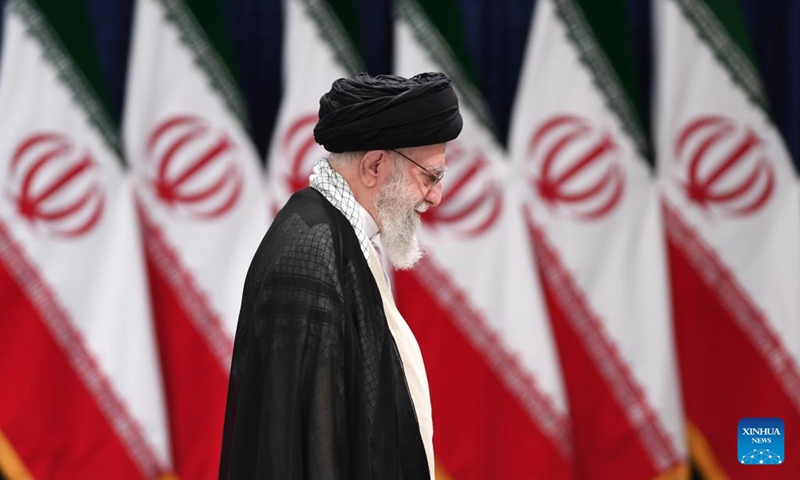
This file photo taken on June 28, 2024 shows Iran's Supreme Leader Ali Khamenei attending Iran's 14th presidential election at a polling station in Tehran, Iran. Photo: Xinhua
Iran's Supreme Leader Ayatollah Ali Khamenei was killed in his office on Saturday morning during US-Israeli air strikes, media reported. Iran announced 40 days of mourning and vowed to revenge, warning "the most devastating offensive operation in the history of Iran's armed forces" is set to begin, according to Iranian media.
The death of Iran's supreme leader would be a profound shock to the Islamic Republic, but it is unlikely to bring about the collapse of the regime, as key institutions and succession mechanisms are already in place, a Chinese expert said. The greater risk, the expert warned, lies in what comes next. Such a strike could provoke fierce retaliation from Tehran against the US, potentially drawing Washington into an escalation it may struggle to control. The killing of another country's leader, the expert added, would deepen distrust and anxiety toward the US among other nations, further damaging its global standing.
Iran's Supreme National Security Council said Ayatollah Khamenei was killed early Saturday morning at his office "while he was carrying out tasks," per BBC.
Using satellite imagery, BBC verify earlier confirmed significant damage to parts of the Leadership House compound, which is Khamenei's office in Tehran.
Two Iranian sources told Reuters that Khamenei met on Saturday with Shamkhani and Supreme National Security Council Secretary Ali Larijani at a secure location shortly before the strikes started.
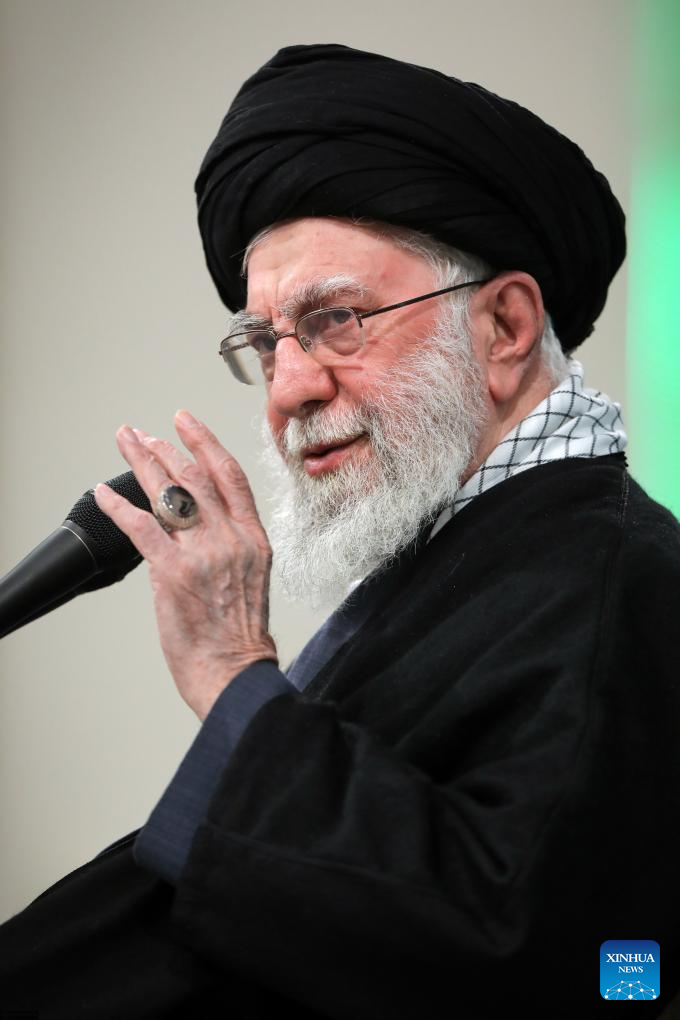
This file photo shows Iranian Supreme Leader Ali Khamenei speaking during an address in Teheran, Iran, on Jan. 17, 2026. (The Office of the Supreme Leader in Iran/Handout via Xinhua)
Iran's state media confirmed Sunday that Supreme Leader Ayatollah Ali Khamenei was killed in US-Israeli attacks on Saturday.
The Iranian government announced a 40-day mourning period after the report of the leader's death.

Gold bullions and gold coins File photo: VCG
The spot price of gold surged past $5,278 per ounce, a notable increase amid escalating geopolitical tensions in the Middle East. Gold prices could hit new highs if the situation in the region intensifies, while crude oil could strengthen further due to worries over possible supply interruptions, analysts said, adding that in the short term, it is unlikely to have a substantial direct impact on China's overall oil supply or consumption.
Gold prices will depend heavily on the intensity of Iran's retaliation and the extent to which the conflict spreads. In the worst-case scenario, gold would become the "ultimate safe haven" for global capital, with prices potentially surging to new highs, Yang Delong, chief economist at Shenzhen-based First Seafront Fund, told the Global Times on Sunday.
Markets were closed over the weekend, but spot gold traded higher in electronic sessions, with analysts widely forecasting a "gap-up" opening on Monday, due to the heightened risk premium.
"The escalation in geopolitical tensions following the US-Israel strikes on Iran has heightened risk premiums ahead of the trading resumption on Monday. Markets are bracing for a classic risk-off response: Safe-haven investments such as gold and silver are poised for a potential upward gap at the open, while crude oil could strengthen further due to worries over possible supply interruptions," Yang said.
Pre-strike gold prices were already elevated, with an all-time high near $5,608 in January, but the fresh escalation has amplified demand, Yang said.
This picture shows a view of Jerusalem with and empty Al-Aqsa Mosque compound and its Dome of the Rock on February 28, 2026. The Israeli military said it detected missiles launched from Iran on February 28 as sirens sounded across several parts of the country, after Israel earlier launched strikes on Iran. Photo: VCG
The Chinese Embassy in Israel on Sunday issued a notice regarding the registration for relocation and evacuation of Chinese nationals in Israel after the US and Israel launched strikes against Iran. Multiple embassies in the Middle East, including those in Turkey, Azerbaijan, and Iraq, have issued notices for Chinese nationals who evacuated from Iran to these countries.
The Chinese Embassy in Israel said that at present, Israel continues to be subjected to missile and drone attacks, and the security situation remains severe, with the possibility of further deterioration not ruled out.
Thus, Chinese nationals currently in Israel (including compatriots from Hong Kong, Macao special administrative regions, and island of Taiwan) are advised, on the premise of ensuring their personal safety, to relocate as soon as possible to safer areas within Israel (away from central Tel Aviv, Haifa, and Jerusalem; away from military units, sensitive institutions, and major transportation hubs; and away from government agencies and key infrastructure facilities) to seek shelter, or to evacuate to Egypt via the Taba border crossing for safety, said the embassy.

Photo: QR code issued by Chinese Embassy in Israel for registration for evacuation and relocation
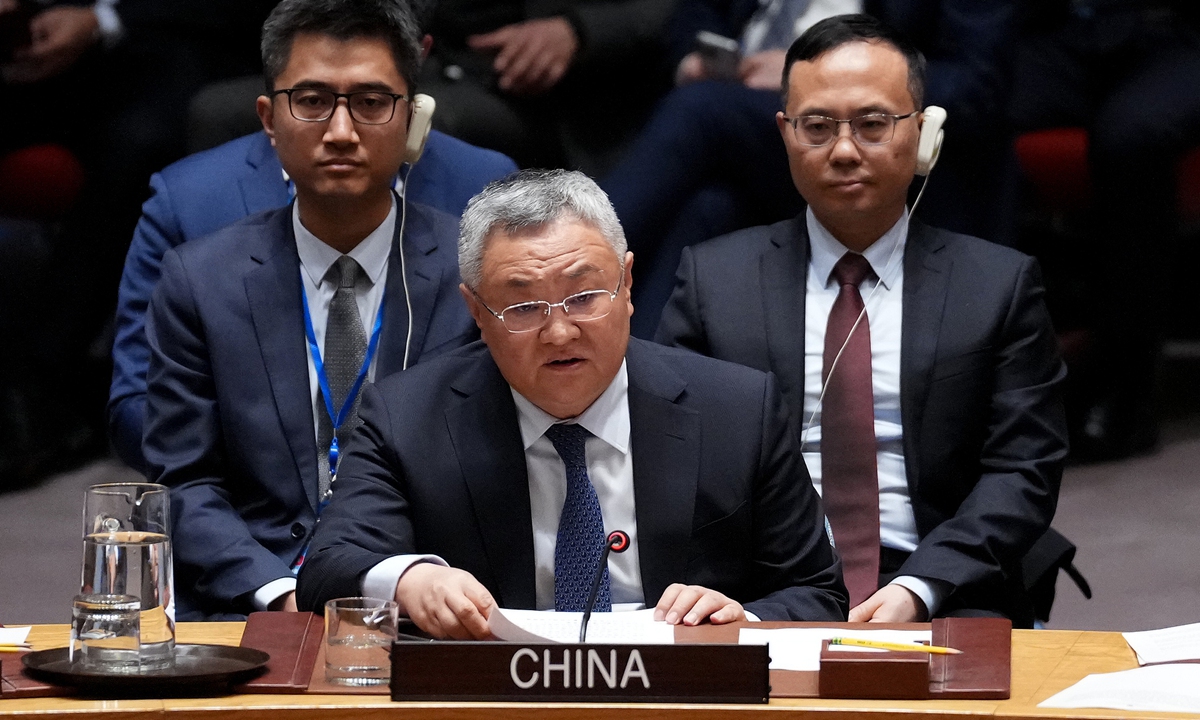
Fu Cong, China's permanent representative to the United Nations (UN), speaks during a UN Security Council meeting in New York on February 28, 2026. Photo: VCG
The UN Security Council held an emergency meeting on the situation in Iran on Saturday local time, during which China's Permanent Representative to the United Nations Fu Cong stated that the US and Israel had brazenly launched military strikes against targets inside Iran, causing a sudden escalation of regional tensions. China expressed deep concern over this.
China has always maintained that all parties should abide by the purposes and principles of the UN Charter and opposes and condemns the use or threat of force in international relations, Fu noted. He stressed that the sovereignty, security and territorial integrity of Iran and other regional countries must be respected.
China was deeply saddened by the large number of civilian casualties caused by the conflict. At all times, the red line of protecting civilians in armed conflicts must not be crossed, and the indiscriminate use of force is unacceptable. He called on all parties to fulfill their obligations under international law, including international humanitarian law, effectively protect the safety of civilians, and avoid attacks on civilian facilities.
Fu noted that the use of force is not the right way to resolve international disputes, but will only exacerbate hatred and contradictions. An escalation and spillover of the situation in the Middle East is not in the interests of any party. Resolving differences through dialogue and negotiation is the only way out. China calls for an immediate end to military actions to prevent a cycle of escalation.
Dubai Media Office said that civil defense teams were able to control the incident without any injuries reported.
In a post on social media platform X, the airport operator confirmed that the deceased was an Asian, and the injured were provided with medical assistance.
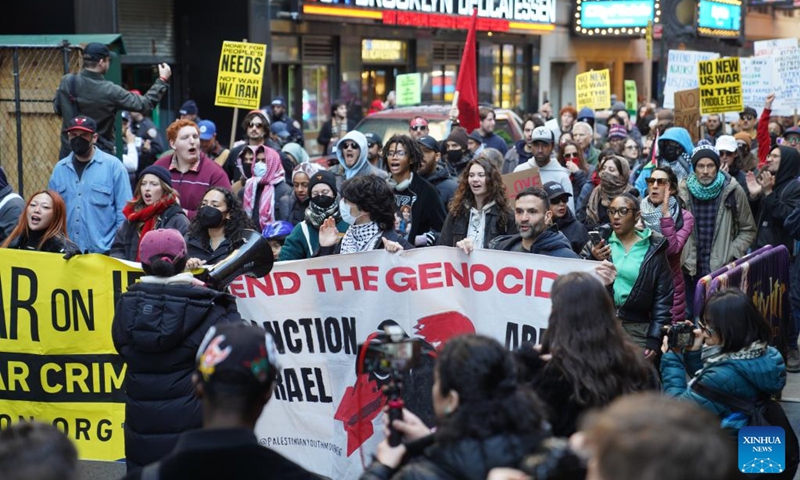
People attend a protest against U.S.-Israeli attacks on Iran, in New York, the United States, on Feb. 28, 2026.Hundreds of New Yorkers rallied in Times Square and then marched along streets in New York City in protest of U.S.-Israel coordinated airstrikes against Iran on Saturday. (Xinhua/Zhang Fengguo)
Hundreds of New Yorkers rallied in Times Square and then marched along streets in New York City in protest of U.S.-Israel coordinated airstrikes against Iran on Saturday.
Participants condemned the latest strikes on Iran and called for money to be spent on education, housing and other domestic priorities.
People held banners reading "Stop the War on Iran," "No Regime Change Wars," "Trump Must Go Now" and others.
Protesters also chanted "From the belly of the beast, hands off the Middle East," "Up up with liberation, down down with occupation" and other slogans.
"We cannot forget that it is the United States that has over 5,000 nuclear warheads ready to be launched. It is the United States that is pointing those nuclear warheads at the towns and cities of everyday people like you and me all across the world," said Layan Fuleihan, education director at The People's Forum, a socialist organization and movement incubator based in New York City.
This file photo taken on June 28, 2024 shows Iran's Supreme Leader Ali Khamenei attending Iran's 14th presidential election at a polling station in Tehran, Iran. U.S. President Donald Trump said on Feb.28, 2026 that Iran's Supreme Leader Ayatollah Ali Khamenei was killed in U.S.-Israeli attacks earlier in the day. Khamenei "is dead," Trump announced in a post on social media platform Truth Social. Meanwhile, Trump said the massive military campaign against Iran will continue. (Xinhua/Shadati)
U.S. President Donald Trump said Saturday that Iran's Supreme Leader Ayatollah Ali Khamenei was killed in U.S.-Israeli attacks earlier in the day.
Khamenei "is dead," Trump announced in a post on social media platform Truth Social.
Meanwhile, Trump said the massive military campaign against Iran will continue.
"The heavy and pinpoint bombing, however, will continue, uninterrupted throughout the week or, as long as necessary to achieve our objective of PEACE THROUGHOUT THE MIDDLE EAST AND, INDEED, THE WORLD!" Trump said in the post.
Trump repeated his earlier call for Iran's Islamic Revolutionary Guard Corps, armed forces and police to lay down their weapons in exchange for immunity.
latest news
The Global Times learned from Tan Kai, president of the Iran Federation of Chinese Organizations, that Chinese nationals in Iran began evacuating on Saturday local time. So far, about 100 people have registered for evacuation. They are scattered across different parts of Iran and are expected to leave in an orderly manner via land border crossings that remain open.
As of press time, the Chinese Embassy in Iran had not confirmed the start of the evacuation.
Earlier on Saturday, the Chinese Embassy in Iran issued a notice evening saying that, according to its understanding, Iran's land border crossings with Azerbaijan, Armenia and Turkey are still open, and Chinese nationals may travel to those crossings on their own provided safety can be ensured. The status of border crossings with Turkmenistan has yet to be verified, according to Tan.
Araghchi said in an exclusive interview with NBC News that two commanders had died, but senior Iranian officials, including the head of the judiciary and the parliament speaker, had survived.
"All high-ranking officials are alive," he said. "We are handling this situation, and everything is fine."
The Ynet Global, an Israeli major daily news source in English, reported that Israeli officials believe Khamenei was killed in the opening strike on Iran.
The Ynet report said Khamenei was among several senior Iranian leaders targeted in the United States' and Israel's coordinated strikes at multiple locations where they had gathered earlier in the day, citing Israeli security assessments.
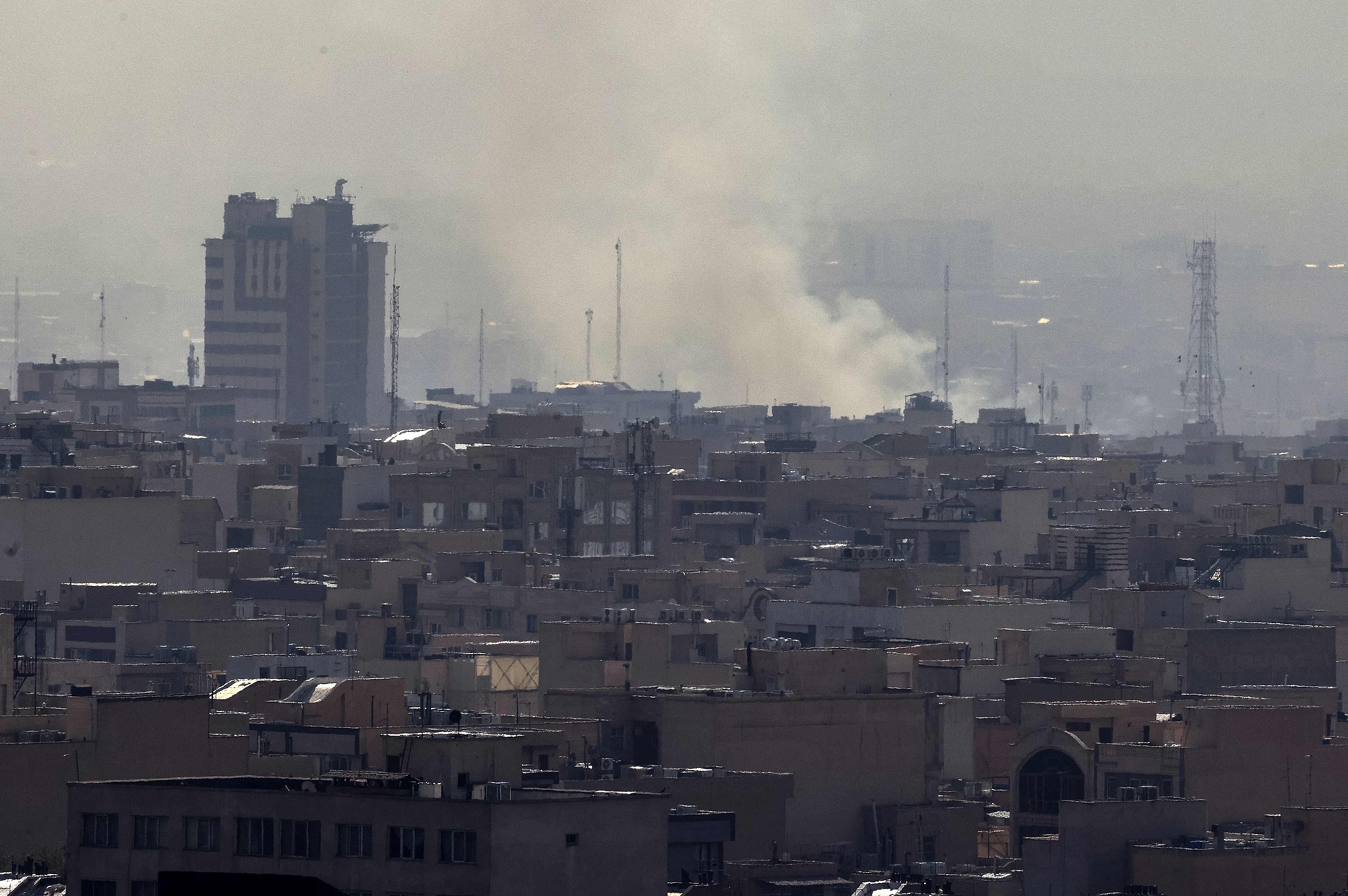
An incoming projectile explodes over the water as Israel issues a nationwide alert following its strikes on Iran, in Haifa Bay, northern Israel, Saturday, February 28, 2026. (AP Photo/Leo Correa). Photo: VCG
The Chinese Embassy in Iran told the Global Times on Saturday that it has so far received no reports of Chinese casualties after the US and Israel launched strikes against Iran. The Global Times also learned from the president of the Iran Federation of Chinese Organizations that, acting on instructions from the Chinese Embassy in Iran, the organization is making evacuation preparations and expects to carry out an orderly withdrawal from Iran via land border crossings once conditions permit.The Embassy issued a special reminder on Saturday afternoon local time, urging Chinese nationals in Iran to strengthen security precautions. According to the notice issued earlier Saturday local time, Iran was subjected to military strikes, and the local security situation has become extremely severe and complex. The Chinese Embassy and consulates in Iran urged Chinese nationals to closely follow developments, remain calm, stay alert, enhance personal security measures, and be prepared to take immediate emergency shelter.
Chinese nationals in Iran were advised to avoid sensitive locations and crowded places. In case of emergency, Chinese nationals were urged to promptly report to local police and contact the Chinese Embassy or consulates in Iran.
The Global Times learned from Tan Kai, president of the Iran federation of Chinese organizations, that there are currently more than 200 Chinese nationals living in Iran.
Once the embassy has coordinated arrangements with border authorities, it will notify the organizations, which will then organize Chinese nationals to proceed to the border crossings. At present, the current status is standing by, while some Chinese nationals who are able to leave on their own have already departed, Tan told the Global Times.
Chinese Foreign Ministry
A Chinese Foreign Ministry spokesperson said on Saturday that China is highly concerned about the military attacks by the US and Israel on Iran. Iran's national sovereignty, security and territorial integrity should be respected. China calls for an immediate halt to military operations, to avoid further escalation of tensions, to resume dialogue and negotiation, and to maintain peace and stability in the Middle East, the spokesperson said.
The Russian Foreign Ministry said in a statement that the U.S. and Israeli airstrikes were a "premeditated and unprovoked act of armed aggression" against a sovereign United Nations member state in violation of international law.
The ministry condemned the fact that the attacks were carried out under the cover of a renewed negotiation process ostensibly aimed at ensuring long-term stabilization around Iran.
The ministry said that actions of the U.S. and Israel risk pushing the region toward a humanitarian, economic and potentially radiological catastrophe, adding that responsibility for any negative consequences would rest fully with them.
"Of particular concern is the serial nature of the destabilizing attacks carried out by the U.S. Administration over the past few months on the international legal pillars of world order, including non-interference in internal affairs, renunciation of the threat or use of force, and the peaceful resolution of international disputes," said the statement.
"As part of our longstanding commitments to the security of our allies in the Middle East, we have a range of defensive capabilities in the region, which we have recently bolstered. We stand ready to protect our interests," a government spokesperson said, following "major combat operations" against Iran launched by the United States and Israel on Saturday.
The government added that 24/7 consular assistance is available to British nationals in the region.
According to BBC, British Prime Minister Keir Starmer chaired an emergency COBRA security meeting on Saturday morning.
The British government said Friday that its staff in Iran had been "temporarily withdrawn" and its embassy continues to "operate remotely."
Iranian Foreign Minister Abbas Araghchi said that all U.S. military bases in the region are now considered legitimate targets of Iran's military.
In Bahrain, a missile attack hit a service center belonging to the U.S. Fifth Fleet, Bahrain's National Communication Centre said.
Blasts were also heard over central Doha and near the Al-Udeid military base -- the largest U.S. military facility in the region, according to media reports.
U.S. President Donald Trump said early Saturday that the U.S. forces are carrying out a "massive and ongoing" attack on Iran to "destroy their missiles and raze their missile industry to the ground."
The notice advised US citizens to seek a secure location and remain indoors, urging them to maintain a supply of food, water, medications and other essential items.
It also advised them to monitor local media for updates, keep mobile phones charged, and stay in contact with family and friends.
On the same day, the US embassy in several countries, including Qatar, Jordan, and Bahrain, also urged staff and citizens to shelter in place.
Multiple targets are attacked and an explosion occurs in Tehran, Iran on February 28, 2026. Photo: IC
The US and Israel began a wave of strikes against Iran on Saturday morning, with Iran striking back at Israel and US military bases in the Middle East, according to media reports. Notably, the strikes came amid negotiations between the US and Iran over nuclear weapons. Why the US and Israel launched the strikes amid the negotiations? Militarily, how is the conflict unfolding?
In interviews with the Global Times on Saturday, a Chinese international affairs expert said that the US and Israel's intentions have always been regime change, and the negotiations were likely just a diplomatic cover. Meanwhile, a Chinese military affairs expert said that the US is likely focusing on air strikes instead of ground attacks at the current stage, while Iran will likely focus on deploying missiles and unmanned aerial vehicles in retaliation against Israel and US bases in the region.
Intention for regime change
In a pre-recorded eight-minute video message shared on Truth Social, US President Donald Trump confirmed the strikes and threatened Iran, claiming that Iranians to "take over your government" after the attack.
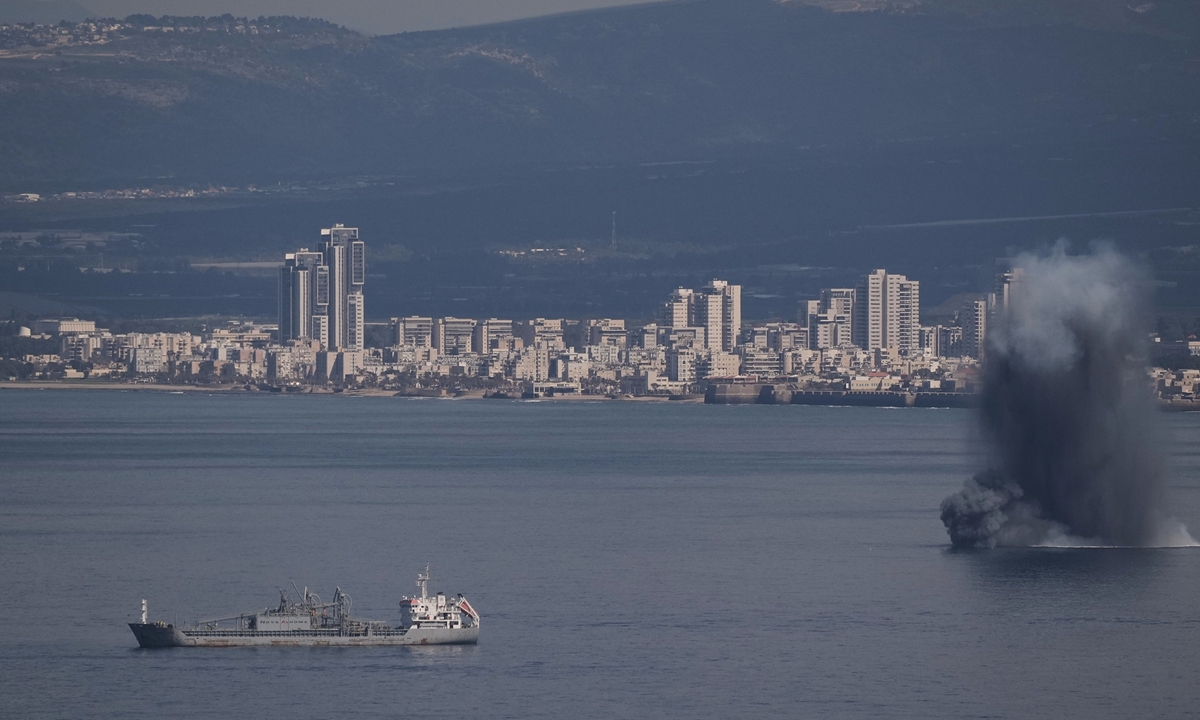
An incoming projectile explodes over the water as Israel issues a nationwide alert following its strikes on Iran, in Haifa Bay, northern Israel, Saturday, February 28, 2026. (AP Photo/Leo Correa). Photo: VCG
Several Chinese embassies and consulates in the Middle Eastern countries, including Israel, Iran and Bahrain, on Saturday reminded Chinese nationals in the countries to closely monitor the situation and strengthen safety precautions amid the US and Israel's strikes against Iran, which has retaliated.
The Chinese Embassy in Israel on Saturday reminded Chinese nationals in the country to closely monitor developments and changes in the situation, remain highly vigilant, familiarize themselves in advance with nearby shelters and evacuation routes, and keep communication channels open at all times.
Israel and the US launched military strikes against Iran on Saturday morning. The Israeli government has issued a nationwide alert, announcing that beginning at 8:00 am on Saturday, all work and school activities will be suspended and all non-essential activities halted and Israeli airspace has been closed, according to a statement published on the WeChat account of the Chinese Embassy in Israel. The local security situation is extremely severe, the embassy said in the statement.
The Chinese embassy said all necessary safety precautions must be strengthened and be fully prepared against various forms of attacks, including missiles, rockets, and drones.
On Saturday, the Chinese Embassy and Consulates in Iran also reminded Chinese citizens in the country to closely follow developments, remain calm, stay highly vigilant, strengthen security precautions, and be prepared to take immediate emergency shelter if necessary. The embassy described the local security situation in Iran "has become extremely severe and complex" amid attacks.
The ministry said the kingdom stood in full solidarity with the affected countries and was ready to deploy all its capabilities in support of any measures they take.
Saudi Arabia warned of serious consequences from continued breaches of state sovereignty and international law, urging the international community to condemn the attacks and take firm action against what it described as threats to regional security and stability.
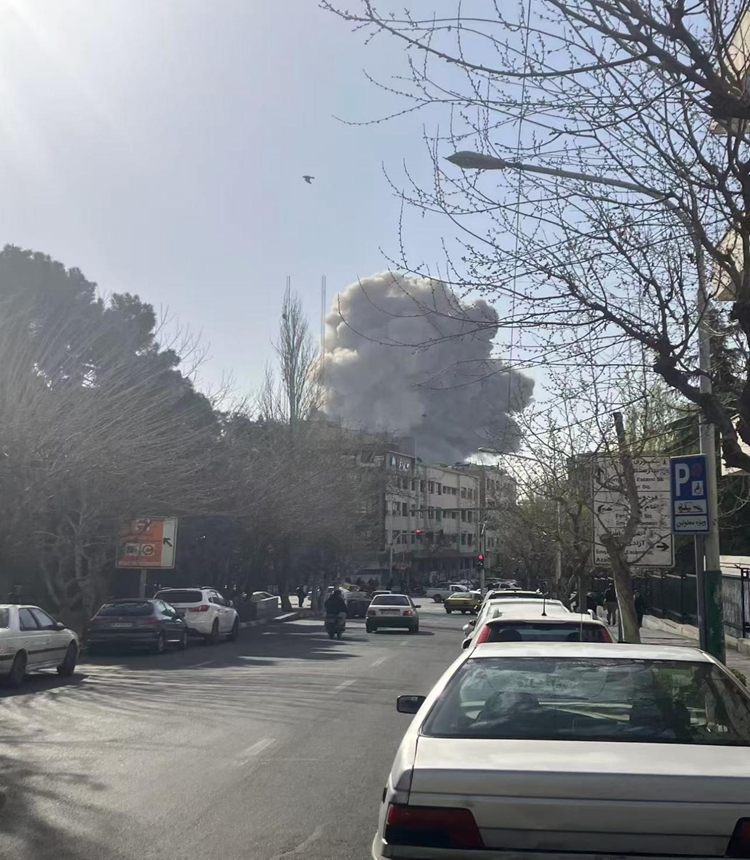
Explosions occurred in the center of Tehran, Iran on Saturday. A Chinese national surnamed Gao takes the photo of the blast.
The US and Israel launched attacks on Iran, with explosions rocking Tehran. Missiles hit University Street and the Jomhouri district, Fars News Agency reported, as smoke billowed across parts of the capital, according to Al Jazeera. Some Chinese nationals in the city told the Global Times that the blast site was just a four- to five-minute drive away from them and that communications were temporarily disrupted.
At the time of the blast, Li Zhe, a Chinese student studying Iranian studies at the University of Tehran, was planning to head to an office near a government building in central Tehran to handle paperwork. Photos he sent to the Global Times showed that the explosion site was only a four- to five-minute drive from where he was, with heavy smoke billowing into the air. Li said he could hear a distinct roaring sound of aircraft but could not determine whether it was a plane or a helicopter, along with several explosions.
Another Chinese student in Tehran, surnamed Gao, who is also studying Iranian studies, said he was on the road at the time and observed the situation near his campus. After the bomb fell, many people immediately ran out of buildings. They gathered in open areas, urgently trying to call their families but phone connections soon became unavailable, and for a period of time communication was completely disrupted.
A Chinese national surnamed Li, who resides in Tehran, told the Global Times that she witnessed the outbreak of the conflict on the spot at a square near the Azadi Tower in Tehran on the day. "A number of muffled booms suddenly rang out on the otherwise normal street, followed by plumes of smoke rising. I simply couldn't believe the war had started at that moment," she said.
She added that many Chinese nationals had been prepared for the escalation of the conflict, as the Chinese embassy had issued repeated warnings through various channels. A large number of Chinese citizens had already returned to China ahead of the Chinese Spring Festival.
"The United States military is undertaking a massive and ongoing operation ...," he said in a video message on his social media platform Truth Social. "We are going to destroy their missiles and raze their missile industry to the ground."
Sources told CNN that Trump's assertion that Iran was working on missiles that could reach the United States is not supported by US intelligence.
Trump also called on the Iranian people to "take over the government" after US military operations conclude.
Meanwhile, Trump acknowledged that the attack on Iran could result in US casualties. "We may have casualties," he said. "That often happens in war."
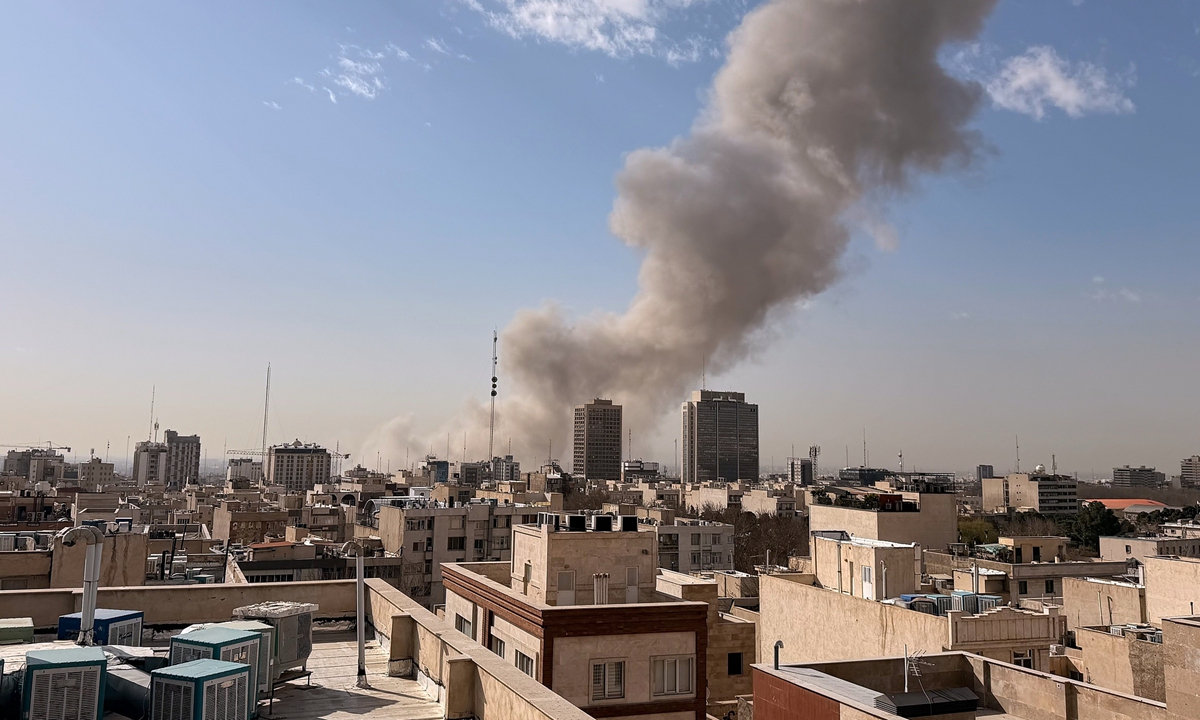
Smoke rises on the skyline after an explosion in Tehran, Iran, Saturday, Feb. 28, 2026. Photo: VCG
The US and Israel carried out military strikes on targets in Iran early Saturday. US President Donald Trump and Israeli Prime Minister Benjamin Netanyahu respectively issued statement on the strikes: Trump threatens Iran, claiming that Iranians to "take over your government" after the attack, which comes after weeks of threats and negotiations over Iran's nuclear program.
Trump confirmed the strike in a video message shared on Truth Social saying, "A short time ago, the US military began major combat operations in Iran," NBC News reported. Trump claimed in the pre-recorded eight-minute video message that "when we are finished, take over your government," according to multiple media reports.
Describing the decision to launch a "major" military operation against Iran Saturday morning, Trump said in a video posted to social media that Iran was developing "long-range missiles that can now threaten our very good friends and allies in Europe, our troops stationed overseas, and could soon reach the American homeland," CNN reported.
"They rejected every opportunity to renounce their nuclear ambitions, and we can't take it anymore," he said, per CNN.
Israel and the US launched military strikes against Iran on Saturday morning. The Israeli government has issued a nationwide alert, announcing that beginning at 8:00 am on Saturday, all work and school activities will be suspended and all non-essential activities halted and Israeli airspace has been closed, according to a statement published on the WeChat account of the Chinese Embassy in Israel.
The local security situation is extremely severe, the embassy said in the statement.
The Chinese embassy said all necessary safety precautions must be strengthened and be fully prepared against various forms of attacks, including missiles, rockets, and drones.
Upon hearing an air defense siren, immediately enter a designated shelter, the embassy said, reminding Chinese nationals not hesitate, linger, or take photos or videos, so as to avoid injury from falling debris or legal liability resulting from the disclosure of sensitive information.
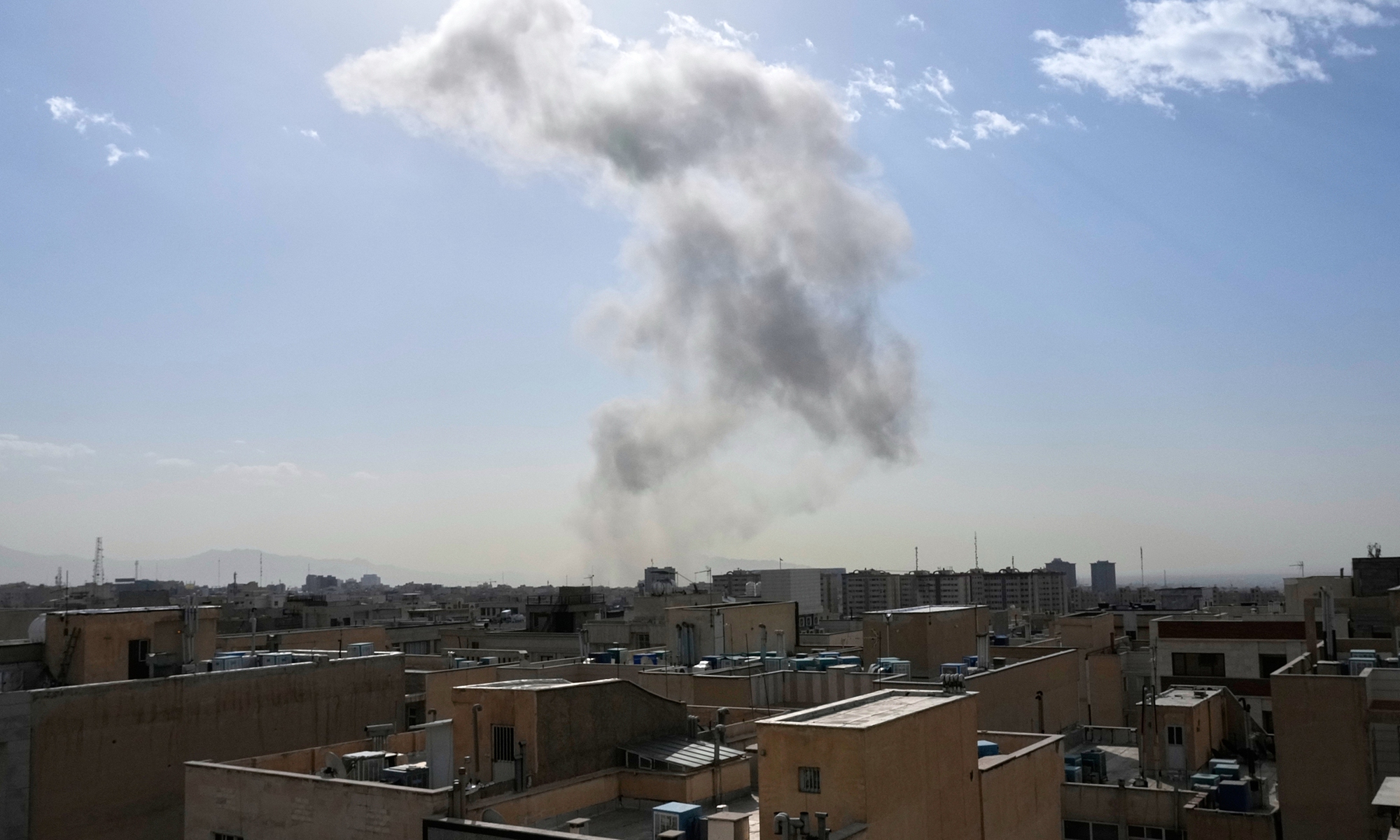
Smoke rises on the skyline after an explosion in Tehran, Iran, Saturday, Feb. 28, 2026.Photo:VCG
The US and Israel launched strikes against Iran Saturday morning, according to Israeli Defense Minister Israel Katz and two US officials, CNN reported.
Israel declared a state of emergency across the country as the strikes were launched, in anticipation of Iranian retaliation, according to CNN.
Citing three US officials, CNN reported that the US was carrying out strikes on Iran. One official said the strikes are in progress, describing them as "not a small strike," according to the report.
Earlier on Saturday, Israel launched a "preemptive" strike against Iran on Saturday morning "to remove threats to Israel," the Israeli Defense Ministry said in a statement, according to the Xinhua News Agency.
At 2:41 pm, Xinhua reported that apparent strike in Tehran happened near offices of Supreme Leader Ayatollah Ali Khamenei. At 2:55 pm, Xinhua reported, citing media, that Iran's Supreme Leader Ali Khamenei was not in Tehran, and has been moved to secure location.
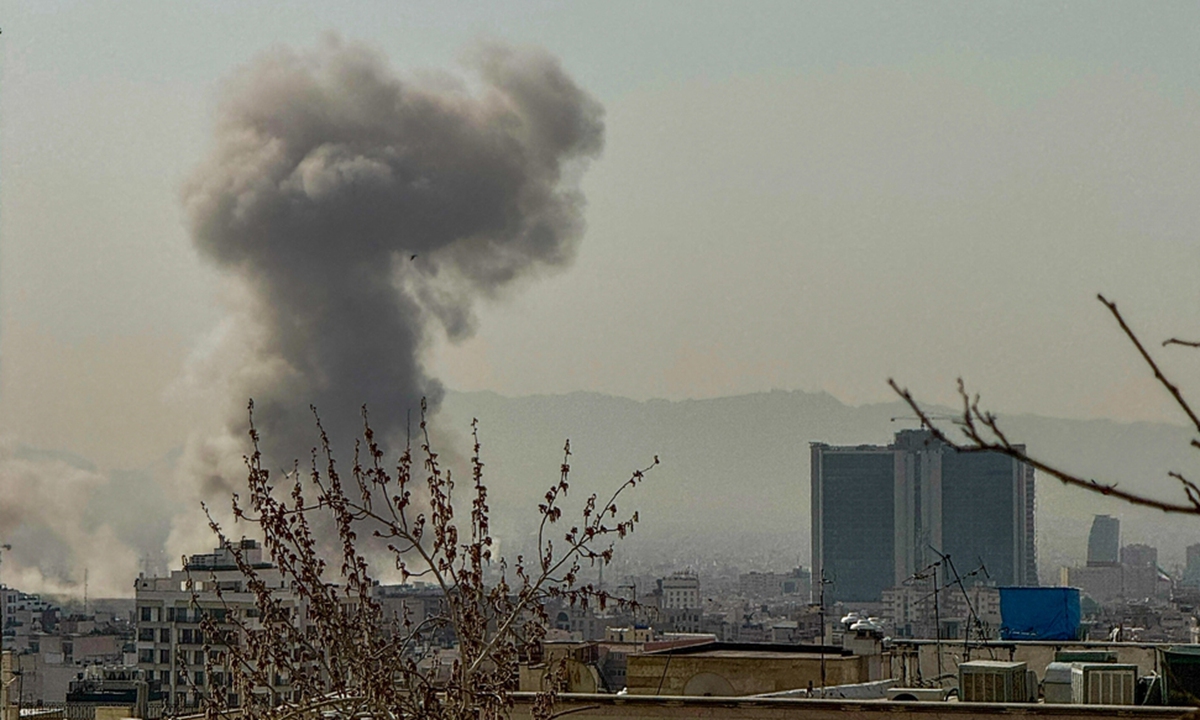
A plume of smoke rises over Tehran, Iran, after a reported explosion on February 28, 2026, after Israel said it carried out a preemptive strike on Iran. Photo: IC
US military began major combat operation in Iran -- Trump